8,500 Bitcoin Flooded Exchanges in Days – Can the Market Absorb This Supply Tsunami?

Bitcoin faces a hidden warning as over 8,500 BTC have been moved to exchanges in a matter of days, a surge that could trigger a 10% correction if demand falters, according to on-chain analyst Axel Adler. The net inflows, occurring in two massive spikes on April 27 and April 30, total 8,512 BTC across all platforms, yet the price stubbornly holds above $78,000 amid US-Iran tensions that have rattled global risk appetite. This supply buildup, without the corresponding sell-off, signals a market that is more fragile than its surface resilience suggests, demanding close scrutiny from traders and regulators alike.

What is notable is what did not happen next. During the most aggressive inflow period, the price did not decline — it rose. The market absorbed the arriving supply without immediate price damage, suggesting that demand at current levels was sufficient to match what holders were moving toward the sell side.
Since May 1, flows have moderated to near-neutral levels. The coins are on exchanges. The selling has not started. Adler’s analysis describes this as a dry powder structure — and the question of when, and whether, that powder gets used is what defines Bitcoin’s next move.
The Supply Is Positioned. The Selling Has Not Started
Adler’s second chart adds the cumulative picture that completes the netflow analysis. Total Bitcoin exchange reserves across all platforms stood at 2,685,541 BTC as of May 4 — up 5,773 BTC from the 2,679,768 recorded on April 28. The weekly peak of 2,686,791 BTC was hit on April 30, after which reserves began a modest decline over the following days.

That modest decline is the most constructive recent development in the data. When reserves fall alongside stable or rising prices, it suggests the market is digesting available supply rather than allowing it to accumulate into a growing overhang. The direction of the reserve over the coming sessions will determine whether the current structure resolves constructively or becomes a risk.
Adler names the current setup with precision: dry powder. Supply has been deposited on exchange platforms by holders positioning for potential sales. But the conversion of that deposited supply into actual market selling has not yet been confirmed. The coins are present. The pressure is not — at least not yet.
The risk the analysis identifies is mechanical and specific. If the market stops absorbing new inflows — if demand falters at current price levels while the reserve remains elevated — the overhang can transition into real selling pressure quickly. The buffer between positioned supply and active selling is thinner than the held price level suggests.
The confirmation signal Adler points toward is equally specific: a further decline in exchange reserves alongside continued price growth would validate that the market structure is genuinely healthy rather than artificially supported. Until that combination appears, the dry powder remains loaded.
Bitcoin Tests $79K As Price Compresses Between Key Moving Averages
Bitcoin is trading near $79,000 after extending its recovery from the February capitulation low, but the structure remains transitional rather than fully bullish. The chart shows a clear shift from a downtrend into a developing higher-low sequence, with price reclaiming the short-term moving average and pushing back above the $74,000–$75,000 zone, which previously acted as resistance and is now being tested as support.
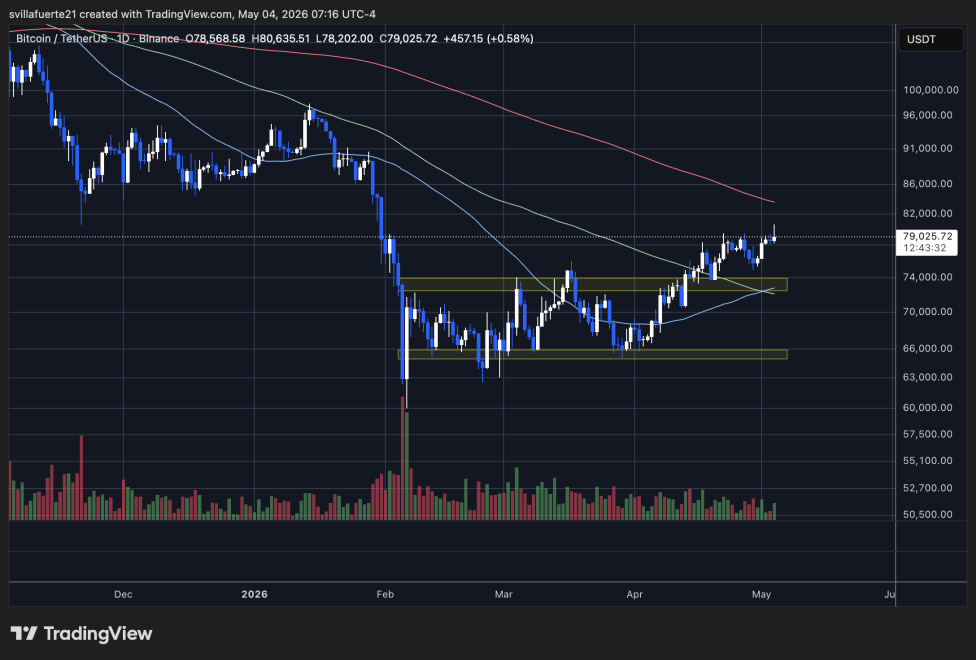
This level is technically significant. It aligns with both the 50-day moving average and a prior consolidation range, making it a key validation point for the current recovery. So far, buyers have defended it on pullbacks, suggesting demand is present, but not aggressive.
At the same time, Bitcoin is approaching the $80,000–$82,000 region, where the 200-day moving average continues to trend downward. That creates a confluence of dynamic resistance overhead. The price is effectively compressed between rising short-term support and declining higher-timeframe resistance.
Volume does not confirm a breakout yet. Participation has been relatively muted compared to the selloff phase, which implies the move higher may be driven more by reduced selling pressure than strong new demand.
If Bitcoin holds above $74,000, the structure favors continuation. Failure to hold it would likely send price back toward the $65,000–$67,000 demand zone.
Featured image from ChatGPT, chart from TradingView.com

Log in to Reply
Log in to comment your thoughtsComments
Related Articles
|Square
Get the BTCC app to start your crypto journey
Get started today Scan to join our 100M+ users