Bitcoin Supply Pressure Builds As Short-Term Holders Realize Losses Below $70K

Bitcoin's price action is creating a classic market stress test. Short-term holders are hitting the sell button as the asset trades below the $70,000 psychological threshold, realizing losses and adding tangible supply pressure to the market.
The Weak Hands Shake Out
This isn't a story of fundamentals breaking—it's a story of sentiment shifting. The cohort holding coins for less than 155 days is demonstrating its notorious volatility. When prices dip below their recent acquisition cost, fear overrides conviction. This selling creates a friction point, a wall of supply that the market must absorb before any sustained upward move can resume. It's the predictable, almost rhythmic, cleansing of speculative excess.
A Bull Market Pause, Not a Breakdown
For long-term believers, this is a feature, not a bug. These periodic shakeouts transfer assets from impatient speculators to steadfast holders, strengthening the network's foundational support. The pressure below $70,000 acts as a proving ground, separating tactical traders from strategic allocators. It's a necessary consolidation phase that historically precedes the next leg up—provided core adoption metrics hold firm.
The Institutional Floor Remains
While retail sentiment flickers, the structural bull case hasn't eroded. The institutional infrastructure built over the past cycle—from ETF flows to corporate treasuries—provides a baseline of demand absent in previous eras. This creates a higher floor, even when short-term volatility spikes. The current supply pressure is meeting a fundamentally different demand profile than in years past.
So, while the headlines scream about losses and pressure, remember this is how markets mature—one weak-handed sell order at a time. It's enough to make you wonder if traditional finance's 'risk management' is just a fancy term for buying high and selling low.

Between March 2 and March 9, STH SOPR crossed above 1.0 only once, briefly on March 4 when Bitcoin touched around $70,800. For the rest of the period, the indicator remained in loss-selling territory, with the weekly low recorded at 0.979 on March 6. As of March 9, the intraday average stands near 0.987, confirming persistent selling pressure among recent market entrants.
Short-Term Holder Supply Continues To Contract
The report also highlights important developments in the behavior of Bitcoin’s short-term holders, particularly through changes in the Short-Term Holder (STH) Supply metric. This indicator measures the total amount of BTC held by investors whose coins are younger than 155 days, offering insight into the activity of more reactive market participants.

Over the past two weeks, STH Supply has declined noticeably, falling from approximately 6.06 million BTC to around 5.92 million BTC. This represents a reduction of roughly 140,000 BTC within the cohort, signaling that a significant number of coins have either been sold or transitioned into longer holding periods. At the same time, the realized price of this group remains near $89,028, while Bitcoin’s market price is trading closer to $67,175.
This roughly 24% gap highlights the magnitude of unrealized losses currently affecting short-term holders. Such conditions often create psychological pressure, as investors who entered the market at higher prices face extended periods of negative returns.
The decline in STH Supply can reflect two parallel processes. In some cases, it represents capitulation as investors sell at a loss. In others, it reflects the natural maturation of coins into long-term holding categories. However, the large difference between realized price and market price suggests a potential supply overhang, as some holders may sell during future rallies to exit positions without losses.
Bitcoin Holds $67K After Sharp Correction From Cycle Highs
The 3-day chart shows Bitcoin trading near the $67,800 region after a sharp correction from the late-2025 highs above $120,000. The market structure shifted decisively at the start of 2026 when BTC lost momentum near the $110,000–$115,000 range and began forming a series of lower highs. This transition signaled a weakening trend and triggered an accelerated decline once price broke below the 50-period moving average (blue).
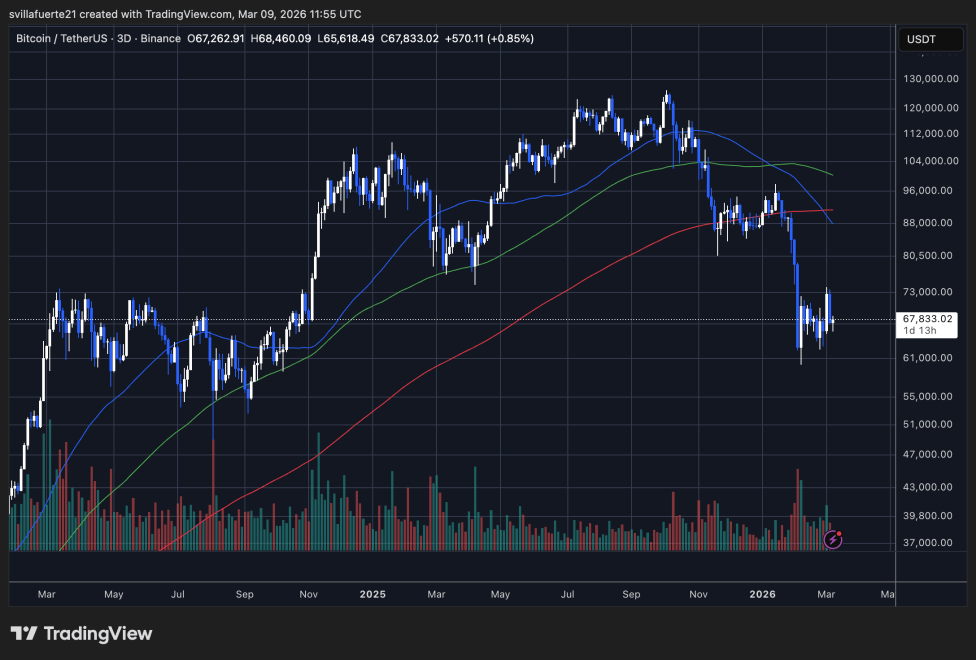
Selling pressure intensified during the first quarter of 2026, pushing Bitcoin quickly through the 100-period moving average (green). The breakdown confirmed a broader shift toward a corrective phase and eventually drove BTC toward the $62,000–$65,000 support area before buyers stepped in to stabilize price action.
Currently, Bitcoin is attempting to consolidate between $65,000 and $70,000, a range that now represents a critical short-term equilibrium zone. The 200-period moving average (red), positioned around the $88,000 region, remains far above the current price and acts as a major resistance level that bulls would need to reclaim to restore stronger long-term momentum.
Volume activity increased during the recent decline, suggesting that the correction involved significant distribution. For Bitcoin to reestablish a bullish structure, price would likely need to recover the $70,000–$75,000 range and reclaim the shorter moving averages.
Featured image from ChatGPT, chart from TradingView.com
