Kraken & Nasdaq Forge Game-Changing Tokenized Stocks Alliance

Wall Street's old guard just got a crypto-powered upgrade. Kraken, the crypto exchange giant, is teaming up with Nasdaq in a landmark move to bring tokenized stocks to the masses. This isn't just a partnership—it's a direct bridge between traditional finance and the digital asset frontier.
The Mechanics of the Merge
Forget clunky settlement systems and multi-day waits. The collaboration leverages blockchain to issue digital tokens that represent real-world equities. Each token is backed 1:1 by the actual stock, held in custody. It's ownership, stripped down and supercharged for the internet age. Trades could settle in minutes, not days, slashing through the red tape that has bogged down markets for decades.
Why This Changes Everything
This move does more than just add a new product line. It validates the entire infrastructure of tokenization. Nasdaq isn't some fringe player; it's the second-largest stock exchange on the planet. Their tech and regulatory muscle combined with Kraken's crypto-native platform creates a powerhouse. Suddenly, buying a slice of Apple or Tesla could be as seamless as trading Bitcoin—available 24/7 to anyone with an internet connection.
A Provocative New Reality
The implications are staggering. Global access, fractional ownership, and unprecedented liquidity for traditionally illiquid assets. It democratizes the playing field, letting retail investors play by the same rules as the institutional whales. Of course, the traditional finance crowd will grumble about 'speculation' and 'risk'—the same folks who brought you the 2008 financial crisis with their 'safe' mortgage-backed securities.
The fusion is complete. The lines between crypto and conventional assets aren't just blurring—they're being erased. This partnership isn't a tentative step; it's a declaration that the future of asset ownership is tokenized, transparent, and tearing down the old walls. Watch as the rest of the industry scrambles to catch up.
Nasdaq And Kraken Join Forces
Under the proposed setup, xStocks will power the permissionless infrastructure layer for Nasdaq’s upcoming issuer-sponsored equity token design. That design, which Nasdaq expects to become operational starting in the first half of 2027, is meant to preserve issuer control, existing regulatory frameworks, and the rights attached to the underlying shares while still allowing those assets to interact with blockchain-based financial systems.
In practical terms, the gateway is supposed to let eligible users swap tokenized equities between a regulated, permissioned market environment and open on-chain ecosystems. Payward said this would allow assets to move “fluidly” between institutional trading infrastructure and decentralized financial networks, while Payward Services handles KYC and AML onboarding for participants accessing the bridge through Kraken.
Arjun Sethi, co-CEO of Payward and Kraken, framed the effort as a structural change to how equities can be used once they are placed on programmable rails. “Tokenization upgrades market infrastructure at the asset layer by allowing equities to exist as programmable financial instruments that can operate across both regulated capital markets and open blockchain networks,” he said. “Today most equities sit inside brokerage systems where their utility is largely limited to directional exposure and, in some cases, broker-specific margin arrangements.”
He argued that the current model leaves capital trapped inside siloed venues. “That structure fragments liquidity across venues and leaves a meaningful amount of capital static relative to its potential utility,” Sethi said. “With xStocks, our goal is to make equities natively interoperable across trading venues, financial applications and blockchain networks while preserving issuer rights, regulatory protections and price integrity.”
Sethi went further, tying tokenized equities to a broader capital-efficiency thesis that will be familiar to crypto derivatives traders. “Bringing equities onto programmable infrastructure expands how they can function within a portfolio,” he said. “Instead of simply representing exposure to a company, tokenized equities can operate as collateral within unified trading systems that support spot markets, cross-margin trading, derivatives, perpetual futures, and financing environments.”
That point sits at the heart of the announcement. Payward is not pitching tokenized stocks merely as wrappers for traditional shares, but as collateral that can move across trading, lending and hedging systems under a unified margin framework. In jurisdictions where xStocks are already available, Payward will also serve for an initial period as the primary settlement layer for transactions tied to Nasdaq’s equity token design.
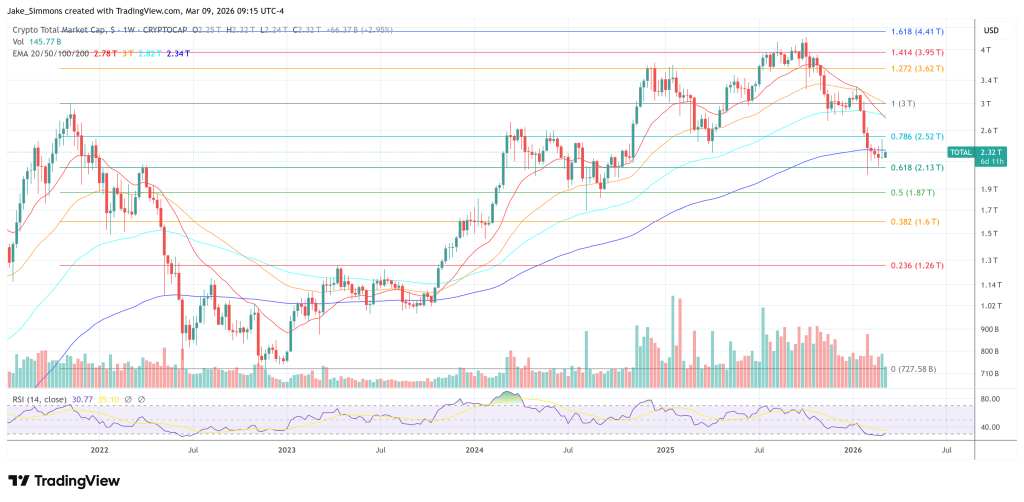
At press time, the total crypto market cap stood at $2.32 trillion.