Bitcoin Correction Intensifies: A Sharp Surge in Coins Held at Loss Signals Market Shakeout

Bitcoin's price correction isn't just a dip—it's a full-scale purge. The latest on-chain data reveals a sharp, uncomfortable surge in the number of coins now held at a loss. This isn't paper-handed retail panic; it's the sound of over-leveraged positions hitting their breaking point.
The Anatomy of a Shakeout
Forget the gentle ebb and flow of a healthy market. This move has teeth. The metric tracking coins in the red is spiking, painting a clear picture of mounting pressure. It's the classic sign of a market washing out weak hands and resetting the board for the next leg up. Every major bull run needs this kind of ruthless consolidation—consider it a necessary evil.
What the Red Means for Green Days Ahead
This surge in underwater holdings acts like a coiled spring. Historically, when short-term holders are forced to capitulate and sell at a loss, it transfers assets to stronger, long-term conviction holders. This process, while painful in the moment, establishes a firmer, higher foundation for the next rally. It's the market's brutal way of finding a true bottom.
The smart money isn't running for the hills; it's watching for the moment the selling exhaustion hits. That's when the real accumulation begins, often while traditional finance pundits are still busy declaring the asset class dead—a cynical but predictable ritual. The path to the next all-time high is being paved right now, one distressed coin at a time.
Growing Share Of Bitcoin Holders Face Losses
After the sudden weekend pullback, Bitcoin market dynamics are experiencing a shift that might shape its direction in the coming days or weeks. As its current decline intensifies, BTC is still under pressure to decline, driving an increasing percentage of its circulating supply into the loss area.
Darkfost, a market expert and verified author at CryptoQuant, recently reported on the X platform that roughly one of two investors is currently sitting at a loss. More specifically, this is the amount of Bitcoin that is kept in each Unspent Transaction Output (UTXO).
This suggests that more Bitcoin is now held at prices lower than their purchase price, indicating how short-term market participants are experiencing increased stress. Rising supply in losses has frequently emerged close to times of market stabilization and is thought to be a crucial sign of market sentiment.
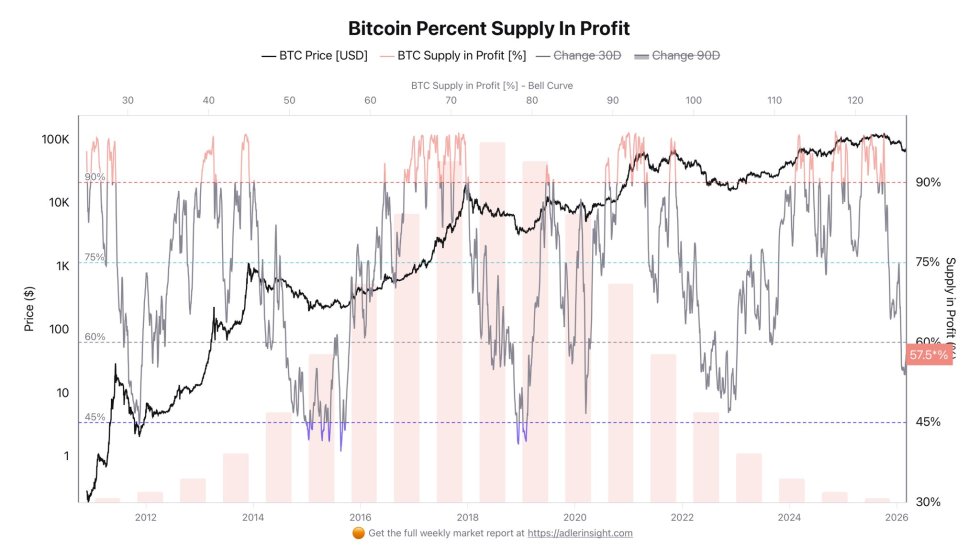
On-chain data currently shows that about 43% of the supply kept in UTXO is in loss, demonstrating the extent to which unrealized losses have propagated throughout the network. In the past, the histogram illustrates that about 75% of the Bitcoin supply has been profitable. The expert highlighted that this level often serves as a rough boundary between a bull trend and a market correction.
Typically, when bull trends are confirmed, they accelerate once the market moves above that level. However, corrections usually start to take shape when a larger portion of the supply starts to lose money. With 57% of supply in profit, the market is currently at levels more similar to those observed during deep bear market stages.
Bitcoin is starting to show signs of stabilization here, which aligns with the ongoing consolidation. Meanwhile, the market may still decline in order to further shake out long-term holders. At the same time, the share of supply in loss could be pushed toward around 45%, marking a level that has been reached in previous bear markets.
BTC Recovering On The ETF Front
Even in the volatile landscape, fresh data from CryptoRus shows that Bitcoin is still witnessing a post-ATH supply reset. During this period, BTC reserves on cryptocurrency exchanges have been declining since late 2024, which means fewer coins are left in these trading platforms. In addition, this trend signals reduced selling as investors choose self-custody wallets, underscoring long-term holdings.
CryptoRus noted that Spot BTC ETF holdings plummeted after Bitcoin reached a new all-time high, a situation that probably contributed to the recent price correction as demand from institutional investors fades. However, these ETF outflows are beginning to stabilize, signaling a crucial shift in demand.
If the ETF starts to record positive flows again while crypto exchanges’ reserves continue to drop, the balance of supply and demand for BTC might quickly tighten.
