Wall Street Goes Crypto: Nasdaq Teams With Kraken to Launch Tokenized Stock Trading

Traditional finance just got a blockchain injection. In a move that blurs the lines between old-school exchanges and the crypto frontier, Nasdaq is partnering with crypto giant Kraken to launch a platform for trading tokenized stocks.
The New Trading Floor
Forget paper certificates and legacy settlement systems. This partnership aims to represent ownership in major companies as digital tokens on a blockchain. It's a direct shot across the bow of traditional brokerage models, promising faster settlements and global, 24/7 access to equity markets.
Why This Cuts Through the Noise
This isn't just another pilot program. It's a major incumbent—the home of Apple and Microsoft—validating the infrastructure of the digital asset world. By leveraging Kraken's crypto-native user base and compliance framework, Nasdaq bypasses years of internal blockchain experimentation to launch a real product.
The Fine Print & The Future
Regulatory hurdles remain, of course. But the signal is clear: the demand for programmable, borderless assets is too loud for traditional finance to ignore. They'd rather join than be disrupted—even if it means finally admitting that a 2-day settlement cycle is a relic best left in the analog age. One cynical observer might note it's the ultimate hedge: if you can't beat the crypto anarchists, tokenize their favorite targets and collect the fees yourself.
The gates are opening. The trading floor of the future won't be on Wall Street—it'll be on-chain.
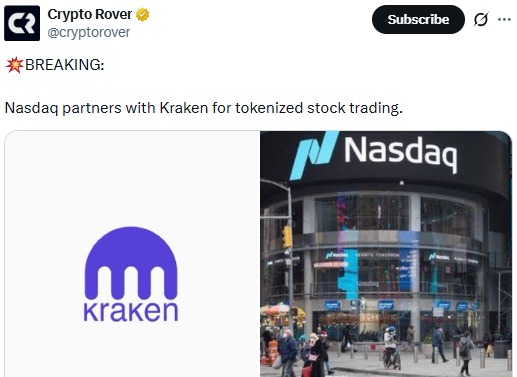
Source: X (formerly Twitter)
Kraken’s xStocks system already shows early demand
Kraken will act as a distribution partner for the initiative. Through this role, tokenized versions of public company shares could become available to Kraken users across Europe and other global markets.
The plan builds on Kraken’s xStocks framework, which has already recorded more than $25 billion in trading volume since launch. These digital assets represent real company shares backed on a one-to-one basis.
Popular stocks such as Nvidia, Tesla, and Apple could appear as blockchain tokens. Investors may trade them on networks like Ethereum and Solana, which support continuous activity and global participation.
Nasdaq first moved toward this idea in September 2025, when it filed a proposal with the U.S. Securities and Exchange Commission. The proposal suggested allowing tokenised versions of listed stocks and exchange-traded products to trade alongside traditional shares.
Both versions would carry the same CUSIP number, meaning they represent the same underlying asset. Settlement would continue through the Depository Trust & Clearing Corporation (DTCC) to maintain regulatory standards.
Blockchain could improve shareholder engagement
The initiative is not only about trading. Nasdaq’s token model also focuses on modernizing how companies interact with investors.
Tokenized shares could automate processes like dividend payments, proxy voting, and other corporate actions. Blockchain records could also connect directly with official share registries, ensuring each token transfer reflects an actual ownership change.
Kraken’s parent company Payward will help design an equities transformation gateway. This infrastructure aims to connect regulated exchanges with block-chain networks so tokenised equities can move between traditional systems and digital markets.
Nasdaq expects the program and related distributed-ledger services to begin launching in the first half of 2027, subject to regulatory approval.
Conclusion
The moment Nasdaq partners with Kraken shows how traditional finance and blockchain are slowly merging. Tokenized stocks could open global access, faster settlement, and continuous trading. If regulators approve the framework, this partnership may become an important step toward modernizing financial markets.
The collaboration reflects growing interest in tokenizing real-world assets. By linking regulated exchange infrastructure with blockchain networks, financial markets could evolve toward faster settlement systems and broader global participation.
