Mt. Gox Ex-CEO Demands Bitcoin’s Core Rules Be Rewritten to Recover $5 Billion in Stolen Coins

A bombshell proposal from the former head of the collapsed Mt. Gox exchange is shaking Bitcoin's foundations. He's calling for a fundamental rewrite of the network's rules—a hard fork—specifically designed to claw back a staggering $5 billion in stolen assets. It's a move that cuts to the very heart of cryptocurrency's core tenets.
The Immutable Ledger vs. The $5B Exception
Bitcoin's blockchain is famed for its immutability—transactions are permanent, irreversible, and censorship-resistant. This proposal would shatter that principle, creating a one-time, governance-mandated exception to reverse historic thefts. It bypasses the established 'code is law' philosophy, replacing it with a controversial 'community justice' override.
The Mechanics of a Rewrite
Executing this wouldn't be a simple software update. It would require overwhelming consensus from miners, node operators, and exchanges to adopt the new fork, effectively creating two competing Bitcoin chains: one unchanged and one with rewritten history. The technical and social coordination needed is unprecedented, risking massive network fragmentation.
A Provocative Precedent for Digital Property
If successful, it sets a world-altering precedent. It asks whether a decentralized network can—or should—act as its own supreme court, retroactively adjudicating property rights. Proponents argue it corrects a historic wrong; critics warn it opens the door to future revisions and erodes the very trust that gives Bitcoin its value. After all, in traditional finance, bailouts and clawbacks are just another Tuesday—but for crypto, it's an existential crisis wrapped in a $5 billion question mark.
A Proposal That Shakes Bitcoin’s Foundation
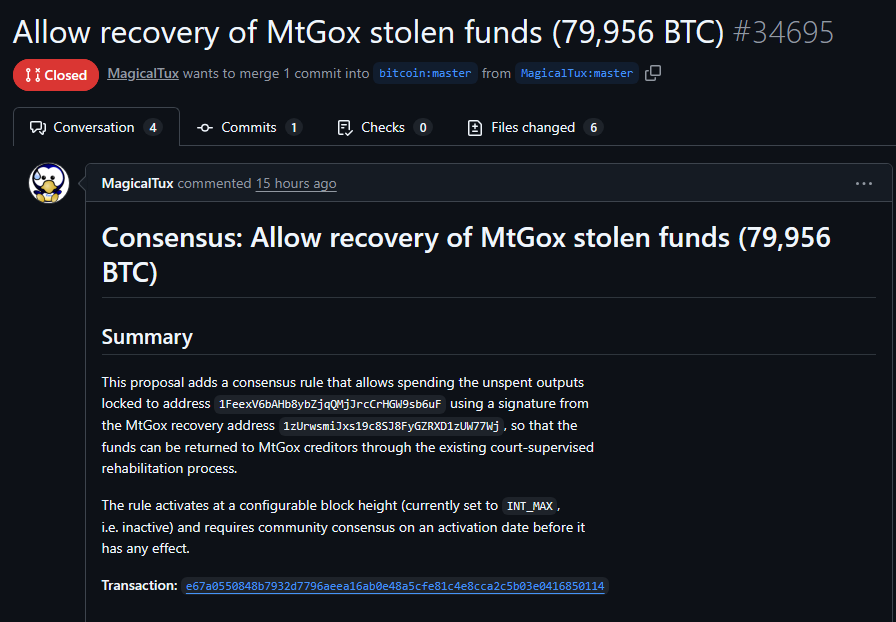
Mark Karpelès, Mt. Gox’s former boss, submitted a formal proposal on GitHub last Friday calling for a hard fork — a fundamental change to Bitcoin’s rules — that WOULD allow nearly 80,000 Bitcoin, currently worth more than $5 billion, to be moved to a recovery address without needing the original private key.
 Former Mt. Gox CEO Proposes Hardfork to Recover $5.2B in $BTC
Former Mt. Gox CEO is urging the #Bitcoin community to consider a #network hard fork to retrieve nearly 80,000 Bitcoin. #crypto pic.twitter.com/xKUG2B0pAR
— CryptOpus (@ImCryptOpus) February 28, 2026
Reports say those coins have not budged from a single wallet in over 15 years, making them one of the most-watched and well-documented addresses in all of crypto.
This is a protocol level change so it needs to be a BIP before it’s a pull request to change code in implementations.
— Jameson Lopp (@lopp) February 27, 2026
Karpelès was blunt about what he was asking for. He did not try to soften or disguise the idea. “This is a hard fork,” he reportedly wrote in the proposal. “It makes a previously invalid transaction valid.”

His reasoning centers on a deadlock that has developed between two key parties. The Mt. Gox trustee overseeing creditor repayments has refused to pursue any on-chain recovery without some guarantee that the Bitcoin community would actually adopt such a rule change.
Not that way. The court should order the thief to turn over the private key.
— Luke Dashjr (@LukeDashjr) February 28, 2026
But the community cannot seriously weigh that idea without a concrete proposal in front of them. Karpelès says his GitHub submission breaks that stalemate.
Critics Say It Opens A Dangerous Door
The pushback came fast. On the Bitcoin forum Bitcointalk, members lined up to argue the proposal would cause serious damage to one of Bitcoin’s most important qualities — the idea that transactions, once confirmed, are permanent and cannot be reversed by anyone.
One user warned that approving a rule change like this would set a template for every future hack victim to demand the same treatment. Another raised concerns about outside governments gaining influence over what Bitcoin can and cannot do.
Those concerns are not unreasonable. Bitcoin’s value, at least in part, rests on the belief that no single person, court, or government can reach in and MOVE coins without the proper key. Break that rule once, even for a sympathetic reason, and the rule is no longer a rule.
Creditors Still Waiting After More Than A DecadeMt. Gox was once enormous. At its height, it processed roughly 70% of all Bitcoin transactions happening anywhere in the world.
Hackers exposed weaknesses in its security systems as early as 2011, draining thousands of coins over time in a theft that went unnoticed for years.
By February 2014, the exchange filed for bankruptcy in Tokyo after reporting losses of 750,000 customer Bitcoin and 100,000 of its own — worth around $500 million at the time.
Featured image from Unsplash, chart from TradingView
