Ethereum’s $159B Stablecoin Empire: Why Infrastructure Trumps Token Price Every Time

Forget the ticker. The real story isn't on the chart—it's in the plumbing.
Ethereum's $159 billion stablecoin dominance isn't a speculative bet; it's a foundational shift. While traders obsess over ETH's price swings, developers and institutions are building an entire parallel financial system on its rails. The value isn't in the volatile asset—it's in the unshakeable, utility-driven infrastructure beneath it.
The Backbone of DeFi
This isn't about store-of-value narratives. It's about throughput. Stablecoins represent pure utility: digital dollars moving at internet speed, settling global payments, collateralizing loans, and powering decentralized exchanges. They're the lifeblood of DeFi, and Ethereum is the circulatory system. Every transaction, every swap, every yield farm pays rent in ETH—regardless of its spot price.
A Network Effect That Can't Be Forked
Price is fickle. Infrastructure is sticky. You can copy code, but you can't replicate $159 billion in settled value and the developer ecosystem that trusts it. This dominance creates a moat deeper than any temporary market downturn. It turns Ethereum from a mere asset into a critical utility—the global settlement layer for programmable money.
The Real Metric That Matters
So, watch the stablecoin supply, not the candle wicks. When the traditional finance crowd finally realizes their beloved 'yield' is being generated by this very infrastructure—often while they're paying banks for the privilege of holding their cash—the real migration begins. Sometimes, the most bullish signal isn't a price pump, but the quiet, relentless accumulation of real-world use.
Key Takeaways
- The Stat: Ethereum holds $153.41 billion in Stablecoins, controlling nearly 60% of the global supply.
- The Argument: Jeff Housenbold views ETH as vertical infrastructure for fintech, distinct from day-to-day asset pricing.
- The Tension: Price lags infrastructure utility, creating a disconnect between value settled and token valuation.
The $159B Stablecoin Moat: Why Institutions Stick with Ethereum
Jeff Housenbold is betting on infrastructure. The President and CEO of Beast Industries (the company behind the viral MrBeast brand) recently termed ethereum the “backbone” of the stablecoin industry in an interview with CNBC.
"Ethereum is the backbone of stablecoin"
CEO of MrBeast’s business empire https://t.co/94rCuJIMyY
That assessment aligns with hard data. As of today, Ethereum hosts $159 billion of the market’s total $300 billion stablecoin supply.
This dominance persists because, arguably, institutional crypto use cases value settlement finality over speed.
While Beast Industries expands its fintech footprint following the acquisition of Step, a financial literacy app with 1.45 million users, the focus remains on where the deepest liquidity lives.
Housenbold’s firm, which also oversees a $200 million investment from Bitmine, isn’t chasing pump-and-dump mechanics. They are looking at the rails moving $10.3 trillion in monthly transfer volume.
That volume matters. While price continues trading sideways, Wall Street institutions are eyeing Ethereum. The 2024 GENIUS Act provided regulatory clarity for stablecoin issuers, but it was Ethereum’s existent liquidity that captured the institutional share.
The sheer market share of USDT ($183 billion) and USDC ($75 billion) on the network creates a self-reinforcing loop. Institutions mint where the liquidity is deepest. That lock-in effect is why the supply on Ethereum’s headstart on the stablecoin sector will be a tough challenge for rivals like Ripple to navigate.
Solana and Base: The Retail Volume Shift
While Ethereum holds the collateral, retail users are transacting elsewhere. That is the clear signal from recent Stablecoins Flow data.
Solana’s stablecoin supply surged 40% in late 2025, outpacing Ethereum’s percentage growth, according to BitWise research analyst Danny Nelson. Traders chasing speed and low fees have migrated, driving solana to 2.3 million daily active users compared to Ethereum’s 709,000.
Solana might just be winning the GENIUS Era
Solana doesn’t host the most stablecoins. And yet: it boasts the fastest-growing stablecoin supply. In the nearly 3 months since TRUMP signed the GENIUS Act, Solana’s stablecoins in circulation have jumped over 40%, reaching $15b.…
Base, Coinbase’s Ethereum Layer 2, processed $5.3 trillion in January 2026 Circle (USDC) transfers despite holding a fraction of the supply found on mainnet.
This points to a high velocity of money on Layer 2, i.e., tokens moving fast in small amounts, versus the stagnant, high-value collateral sitting on Ethereum.
Stablecoin transfer volume across EVM, Solana, and TRON reached $10.3T in Jan ’26.
While Ethereum holds the supply, velocity is moving to L2s and Solana.
— CryptoNews Analyst (@CryptoNews) February 12, 2026
Circle is a primary beneficiary of this multi-chain expansion. The issuer recently saw revenue surges as USDC proliferates across high-speed chains.
However, for Ethereum, the loss of retail transaction dominance hasn’t eroded its reserve status. It has simply specialized: Ethereum is the savings account; Solana and Base are the checking accounts.
Beyond the Stablecoin Advantage, Is $2,000 the Floor for Ethereum?
Ethereum is trading at $1,960. The price has compressed into a tight range, lagging behind the broader market rally. The $2,000 level is now the critical psychological and technical pivot that will help ETH consolidate its current ground and go up to the next leg.
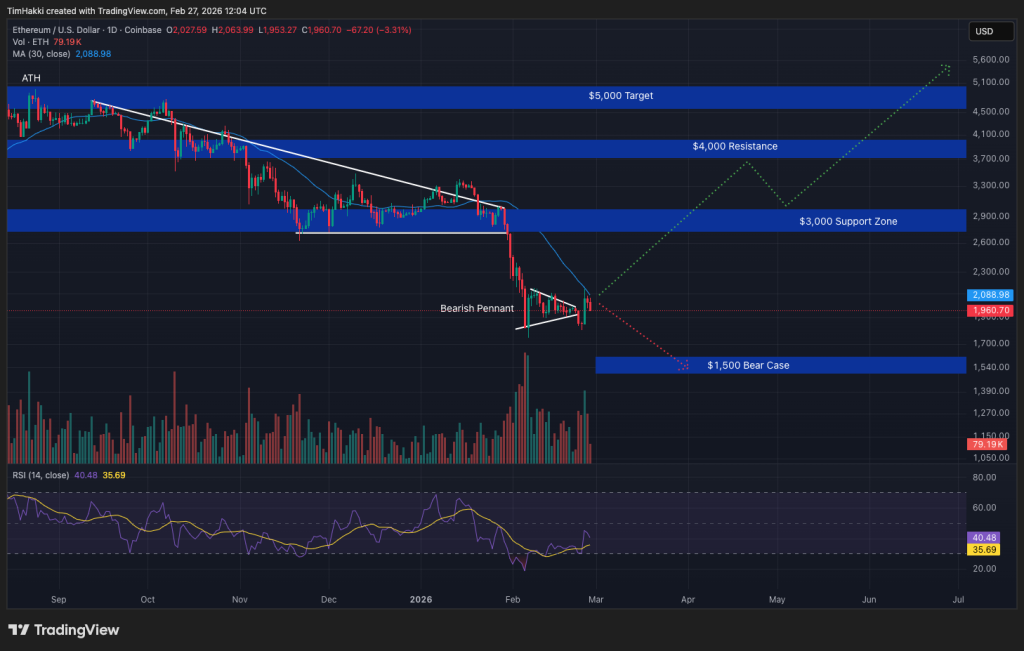
Losing this support level could put Ethereum in freefall, which may not break until $1,500, effectively invalidating all gains since the post-FTX 2021/2022 crash.
Supply dynamics favored a MOVE higher. 31% of the total ETH supply is now staked, removing over 10 million coins from circulation since 2024.
That supply shock is latent energy. Standard Chartered sees this leading to $7,500 by year-end, but the market needs a catalyst to ignite it.
For now, momentum indicators are neutral. The RSI is sitting at 41, indicating indecision. The market is waiting for institutional capital to deploy the stablecoin dry powder sitting on Ethereum’s network. Until that capital rotates from stablecoins into risk assets, ETH remains in a consolidation phase.
