The $10 Billion Vanishing Act: Binance Stablecoin Reserves Evaporate To Levels As Liquidity Flees Crypto

Liquidity's making a run for it—and taking billions in stablecoin reserves with it. Binance just watched its war chest shrink back to levels not seen since early 2024. That's a $10 billion evaporation. Poof.
The Great Liquidity Exodus
Markets don't lie. When capital starts sprinting for the exits, the numbers tell the story. The flight from major exchanges isn't a trickle; it's a tide going out. This isn't just a Binance story—it's a sector-wide signal flare. Stablecoins, the lifeblood of crypto trading pairs, are being pulled, parked, or punted elsewhere. The on-chain data paints a stark picture of risk being re-priced in real-time.
Decoding the Drain
So where's the money going? Some is chasing yield in newer, shinier DeFi protocols that promise better returns than centralized order books. A chunk is likely sitting in cold storage—the ultimate 'wait-and-see' asset. And let's be honest, a portion probably fled to the perceived safety of traditional finance's arms, where the only thing volatile is the CEO's mood after reading the Fed minutes.
The New Calculus for Traders
Thinner reserves mean one thing above all else: volatility is back on the menu. Get ready for wider spreads and sharper, more violent price moves on less volume. The market's shock absorbers are deflating. This environment separates the algorithmic high-frequency traders from the rest—those with the fastest bots and the deepest pockets will feast on the inefficiencies.
For the long-term holder? This is noise. For the active trader? Strap in. The machine is running leaner and meaner. The easy liquidity of the last bull run is a distant memory. Now we see who's built to last and who was just riding the wave. As the old finance jab goes: liquidity is like a reputation—it takes years to build and one bad headline to lose. The market's memory is short, but its reaction time is instantaneous.
Stablecoin Outflows Signal Liquidity Drain Across Crypto Markets
The report explains that liquidity dynamics within crypto markets are often reflected through stablecoin flows, which act as a proxy for deployable capital. When stablecoin reserves rise on exchanges, it typically signals increasing readiness to enter risk positions. Conversely, sustained outflows tend to indicate capital withdrawal or reduced trading appetite.

On Binance, stablecoin reserves have been declining steadily since November 13, with nearly $10 billion withdrawn as investors gradually reduce market exposure. These reserves, which generally fluctuate based on investor demand, have fallen from approximately $50.9 billion to $41.4 billion — a contraction of about 18.6%. This shift suggests a measurable reduction in immediately available liquidity across one of the industry’s largest trading venues.
As stablecoins continue to Flow out, Binance’s reserve levels have now returned to those last observed around October 2024. Although the platform still accounts for roughly 64% of total stablecoin reserves across centralized exchanges, changes at this scale tend to influence broader market liquidity conditions.
If this trend persists, price stability may remain elusive. Historically, renewed stablecoin inflows have coincided with improving risk appetite and stronger price support. Therefore, a sustained reversal in stablecoin flows will likely be necessary before a more durable recovery phase can develop.
Total Crypto Market Cap Tests Key Structural Support
The total crypto market capitalization chart shows a clear transition from expansion to consolidation following the peak reached during the 2025 rally. After climbing toward the $4 trillion region, total market cap entered a sustained corrective phase, gradually compressing toward the $2.1–$2.2 trillion zone. This decline reflects broad risk-off behavior affecting both bitcoin and altcoins, rather than an isolated asset-specific retracement.
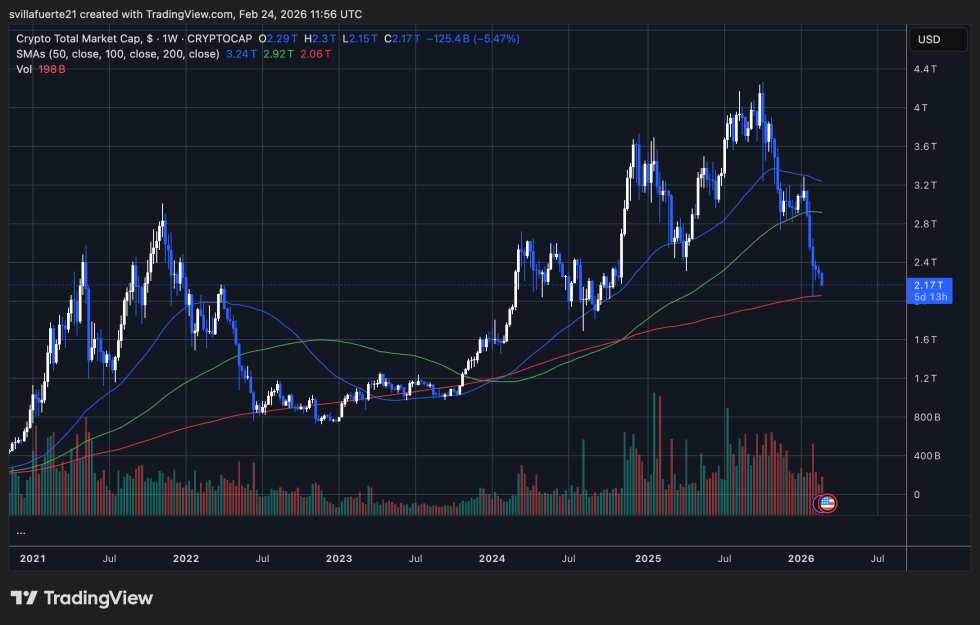
From a structural perspective, the market has recently broken below the 50-week moving average and is now approaching the 100-week average, while the 200-week moving average continues to trend upward beneath price. Historically, this configuration often characterizes mid-cycle corrections rather than full structural reversals, although confirmation requires stabilization above longer-term support levels.
Volume patterns also suggest distribution rather than aggressive accumulation. Selling spikes during declines appear more pronounced than buying reactions, indicating persistent caution among market participants. The absence of strong follow-through rallies reinforces the idea that liquidity remains constrained.
If the $2 trillion region fails to hold, downside volatility could increase due to thinner liquidity conditions. Conversely, stabilization above current levels combined with renewed inflows — particularly through stablecoins — WOULD be the first indication that broader market confidence is gradually returning.
Featured image from ChatGPT, chart from TradingView.com
