Bitcoin Mining Difficulty Skyrockets Back – Erasing Winter Slump in Sharp Rebound

Bitcoin's backbone just flexed its muscles. Mining difficulty—the measure of how hard it is to add a new block to the chain—has snapped back with a vengeance, completely wiping out the declines triggered by last month's brutal cold fronts.
The Network's Immune Response
Think of difficulty adjustments as Bitcoin's autonomous immune system. When hash rate drops—say, because a Texas freeze knocks miners offline—the protocol makes it easier to mine, keeping block times steady. But when those miners plug back in? The system slams on the brakes, ramping difficulty back up to maintain its ten-minute heartbeat. That's exactly what just happened, and the rebound wasn't gentle.
What the Rebound Signals for BTC
This isn't just a technical recalibration. It's a flashing indicator of miner confidence and capital commitment. Miners are betting big on the future by reinvesting and reconnecting hardware. That massive computational vote of confidence typically flows upstream to price action. More security often translates to a stronger foundation for the next leg up—assuming, of course, the usual Wall Street paper hands don't get spooked by their own shadows again.
The network self-healed, proving its resilience once more. While traders obsess over daily candles, the real machinery of Bitcoin just executed a perfect, silent recovery. Now, all eyes turn to whether the price will follow the hash rate's lead, or if we're in for another round of the market ignoring fundamentals—a favorite pastime in traditional finance, where sentiment often trumps sense.
Mining Difficulty Rebound Signals Network Resilience
The recent dip in mining difficulty was largely weather-driven rather than structurally bearish. Severe winter storms temporarily disrupted energy supply in key mining regions, forcing portions of the network’s hashrate offline. As a result, the previous difficulty adjustment registered a short-lived decline, reflecting reduced computational power securing the network at that moment.

However, the disruption proved brief. According to on-chain data, the latest adjustment reversed the drop and pushed difficulty back to new highs, confirming that miners rapidly restored operations. Network hashrate has rebounded toward its prior range, signaling that the infrastructure impact was temporary rather than systemic. Block production times, which had briefly slowed, normalized quickly as computational power returned.
This rebound carries structural implications. Mining difficulty rising after a shock indicates that capital remains committed to the network despite price weakness below $70,000. It also suggests that the broader mining ecosystem retains operational resilience, even under adverse conditions.
At the same time, greater difficulty increases production costs, particularly for less efficient operators. If Bitcoin’s price remains compressed NEAR the $63,000–$65,000 range, margin pressure could intensify for high-cost miners. Nonetheless, the swift recovery in difficulty reinforces the view that network fundamentals remain intact despite short-term volatility.
Bitcoin Tests Key Support As Downtrend Pressure Persists
Bitcoin’s weekly chart shows a clear deterioration in momentum after losing the $70,000 level, with price now consolidating near the $63,000 zone. The structure reflects a sequence of lower highs since the late-2025 peak above $120,000, indicating that sellers remain dominant despite intermittent stabilization attempts.
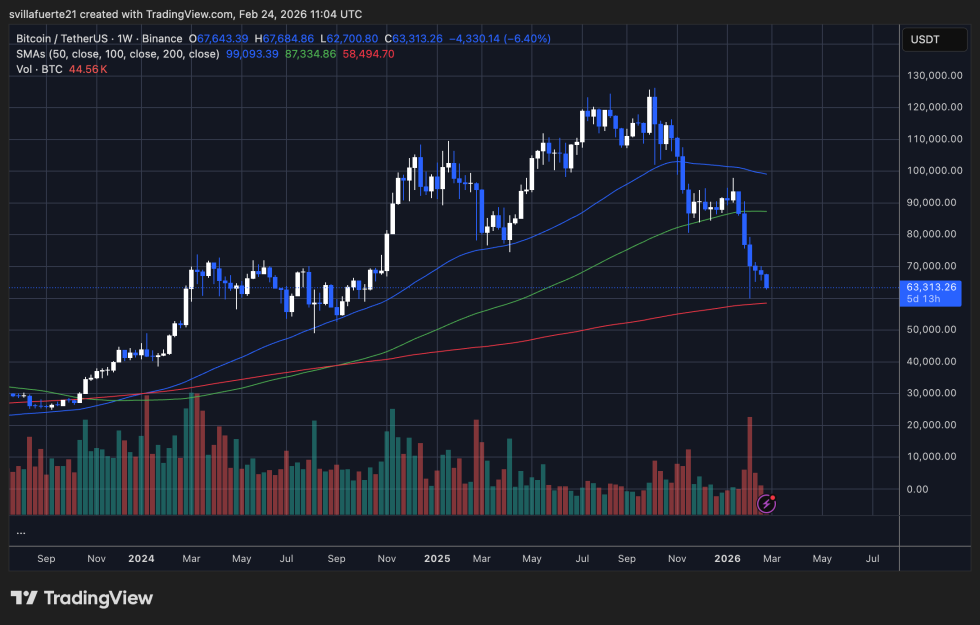
Technically, Bitcoin is trading below the 50-week and 100-week moving averages, both of which have shifted from support into dynamic resistance. This configuration typically signals a transitional or corrective phase rather than a confirmed bullish continuation. Meanwhile, the 200-week moving average — currently much lower — remains the long-term structural support reference.
Volume patterns also suggest caution. Selling activity increased during the latest decline, pointing to distribution rather than simple low-liquidity drift. However, recent candles show some compression in volatility, implying that the market may be attempting to establish a short-term base around current levels.
From a structural perspective, the $60,000–$63,000 region now acts as immediate support. A sustained break below it could expose deeper retracement zones toward the mid-$50,000 area. Conversely, reclaiming the $70,000 threshold WOULD be necessary to restore bullish momentum and shift sentiment toward recovery.
Featured image from ChatGPT, chart from TradingView.com
