Cardano’s Institutional Surge: Smart Contract Fund Exposure Skyrockets in 2026

Forget the whispers—institutional money is now shouting Cardano's name. The once-academic blockchain is seeing its smart contract fund allocations explode, moving from speculative bet to portfolio cornerstone.
The Proof Is in the Positioning
Fund managers aren't just dipping toes anymore; they're diving in headfirst. Exposure to Cardano's smart contract ecosystem has surged, signaling a stark shift in institutional confidence. It's no longer about 'if' but 'how much'—allocations are being recalibrated across the board.
Beyond the Hype Cycle
This isn't fleeting momentum. The move reflects a deeper analysis of scalable, proof-of-stake infrastructure that actually delivers. While other chains hype roadmaps, Cardano's methodical rollout is finally hitting its stride, turning peer-reviewed promises into deployable assets.
The New Institutional Darling
Gone are the days of pure Bitcoin and Ethereum dominance. Portfolio diversification now demands third-generation contenders, and Cardano's rigorous development approach is cutting through the noise. It's becoming the smart money's answer to blockchain's scalability trilemma.
So, while traditional finance still debates digital assets—often over painfully expensive lunches—the real allocation decisions are already made. The ledger doesn't lie, and right now, it's spelling out C-A-R-D-A-N-O.
Institutional ADA Allocation Expands Despite Market Weakness
Grayscale’s latest rebalancing shows ADA accounting for roughly 20.2% of the Smart Contract Platform Select Capped Index (SCPXC), up from about 18.55% at the start of the year. The increase makes Cardano the third-largest holding in the fund, behind ethereum and Solana, which each command allocations above 28%.
The fund maintains diversified exposure across several smart contract networks, including Hedera, Avalanche, and Sui, while managing approximately $1.8 million in assets under management with a net asset value of $5.81 per share.
The rising allocation comes amid macro-driven pressure on crypto markets, with risk sentiment weakening across major tokens. Despite the downturn, institutional positioning suggests investors are reassessing long-term blockchain infrastructure plays rather than reducing exposure entirely.
Cardano-LayerZero Integration Strengthens Ecosystem Outlook
Alongside institutional accumulation, cardano (ADA) has introduced technical developments to expand its interoperability. The network recently integrated with LayerZero, enabling cross-chain messaging and asset transfers across more than 80 blockchain networks.
The upgrade allows dApps on Cardano to interact directly with ecosystems such as Ethereum and Solana, addressing long-standing liquidity fragmentation challenges. Developers can now move assets and data across chains without relying heavily on wrapped tokens or centralized bridges, potentially widening DeFi access.
Additional roadmap initiatives, including protocol upgrades, privacy-focused sidechains, and stablecoin integrations, are designed to improve scalability and attract institutional-grade use cases over the coming year.
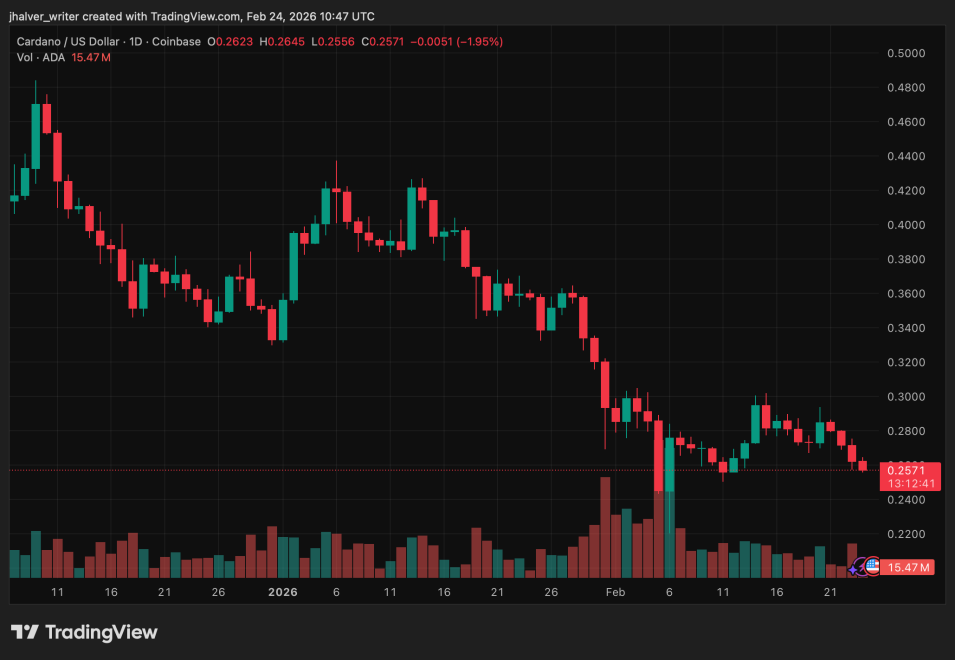
Price Structure Remains Fragile Near Key SupportWhile institutional signals have strengthened, ADA’s market structure remains under pressure. The token is trading around $0.25 after a prolonged downtrend from January highs around $0.42.
Analysts are closely monitoring the $0.24 level, a long-standing demand zone that has historically attracted buyers during periods of heavy selling.
Related Reading: CZ Eyes Binance US Expansion Following Withdrawal Of SEC’s Lawsuit – Report
Technical indicators remain cautious, with resistance forming NEAR the $0.30–$0.31 range. A sustained move above that zone could shift short-term sentiment, while a breakdown below support may expose lower historical price areas.
Cover image from ChatGPT, ADAUSD chart on Tradingview
