BIP-110 Threatens Bitcoin’s Unity: Jameson Lopp Warns of Looming Soft Fork Civil War

Bitcoin's bedrock consensus is cracking under pressure. A new proposal, BIP-110, is sparking fears of a network split—a soft fork fight that could fracture the world's premier cryptocurrency.
The Core Conflict
Forget minor technical tweaks. This is a fundamental clash over Bitcoin's governance and future roadmap. The proposal introduces a contentious change to the protocol's block validation rules, creating a potential fault line where nodes running different software versions could see different versions of the blockchain. It's a recipe for chaos.
Why This Fork Feels Different
Past upgrades often rallied the community. This one feels divisive from the start. The debate isn't just about code efficiency or transaction speed; it's about philosophical control and who gets to steer the ship. Proponents argue it's a necessary evolution. Critics, like veteran cypherpunk Jameson Lopp, see it as an unnecessary risk that could Balkanize the network's security and user base.
The Ripple Effect on Finance
For institutional money—always skittish around crypto drama—a potential chain split is a nightmare scenario. It threatens settlement finality, creates asset confusion, and could trigger a wave of panic-selling masked as 'risk management.' Nothing makes traditional finance scoff harder than a decentralized project arguing over who's in charge.
Bitcoin now faces its toughest stress test yet: not from external regulators or market crashes, but from within. The community's ability to navigate this upgrade will prove whether decentralized governance is a strength or its greatest vulnerability. The stakes? Nothing less than the integrity of the entire system.
Why Lopp Thinks The Activation Path Is Dangerous For Bitcoin
The Core of Lopp’s argument is not just what BIP-110 changes, but how it tries to activate. He points to the proposal’s 55% miner-signaling threshold for a user-activated soft fork and says that low bar materially increases the probability of two competing chains if the ecosystem is not aligned.
He also stresses that BIP-110 nodes would reject non-compliant blocks outright, which raises coordination risk compared with soft forks that old nodes can continue to follow without enforcement conflicts.
Lopp is especially pointed on the mandatory activation posture at block height 961,632. In one of the sharpest passages, he writes: “This is not a neutral, low-drama deployment posture. It’s dogmatic bullying. […] you cannot pretend it’s low-risk.” He ties that warning to a broader point: even if one views UASF tactics as legitimate, the proposal’s design increases the odds of a messy failure mode if miners, exchanges, wallets, and infrastructure providers do not converge in time.
He also pushes back on comparisons to 2017, noting that the UASF many people cite in the SegWit era never actually had to run to the edge because SegWit activated via miner signaling instead. That distinction matters in Lopp’s framing, because BIP-110 proponents are, in his view, leaning on a historical precedent that did not test the exact scenario they now describe as manageable.
Another major section of Lopp’s post targets the claim that BIP-110 has meaningful grassroots momentum. He argues that raw node counts (roughly 20% run Knots) are a weak proxy for consensus because signaling is cheap, node operation can be low-cost, and Tor addresses are “effectively zero” cost to create at scale. He publishes a breakdown of reachable nodes and highlights the higher Tor-to-IPv4 ratio among Knots and BIP-110 signaling nodes as a reason to treat node-count narratives cautiously.
On mining support, Lopp says the gap is more straightforward. At the time of publication, he writes miner signaling was “precisely […] zero,” and he cites public opposition from F2Pool while arguing miners have limited incentive to back a proposal that could reduce fee revenue. That point reinforces his broader thesis that BIP-110 supporters are overestimating social signaling and underestimating the role of economically significant actors in Bitcoin upgrade politics.
Lopp’s post ultimately reads as a warning that the immediate issue is not simply whether BIP-110 activates, but what the campaign reveals about where Bitcoin’s internal dispute over neutrality, censorship resistance, and block-space usage is heading. Even a failed fork push, in his framing, can still impose real costs by forcing operators and businesses to plan around low-probability but high-impact coordination failure.
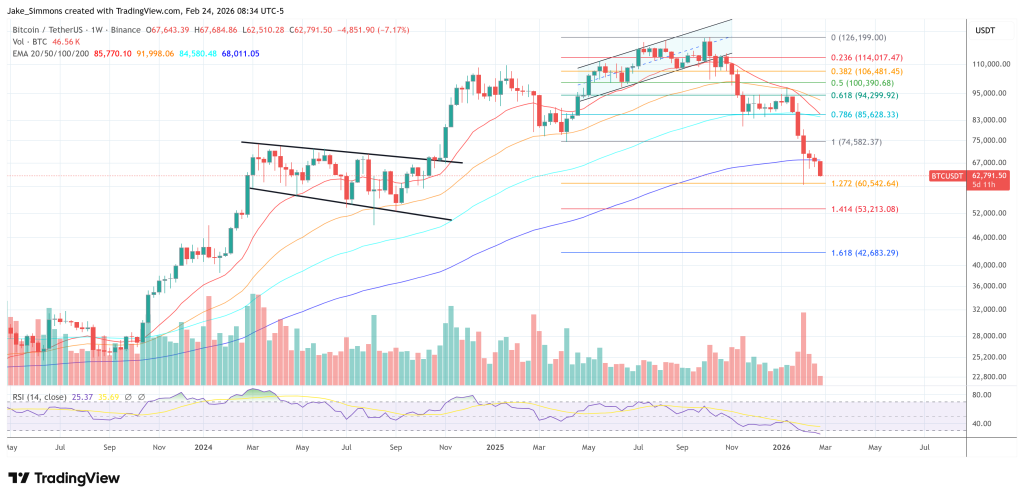
At press time, Bitcoin traded at $62,791.