Cardano Hard Fork Imminent Next Month, Leios Still On Track for ’This Year’ Release, Says Hoskinson

Cardano's roadmap is accelerating, with founder Charles Hoskinson confirming a major network upgrade is just weeks away.
The Hard Fork Countdown
Mark your calendars. The next Cardano hard fork is locked in for next month, a move that will inject new protocol capabilities directly into the blockchain's core. This isn't just maintenance—it's a calculated step in Cardano's methodical evolution, designed to bolster performance and set the stage for what's next.
Leios: The Scaling Engine on the Horizon
While the hard fork takes center stage now, all eyes remain on Leios, the key scaling solution. Hoskinson's commitment that it's still coming 'this year' is a clear signal to the market. This in-memory, optimistic rollup solution promises to slash latency and supercharge transaction throughput, directly tackling the scalability trilemma head-on.
Why This Sequence Matters
The hard fork clears the technical runway. Leios is the jet waiting to take off. This one-two punch strategy underscores a development philosophy that prioritizes foundational upgrades before launching transformative features—a deliberate pace that sometimes leaves traders chasing the next shiny object elsewhere.
Execution is everything. The coming weeks will test Cardano's deployment rigor. If both milestones land smoothly, they could redefine the chain's capacity and competitive edge. Miss a step, however, and the 'patient, peer-reviewed' narrative starts to sound like an excuse to the fast-money crowd watching from the sidelines. The clock is ticking.
Cardano Momentum: Midnight, LayerZero And USDCx
In the livestream, Hoskinson spent his opening stretch recapping what he characterized as a productive Consensus week, pointing to “a lot of great announcements” and relationships around the Midnight ecosystem, including infrastructure and distribution names he said were involved with the network. He argued that the ability to launch a large, exchange-listed project like Midnight is itself a signal about Cardano’s maturity as a platform for “tier one” efforts.
On the Cardano side, he highlighted a newly announced LayerZero integration that he said connects Cardano “to more than 80 blockchains,” positioning it as a step away from the perception that the network operates in isolation. In the same segment, Hoskinson pointed to USDCx as a stablecoin-like asset he said is designed for “these non-EVM systems,” and emphasized the user-experience work around exchange flows—“autoconvert,” as he described it, so users can move value “straight to the exchange, straight back from the exchange.”
He also drew a distinction between USDCx and “basically USDC,” saying the tradeoff for cardano users is an asset that, in his telling, preserves “privacy” and “can’t be frozen.” Hoskinson positioned that as “the best compromise” available for a “tier one stablecoin of that nature” in the Cardano ecosystem, while arguing that the LayerZero integration could open the door to “eight major stablecoins” over time, depending on integration sequencing.
Hard Fork ‘Next Month,’ Leios ‘This Year’
The most concrete near-term timing signal came when Hoskinson addressed the protocol schedule directly, saying: “Cardano hard fork is happening I believe next month. But you know the community is kind of working its way through that and getting these things done.”
In the same breath, he reiterated that Leios, Cardano’s scalability initiative, remains on track, noting recent travel and discussions with product manager Michael Smolenski about progress. “All things considered we’re pretty happy with the rate of progress of Cardano,” Hoskinson said, while also pointing to a new Plutus version, continued development of Aiken, and “node diversity coming this year,” alongside Leios.
Hoskinson also flagged developer activity he expects in March, referencing a “Dev Builder Fest down in Argentina” and describing the “integration of Pyth” into the ecosystem, which he presented as the arrival of a “tier one Oracle” for Cardano.
Beyond shipping timelines, Hoskinson used the livestream to argue that the industry’s central fight is shifting from enforcement actions to culture and narrative, particularly around non-custodial wallets and permissionless settlement. He warned about what he called “factions” that want crypto transactions routed through “permission federated networks owned and operated by large financial institutions,” and singled out US policy debates as part of that backdrop.
“What’s not okay is to build a network that’s forever owned and operated by five or 10 or 20 banks and they basically lord and leverage that power and position over the users,” he said. “And once they have absolute control, they just simply flip a switch and you’re at their mercy and they own all your money. And unfortunately, the system is moving in that direction right now.”
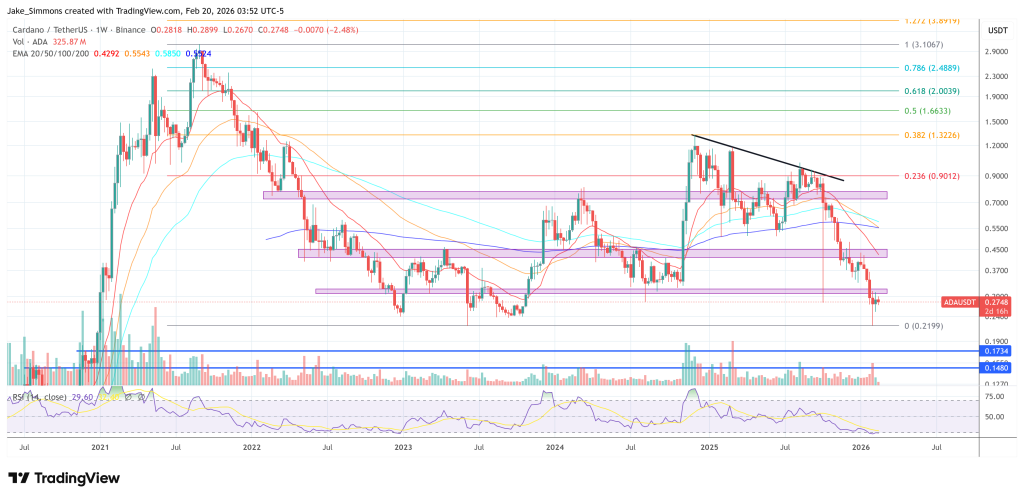
At press time, ADA traded at $0.2748.