Stablecoin Crime Wave? $141B In Illicit Activity Reported This Year

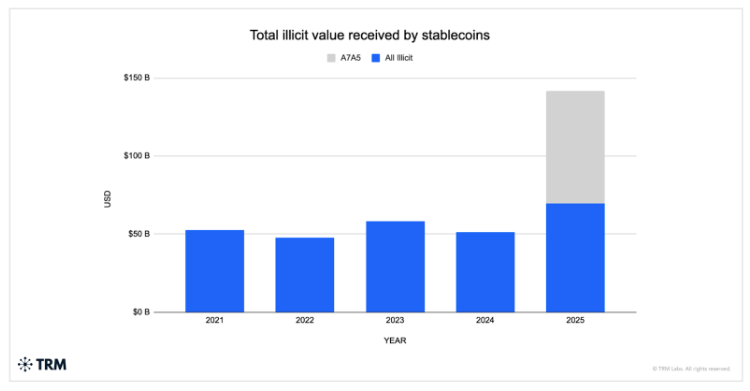
Stablecoins—the supposed safe harbor of crypto—just got hit with a $141 billion reality check.
The New Face of Financial Crime
Forget shadowy Bitcoin wallets. The latest reports show illicit actors are flocking to dollar-pegged tokens. They offer the perfect cover: the stability of fiat with the frictionless, cross-border movement of blockchain. It’s a money launderer’s dream—fast, global, and wrapped in a veneer of legitimacy.
Regulators Are Playing Catch-Up
Global watchdogs are scrambling. Their old rulebooks, built for slow-moving bank transfers, are useless against instant, pseudonymous stablecoin flows. Every new compliance directive seems to arrive just as criminals have already moved to the next loophole. It’s a multi-billion dollar game of whack-a-mole, and the moles are winning.
The Transparency Paradox
Here’s the ironic twist: the very transparency of public blockchains might be the ultimate weapon. Every transaction leaves a permanent, analyzable trail. Forensic firms are getting scarily good at connecting the dots, tracing the flow of tainted funds across exchanges and protocols. The criminals’ advantage may be temporary.
So, is this the stablecoin’s death knell? Hardly. It’s a painful, expensive growing pain. The path to mainstream finance was never going to be clean—just ask any traditional banker about their industry’s own sordid history. The $141 billion figure isn't just a scandal; it's a price tag for building a new financial system under the harsh glare of the digital age. The old guard might smirk, but they’re the ones still settling trades with paperwork from the last century.
Sanctions Linked Networks Drive The Bulk Of Flows
According To TRM Labs, sanctions-related flows made up roughly 86% of detected illicit crypto transfers last year. Around $72 billion of the stablecoin total traced back to a ruble-pegged token linked to Russian networks.
These networks are not isolated. Reports note overlaps with entities tied to China, Iran, North Korea, and Venezuela, which shows how stablecoins can act as bridges between different sanctioned systems.
The mechanics are simple: price stability matters when you need predictable settlement and low volatility risk. Stablecoins offer that.
Guarantee Marketplaces And Human Trafficking Rely On Stablecoins
Volume on certain marketplaces surged, mostly in stablecoins. Some escrow and guarantee sites — which act like middlemen for high-value transfers — saw tens of billions of dollars Flow through their systems.
Reports note these venues are almost totally stablecoin-denominated, which raises red flags about their role in moving funds tied to illicit trade. Chainalysis and others have also pointed to sharp increases in flows to networks connected to human trafficking and escort services, and those operations leaned heavily on stablecoins for payments.
In these cases, payment certainty and liquidity matter more to the buyers and sellers than the chance of gains.
Scams, ransomware, and thefts often start in bitcoin or Ether and then shift into stablecoins later in the laundering chain. That pattern is common because attackers want an asset that holds value while they move it through fewer hands.
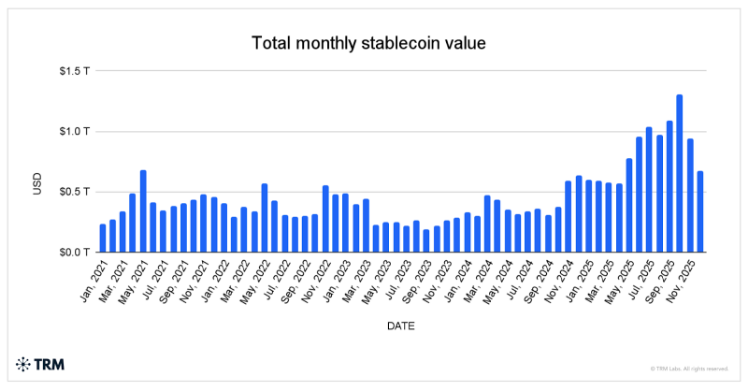
Meanwhile, the global stablecoin market has grown into a multi‑hundred‑billion‑dollar sector, with total market capitalization topping roughly $270 billion in early 2026.
According to data tracking site Stablecoin.com, the combined value of all major stablecoins consistently sits above the mid‑hundreds of billions mark, with fiat‑backed coins accounting for most of that total.
Two issuers dominate the sector. Tether’s USDT leads by a wide margin, with a market cap often reported at around $180 billion or more, and representing more than two‑thirds of the total stablecoin market.
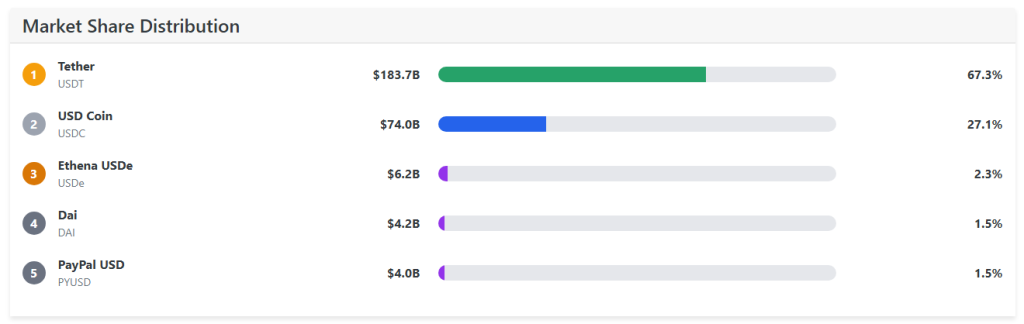
Circle’s USD Coin (USDC) sits in second place with a market cap often above $70 billion, jointly holding over 90% of stablecoin capitalization when combined with USDT.
Smaller stablecoins like Ethena USDe, DAI, and PayPal USD make up a much smaller portion of the market but signal ongoing diversification among providers, the data tracker said.
Featured image from Unsplash, chart from TradingView
