Crypto’s Dark Side: Funds To Suspected Human Traffickers Climb 85% In 2025

Blockchain's anonymity fuels a grim surge in illicit finance.
Tracking the Shadow Economy
While mainstream finance grapples with compliance costs and sluggish cross-border rails, cryptocurrency's permissionless nature presents a double-edged sword. The very features that empower the unbanked—pseudonymity, global reach, and censorship resistance—are being weaponized by bad actors. Forensic analysis of on-chain data reveals a disturbing trend: a significant 85% year-over-year increase in funds flowing to wallets linked to suspected human trafficking operations. The blockchain doesn't lie, but its entries don't come with moral disclaimers.
The Compliance Conundrum
Regulators and law enforcement are playing catch-up. Traditional financial surveillance tools, built for a world of centralized ledgers and known counterparties, falter against the fluid architecture of decentralized networks. Tracing funds across mixers, privacy coins, and cross-chain bridges requires a new forensic playbook—one that's being written in real-time as illicit actors innovate. It's a high-stakes game of cryptographic cat and mouse, where every new compliance rule from the FSA seems to spawn three new evasion techniques.
A Call for Industry Action
This isn't just a regulatory problem; it's an existential threat to the legitimacy crypto seeks. The industry's leading exchanges, analytics firms, and protocol developers are under pressure to deploy more sophisticated on-chain intelligence. The goal: to make illicit activity as economically costly and technically difficult as possible, without dismantling the core tenets of financial sovereignty. After all, what's the point of building a new financial system if it just becomes a more efficient engine for the world's oldest crimes? The path forward demands more than just tech—it requires a collective conscience. Because sometimes, the most bullish thing you can do is clean house.
Stablecoins Dominate Payment Channels
Based on reports, international escort services and prostitution networks operated almost entirely using stablecoins. These tokens were preferred over more volatile cryptocurrencies, allowing operators to receive payments without sharp price swings.
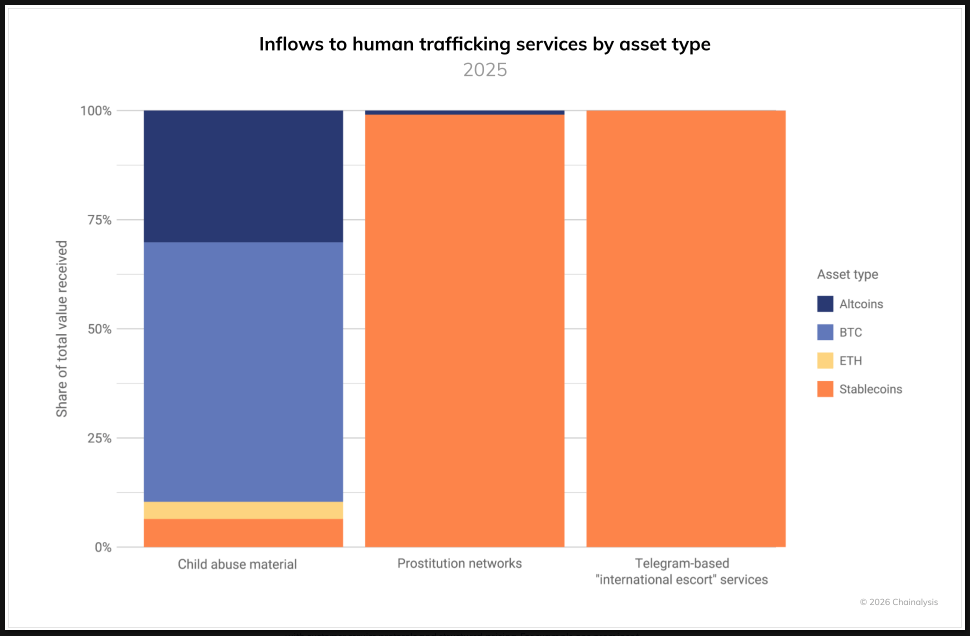
Chainalysis said that labor placement agents — some accused of kidnapping workers and forcing them into scam operations — also relied on crypto to collect and MOVE funds.
Messaging platforms such as Telegram were cited as distribution points for certain services, including escort listings and recruitment ads. Crypto wallets linked to these listings showed repeated payment patterns and connections to broader illicit clusters.
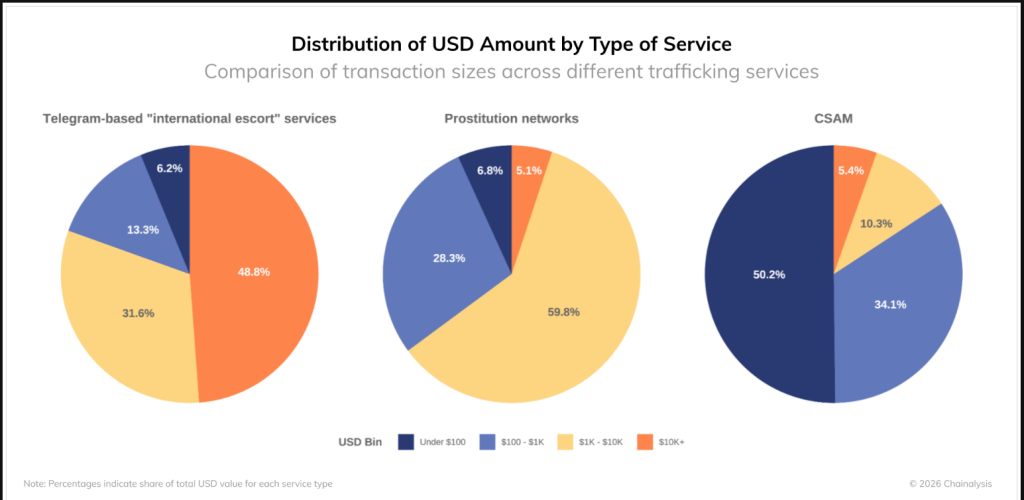
Links To Scam Compounds And Laundering Networks
Reports note that many of the identified wallets were closely aligned with online casinos and Chinese-language money-laundering groups.
Scam compounds, which have drawn global attention for coercing victims into running online fraud schemes, appeared interconnected with trafficking-related payment flows.
In several cases, funds moved between services before being routed toward exchanges or converted into other digital assets.
Chainalysis noted that the convergence of the networks indicated that there is a shared financial infrastructure. Instead of individual operations, the data indicated that there are clusters of wallets that overlap and interact with each other under different categories of illicit activities.
However, Chainalysis asserted that even with the increase in crypto-related trafficking flows, there were advantages to blockchain investigation. For instance, digital assets are permanently recorded and publicly visible, unlike cash.
This record enables compliance and law enforcement to track movement, detect transaction patterns, and recognize suspicious activity.
The firm advised monitoring for large, recurring transfers to labor brokers, wallet clusters active across several illicit service types, and repeated stablecoin conversion patterns.
The exchanges are seen as strategic choke points, where intervention is possible when funds try to re-enter the traditional financial system.
The Chainalysis findings are a reflection of the increased use of crypto currencies in criminal activities and the increased ability to track them.
Chainalysis argues that although digital assets are utilized in these trafficking networks, the transparency of these systems will aid in the disruption of these networks.
Featured image from Pixabay, chart from TradingView
