Bitcoin’s $55,000 Floor: The Final Stand Before On-Chain Capitulation

Bitcoin teeters on the edge. The $55,000 support level isn't just a number—it's the last line of defense before the market's structural integrity cracks.
The On-Chain Reality Check
Forget the hopium. On-chain metrics don't lie. They show a market holding its breath, with long-term holders refusing to sell and short-term speculators getting squeezed. The $55,000 zone represents a massive concentration of cost basis—a collective psychological floor for millions of wallets. If it breaks, the automated sell-offs begin.
Liquidity at the Precipice
Exchanges are watching order books thin out. The bid wall at $55k is the only thing standing between current prices and a cascade of stop-loss triggers. When major support folds, it doesn't creak—it collapses. The entire derivatives market is leveraged against this single price point, a testament to modern finance's genius for building skyscrapers on fault lines.
Capitulation's Domino Effect
A break below this level triggers a chain reaction. Miner revenue gets slashed, forcing inefficient operations offline. Over-leveraged positions get liquidated en masse, flooding the market with forced selling. This isn't a dip—it's a fundamental reset of the asset's cost structure. The so-called 'strong hands' finally start sweating.
The Bull Case in the Bear's Shadow
Paradoxically, true capitulation creates the cleanest slate for the next bull run. It flushes out weak leverage, resets unrealistic expectations, and lets the network's actual utility—not speculative fever—determine value. Every major cycle has required this painful purge. Consider it the market's version of a colon cleanse—unpleasant but ultimately healthy.
Bitcoin faces its moment of truth. The $55,000 floor holds the entire narrative. Either it becomes the launchpad for the next leg up, or it becomes the trapdoor to a reckoning that's been building for months. The blockchain's ledger is ready to write the next chapter, one way or another. After all, what's a crypto cycle without a little mass financial despair to make the eventual recovery feel earned?
On-Chain Cost Basis Signals Compression of Bitcoin’s Long-Term Support Zone
Adler further explains that the Bitcoin On-chain Cost Basis 7-day Rate of Change chart provides a clearer view of how key structural support levels are evolving. The metric tracks weekly percentage changes in Realized Price, Short-Term Holder (STH) cost basis, and Long-Term Holder (LTH) cost basis, allowing analysts to assess not only absolute levels but also the speed at which they are converging.

Currently, LTH cost basis is rising about 0.96% per week, placing it NEAR roughly $43,223 on a quarterly horizon. Meanwhile, Realized Price is declining around 0.55% per week, projecting a level near $51,157 over the same period. As a result, the support corridor between these levels is compressing from roughly $16,700 today to under $8,000, indicating tightening long-term structural support.
This development is not an immediate trading signal but rather a forward-looking framework. Within a quarter, the $43K–$51K zone could become a decisive structural boundary. Sustained price action below that range WOULD significantly increase the probability of a deeper bearish phase.
Short-term pressure remains elevated as STH cost basis continues falling near 1.77% weekly. However, Realized Price remains the first major support, with LTH cost basis representing the deeper long-term defense level.
Bitcoin Breaks Key Support As Downtrend Pressure Intensifies
Bitcoin’s price action on this chart reflects persistent downside pressure following the rejection from higher levels earlier in the cycle. After peaking near the $120,000 area, BTC entered a sustained corrective phase characterized by lower highs and accelerating downside momentum. The latest decline has pushed price decisively below the $70,000 region, a psychological level that previously acted as intermediate support.
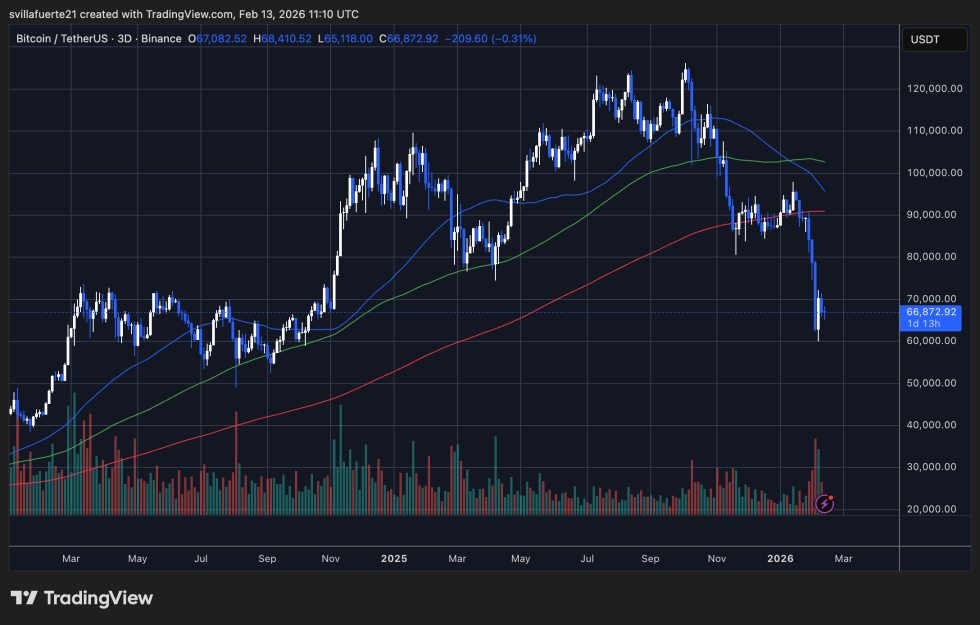
From a technical perspective, BTC now trades beneath the shorter-term moving averages, which are turning downward and reinforcing bearish momentum. The longer-term trend line remains above the current price, highlighting that the broader market structure has weakened significantly compared with earlier bullish phases. This configuration typically signals continued caution until price can reclaim key averages and stabilize.
Recent selloffs have been accompanied by noticeable spikes in trading activity, indicating forced liquidations or panic-driven positioning rather than orderly distribution. Such behavior often appears during late-stage corrections, though it does not necessarily mark an immediate bottom.
If Bitcoin fails to recover the $70,000 level soon, attention may shift toward deeper historical support zones. Conversely, sustained consolidation above current levels could help reduce volatility and FORM the basis for a potential stabilization phase before any renewed directional move.
Featured image from ChatGPT, chart from TradingView.com
