Bitcoin’s Weakness Persists: Stablecoin Supply Signals Risk-Off Environment—What’s Next for Crypto?

Bitcoin can't catch a break. While the broader market holds its breath, stablecoin metrics are flashing warning signs—pointing to a classic risk-off rotation that's squeezing crypto's liquidity lifeline.
The Flight to Safety Playbook
Forget complex on-chain analytics for a second. The simplest signal is often the loudest. When capital floods into dollar-pegged tokens like USDT and USDC, it's not betting on the next parabolic altcoin run. It's parking. It's waiting. It's the digital asset equivalent of moving to cash—a defensive crouch that starves the ecosystem of the fuel needed for major rallies.
Liquidity Is the Name of the Game
Bull markets are built on a simple formula: abundant, cheap capital chasing scarce assets. Stablecoin supply acts as the direct pipeline for that capital. A contraction suggests the pipeline is narrowing. New money isn't rushing in, and existing money is sidestepping volatility. Without that inflow, even the strongest narratives struggle to gain sustainable traction. It turns rallies into mere bounces.
Reading Between the Lines
This isn't necessarily a doom signal—it's a timing one. These phases of contraction have historically been consolidation periods, setting the stage for the next leg up when sentiment eventually flips. But it demands patience. It separates the traders from the tourists. As one cynical fund manager might quip, 'It's the market's way of charging tuition for those who forgot that 'number go up' isn't a fundamental analysis.'
The path forward hinges on a catalyst—a shift in macro winds, a regulatory clarity breakthrough, or an institutional adoption headline big enough to turn the stablecoin spigot back on. Until then, the market is telling you exactly what it's doing: playing defense.

At the same time, the 30-day change in USDT market capitalization has fallen to approximately -$2.87 billion, signaling capital outflows from the crypto ecosystem. Together, these indicators suggest that January’s attempted recovery lacked sustained liquidity support. Unless stablecoin inflows return and the SSR oscillator stabilizes in positive territory for several weeks, the broader market context may remain risk-off, leaving Bitcoin vulnerable to continued pressure in the near term.
Stablecoin Liquidity Trends Reinforce Bitcoin Market Weakness
Axel Adler’s analysis emphasizes the importance of stablecoin liquidity as a leading indicator for Bitcoin market conditions. The 30-day change in USDT market capitalization functions as a directional gauge of dollar liquidity entering or leaving the crypto ecosystem. Positive readings typically signal fresh capital inflows that can support price appreciation, while negative values indicate liquidity contraction and reduced risk appetite among market participants.

According to the data, January briefly showed signs of recovery. The 30-day USDT market cap change moved into positive territory, reaching approximately $1.4 billion during the first week of the month. This inflow coincided with the Stablecoin Supply Ratio (SSR) Oscillator’s attempt to move into positive territory, alongside a short-term rebound in Bitcoin price. However, the trend reversed later in January, and the latest reading NEAR -$2.87 billion confirms renewed capital outflows.
The alignment between these two indicators appears consistent rather than coincidental. Liquidity inflows helped support January’s temporary recovery, while the return of outflows accompanied the subsequent market weakness.
As long as the 30-day USDT change remains negative, a sustained SSR recovery appears unlikely. Together, these signals suggest the market has shifted back into a risk-off environment, reinforcing the view that the recent rebound lacked durable liquidity support.
Bitcoin Remains Under Pressure After Breakdown Below Key Averages
Bitcoin’s daily chart continues to reflect sustained bearish momentum following the loss of the $70,000 level, with price now consolidating in the mid-$60,000 range after a sharp decline. The recent breakdown below this psychological threshold coincided with a decisive MOVE under major moving averages, which have shifted from support to resistance. This structural change typically signals weakening bullish control and increasing caution among market participants.
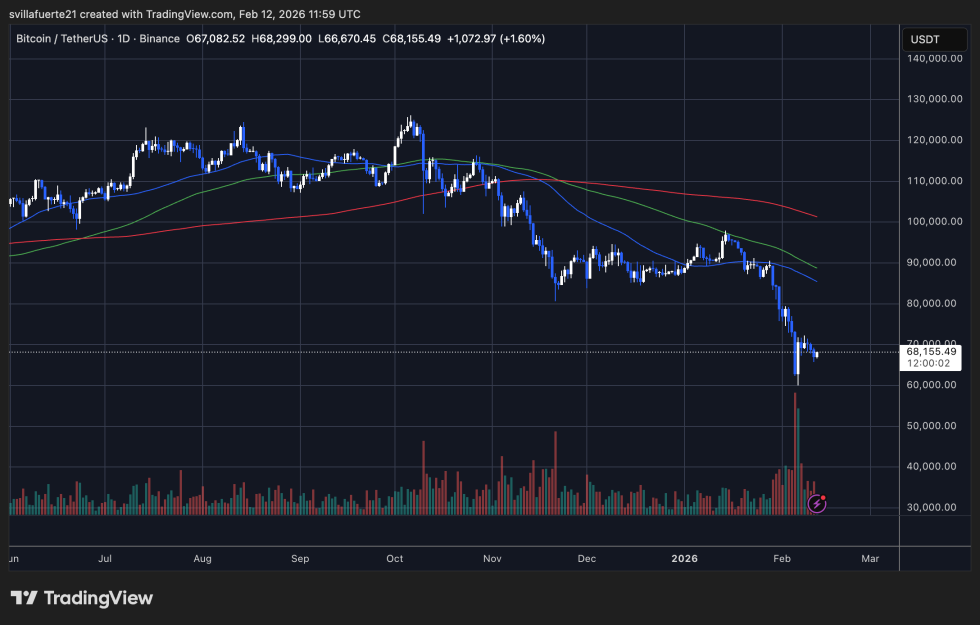
Price action shows a sequence of lower highs since late 2025, suggesting a gradual deterioration in market structure rather than an isolated correction. The latest drop was accompanied by a notable surge in trading volume, often associated with forced deleveraging or defensive repositioning rather than steady accumulation. This dynamic can increase short-term volatility while delaying meaningful recovery attempts.
From a technical perspective, the $60,000–$62,000 region now represents the primary support zone. This area aligns with prior consolidation ranges and historically strong liquidity clusters that could attract demand. Holding this zone WOULD support a stabilization scenario, potentially leading to sideways consolidation. Conversely, a decisive break below it could open the door to deeper retracement phases.
Until Bitcoin reclaims key moving averages and restores higher-high price structure, the market is likely to remain sensitive to liquidity conditions, macro sentiment, and derivatives positioning.
Featured image from ChatGPT, chart from TradingView.com
