Bitcoin Market Stress Ignites Whale Activity: Strategic Selling or Risk Management Masterclass?

Bitcoin's recent market tremors have sent shockwaves through the ecosystem, triggering a surge in high-stakes whale movements. The big question on every trader's mind: is this a coordinated sell-off or a sophisticated risk management play?
The Whale's Dilemma: Panic or Precision?
When volatility spikes, crypto's largest holders don't just HODL—they act. Massive wallet movements during periods of stress aren't always a bearish signal. Sometimes, they represent a calculated rebalancing, a shift into stablecoins to preserve capital, or even a prelude to accumulating more at lower prices. It's the ultimate high-stakes chess game, played with nine-figure stacks.
Decoding the On-Chain Signals
Forget the price charts for a moment. The real story unfolds on the blockchain. Analysts are scouring exchange inflow data, tracking wallet clusters, and monitoring dormant coin movement. A sudden flood of Bitcoin to known exchange addresses often precedes selling pressure. Conversely, withdrawals to cold storage suggest accumulation. In today's market, the whales aren't just participants—they're the weather system.
Risk Management in a Volatile Sea
Let's be real: even whales get seasick. Professional capital doesn't ride 30% drawdowns for fun. Strategic selling during stress can be a sign of maturity, not weakness. It's about portfolio survival, locking in profits, and having dry powder ready for the next opportunity. After all, you can't buy the dip if you're all-in on the top—a lesson some traditional finance titans learned the hard way during the last cycle, much to everyone's cynical delight.
So, is the current whale activity a red flag or a masterclass? It's likely both. Some are cutting risk, others are positioning. In the end, their moves create the waves the rest of us must navigate. Watch the chains, not just the charts.
Rising Whale Exchange Flows Signal Persistent Market Stress
The CryptoQuant report further highlights a notable shift in whale behavior during Bitcoin’s recent correction. As BTC declined from roughly $95,000 toward the $60,000 range, average monthly inflows of Bitcoin to Binance from large holders increased significantly. These transfers ROSE from about 1,000 BTC per month to nearly 3,000 BTC, with a particularly sharp spike of approximately 12,000 BTC recorded on February 6 alone. Such movements typically indicate heightened activity among large investors during periods of price stress.

Since early February, the frequency of large transfers has remained elevated. Data show that seven separate trading days recorded more than 5,000 BTC in daily inflows from whales, an unusually persistent pattern that suggests heightened sensitivity among major holders to rapid market swings. This behavior indicates active portfolio adjustments rather than passive long-term holding.
Historically, rising exchange inflows from whales are often associated with increasing selling pressure, especially when broader market liquidity conditions are tightening. Because these participants control substantial volumes, their actions can significantly influence short-term price dynamics.
Monitoring whale flows, therefore, remains a critical component of market analysis, offering insight into potential volatility phases and helping investors better understand the forces shaping Bitcoin’s current price environment.
Bitcoin Tests Major Support After Sharp Breakdown
Bitcoin’s higher-timeframe chart shows mounting technical pressure following a sharp decline from the $90,000–$95,000 region toward the mid-$60,000 range. The recent breakdown below the $70,000 level confirms a deterioration in market structure, with price now trading beneath key moving averages that previously acted as dynamic support. This shift typically reflects weakening bullish momentum and increased defensive positioning among traders.
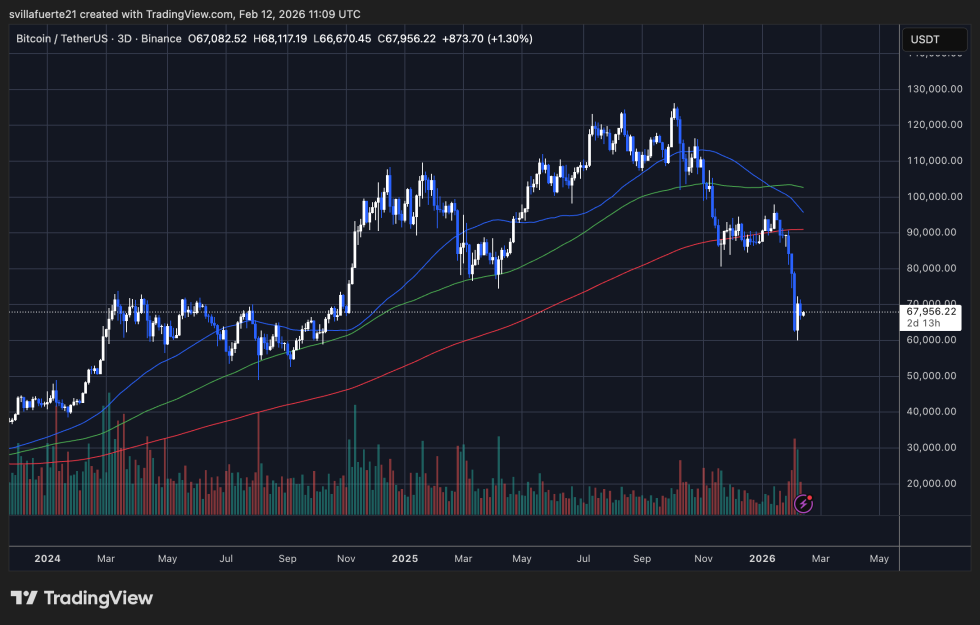
The chart also highlights a clear sequence of lower highs since the late-cycle peak, a pattern often associated with corrective or transitional phases. Recent selloffs have been accompanied by rising trading volume, suggesting distribution or forced deleveraging rather than gradual profit-taking. Such dynamics often intensify short-term volatility while making sustained recoveries more difficult without strong spot demand.
From a technical standpoint, the $60,000–$62,000 area now emerges as a critical support zone, aligning with prior consolidation levels and historical liquidity clusters. Holding this region could stabilize sentiment and allow for a period of sideways consolidation. Conversely, a decisive break below it WOULD increase the probability of deeper retracement scenarios.
Bitcoin remains highly sensitive to macro liquidity conditions, institutional flows, and derivatives positioning, factors likely to determine whether the current correction evolves into consolidation or further downside pressure.
Featured image from ChatGPT, chart from TradingView.com
