Ethereum Sell Pressure Intensifies: Short-Term Holder Supply Flow Dives Negative

Ethereum's market structure just flashed a warning signal—short-term holders are cashing out.
Supply Flow Flips Red
The metric tracking coins held for less than 155 days has turned negative. That means the cohort most likely to sell for quick profits is now a net distributor, not an accumulator. It's a classic sign of profit-taking that adds immediate sell pressure to the order books.
Why Short-Term Holders Matter
These traders are the market's swing voters. They're emotionally and financially tethered to recent price action, making them quick to exit on fear or to lock in gains. When their collective balance starts shrinking, it often precedes or accompanies a period of price consolidation or correction. It's the crypto equivalent of watching the 'smart money' flow indicators—except here, the 'smart money' is often just the nervous money.
Broader Market Implications
This shift doesn't happen in a vacuum. It strains liquidity and can dampen bullish momentum, forcing the asset to find a new support level from more committed, long-term holders. For a network like Ethereum, whose valuation is tightly linked to utility and adoption narratives, excessive short-term trading can feel like a distracting sideshow—all price action, no protocol progress. Sometimes it seems the most innovative thing in digital finance is the number of ways people find to trade the same asset.
The key question now is whether long-term believers step in to absorb the selling. If they do, this could be a healthy shakeout. If not, that negative flow might just be the first chapter in a longer story.
Negative Supply Flow For Ethereum Short-Term Holders
As Ethereum’s price loses its upside momentum, on-chain data are now flashing a cautionary signal, one that demands close attention during volatile market conditions. This cautious signal is coming from the side of short-term ETH holders, who are collectively exhibiting bearish activity.
On-Chain Mind, a crypto and data analyst, has confirmed that ethereum is shifting into negative territory on short-term holder supply flow. A trend of this kind suggests that the most recent buyers of ETH are choosing to sell their holdings, adding fresh supply back into the broader market in periods of uncertainty.
The analysis carried out using the Ethereum Short-Term Holder Net Change metric mainly tracks speculative positioning over a 30-day duration. When short-term holders begin to distribute frequently, it is a pattern that often hints at a decline in confidence and a rise in volatility sensitivity.
Data from the STH Net Change chart reveals that recent buyers are starting to distribute their holdings, and short-term capital is rotating out, not flowing in. During such scenarios, On-Chain Mind advocates a strategy that plays against the short-term crowd.
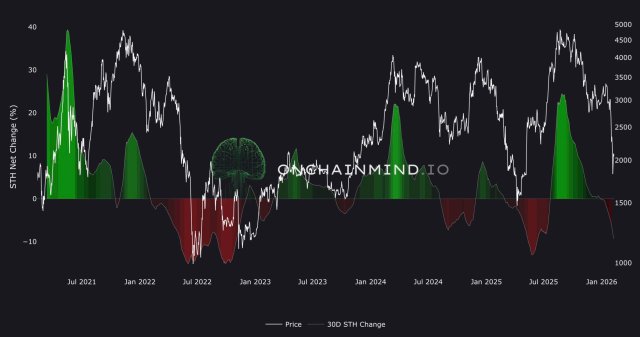
While short-term holders are displaying fear and uncertainty by selling their ETH stash, large holders or whales continue to find a reason to hold on to the altcoin and even buy more. CW on the X platform stated that Ethereum has dropped below the realized price of the accumulation wallet addresses.
Despite losing this key threshold, ETH whales have continued their buying activity. The expert highlighted that the full-scale accumulation of the altcoin by whales started back in June 2025. Meanwhile, the current price has now fallen below the price at which these investors kicked off their accumulation process.
This drop did not stop them as their buying spree is proceeding even more aggressively this time. At the same time, the latest price of ETH will likely appear attractive to whales.
Buying ETH Now Is An Opportunity
Even with a bearish state, Michael Van De Poppe has expressed bullish focus on Ethereum. Following an analysis of the ETH Market Value to Realized Value Ratio (MVRV), the market expert and MN Fund founder and CIO, declares that “it is a tremendous opportunity to be looking at ETH now.”
Van De Poppe stated that the major reason for this is a massive gap between the fair price and the market price. Based on the MVRV ratio, ETH’s present valuation is just as underpriced as it was during the extremely volatile times, such as the April 2025 crash, the June 2022 bottom after Luna tanked, the March 2020 crash triggered by COVID, and the peak bear market of December 2018.
In all of those cases, this offered a fantastic opportunity to purchase the leading altcoin, and this particular signal has unfolded once again in the current market cycle.
