Ripple’s XRP Ledger Gets Zero-Knowledge Proofs: Privacy Meets Enterprise Blockchain

Ripple just dropped a tech bomb—zero-knowledge proofs are coming to the XRP Ledger. This isn't just an upgrade; it's a fundamental shift in how enterprise blockchain handles privacy.
Why This Changes Everything
Zero-knowledge proofs let you verify a transaction without revealing its details. Think of it as proving you have enough money in your account without showing your balance. For financial institutions using XRPL, that means confidential settlements, private DeFi pools, and regulatory compliance without sacrificing transparency where it counts.
Ripple isn't just playing catch-up. They're targeting the multi-trillion-dollar cross-border payments market where privacy isn't a feature—it's a requirement. Banks hate showing their hand, and now they might not have to.
The Tech Under the Hood
The implementation focuses on performance. XRPL's existing speed gets paired with ZK-SNARKs efficiency, aiming to keep transaction costs low and finality fast. It's a direct shot at networks where privacy features bog down the entire system.
What It Means for XRP
This move does two things: attracts institutional capital that's been sitting on the sidelines and injects new utility into the XRP token. More private smart contracts, confidential NFTs, and hidden order books could all emerge from this. Suddenly, XRPL isn't just a payments rail—it's a full-stack financial privacy platform.
The catch? It had to happen. In a world where every hedge fund and treasury department runs on data analytics, broadcasting your transactions on a public ledger is like playing poker with your cards face up—a sure way to get cleaned out by the sharks. Ripple finally gets that finance isn't about transparency; it's about selective opacity.
The race for private enterprise blockchain just got a serious contender. And Wall Street's watching.
What Ripple Is Planning With ZK-Proofs
Malhotra also stressed that integrating modern ZK systems into XRPL is not a simple plug-in exercise. “We are getting past the exploration phase of zero knowledge technologies. When the XRP ledger was built, these technologies were not even around. So it takes a while. We cannot just use any off-the-shelf solution. It takes a while for us to figure out the specifics of ZK technology to integrate with XRP ledger,” she said, describing the work as moving from exploratory research into prototyping.
That prototyping effort, according to RippleX’s Head of Research, is taking a hybrid form. Some components of ZK proofs would be implemented “natively for better performance,” while another portion would sit in a “programmability layer” to let developers choose proving systems and build applications tuned to their requirements.
The goal, she indicated, is a design that balances throughput and developer flexibility rather than forcing a single ZK stack across all use cases. “We are at the stage of prototyping zero knowledge proof,” Malhotra said, adding that the approach is intended to support “different applications [and] different proving systems.”
Much of Malhotra’s framing centered on privacy, specifically, a version that can satisfy compliance and business constraints without collapsing into blanket opacity. “In my opinion, zero knowledge proofs is a very very powerful tool. When we talk about privacy, people think about 100% privacy where everything is hidden […] and those things could be used in nefarious ways,” she said.
“However, what blockchains enable is something called programmable privacy […] you can do selective disclosure meaning disclose the relevant information to third parties for example auditors for compliance purposes.” In her example, a user could prove they are above a threshold, such as being over 18, without revealing the underlying data like an exact age.
Malhotra also pointed to interoperability as a domain where ZK techniques could reduce reliance on trusted intermediaries. She characterized bridges as “fraught with technical challenges,” with trust being the biggest: today’s designs often depend on third parties, federators, or other centralized structures. “What zero knowledge proofs provide is trustlessness. It provides verifiability. So you do not have to trust a third party. Instead what you trust in is cryptography,” she said.
Zero-knowledge proofs will drive breakthroughs in privacy and compute scalability.
Watch Episode 9 of the Onchain Economy: https://t.co/joOV5Uj7uU@aanchalmalhotre, Head of Research at RippleX, explains how zero-knowledge proofs enable programmable privacy on XRP, supporting… pic.twitter.com/oCSBYAitY6
— RippleX (@RippleXDev) January 18, 2026
On scaling, Malhotra described a model where ZK proofs help compress or externalize execution: layer-2 systems perform computation, then submit succinct proofs that can be verified on XRPL. That, in her telling, lets the base LAYER focus on settlement and proof verification rather than running every workload directly. The practical implication is an architecture where XRPL could support more complex applications without forcing all computation onto the L1.
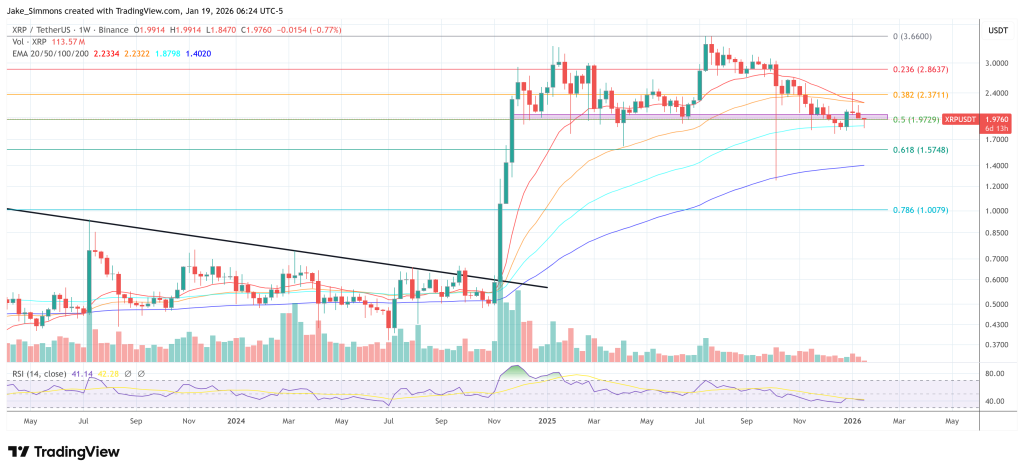
At press time, XRP traded at $1.976.