Ethereum Exchange Supply Plunges to 2016 Levels – Long-Term Holding Takes Over

Ethereum is vanishing from exchanges at a pace not seen since 2016. The trend signals a seismic shift in investor behavior—from trading to hoarding.
The Great Ethereum Exodus
Data doesn't lie. The amount of ETH sitting on centralized exchanges has been in a freefall, hitting lows last witnessed nearly a decade ago. This isn't a minor dip; it's a structural drain. Every coin pulled into cold storage is one less available for panic selling or speculative churn.
HODL Becomes the New Default
The narrative is flipping. The 'digital oil' narrative is giving way to a 'digital treasury' mindset. Investors aren't just betting on short-term price swings anymore—they're locking away ETH for staking, as collateral in DeFi, or simply as a long-term store of value. It’s a vote of confidence that bypasses the daily noise of the markets.
What's Left on the Table?
Scarcity on exchanges has a direct, mechanical impact. It cuts liquidity and amplifies price moves when buy or sell pressure hits. This thinning float makes the market more volatile, but also more susceptible to explosive upside if demand returns. It’s a classic setup that traditional finance would call ‘tightening supply’—though they’d probably charge a 2% management fee for the insight.
The bottom line? Ethereum’s journey from exchange wallets to private vaults is more than a metric—it’s a metamorphosis. The smart money isn't trading; it's building, staking, and waiting. The era of weak hands is closing, one withdrawal at a time.
Exchange Supply Declines Signal Structural Shift
The report highlights a pronounced decline in Ethereum’s Exchange Supply Ratio (ESR), reinforcing the view that supply dynamics are quietly shifting beneath the surface. Across all platforms, the ESR has fallen to approximately 0.137, one of its lowest readings since 2016.

This sustained drop reflects a steady outflow of ETH from exchanges into external wallets, signaling a reduced inclination toward immediate selling and a growing preference for long-term holding. Historically, similar patterns have emerged during re-accumulation phases or in transitional periods that follow extended volatility, often preceding more stable price behavior.
The trend is even more evident on Binance, where the ESR has declined to roughly 0.0325. As the exchange with the deepest liquidity, Binance’s balances serve as a key barometer for short-term supply conditions. The ongoing withdrawal of ETH from its wallets suggests a meaningful reduction in spot-side sellable supply, pointing to increased trader caution rather than aggressive distribution.
At the same time, Ethereum is trading near $2,960, a mid-range level that reflects a temporary equilibrium between buyers and sellers. The combination of falling exchange supply and relatively stable pricing indicates that the market is not under heavy selling pressure.
Instead, it appears to be entering a phase of liquidity absorption and strategic repositioning, where participants reduce exposure to short-term trades while preparing for a potential shift in market structure.
Ethereum Price Struggles Below Key Trend Levels
The daily ETH chart highlights a market that remains structurally fragile despite short-term stabilization. After failing to hold above the $3,200–$3,300 region, Ethereum has continued to print lower highs, confirming a loss of bullish momentum since late October. Price is currently trading around the $2,850–$2,900 area, a zone that has acted as a short-term demand pocket but lacks strong follow-through from buyers.
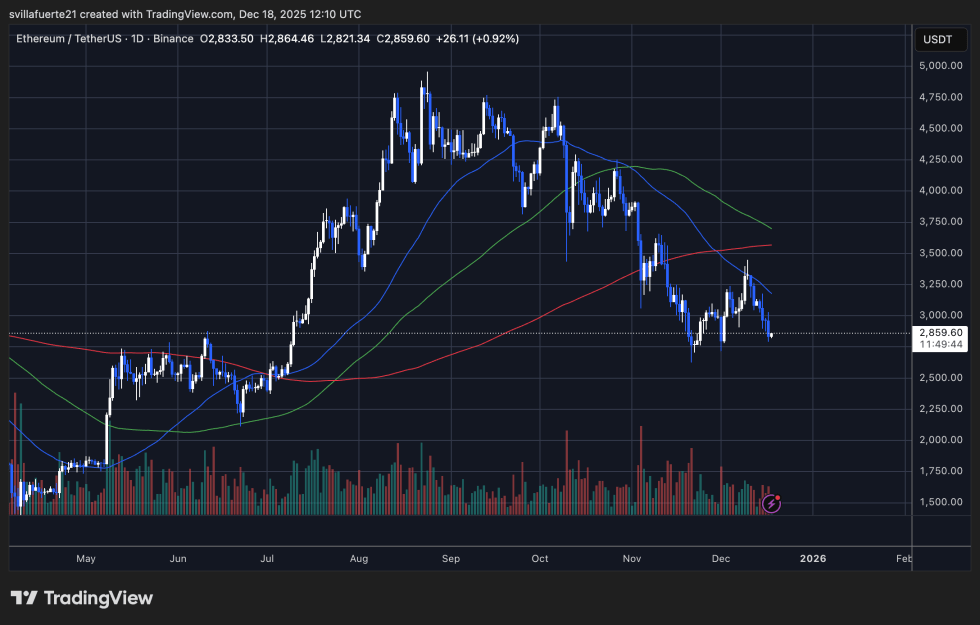
From a trend perspective, ETH remains below its short- and medium-term moving averages. The 50-day moving average has rolled over and is now acting as dynamic resistance, while the 100-day moving average is also trending lower.
The 200-day moving average sits higher, reinforcing the idea that Ethereum has shifted from a trending market into a corrective or distribution phase. As long as price remains capped below these levels, rallies are likely to be sold into rather than extended.
Volume dynamics reinforce this view. Recent rebounds have occurred on relatively muted volume compared to the heavy selling seen during prior breakdowns, suggesting reactive short covering rather than fresh demand.
Structurally, ETH needs to reclaim and hold above the $3,100–$3,200 range to rebuild a bullish case. Failure to do so keeps the risk tilted toward continued consolidation or a deeper corrective leg toward lower support levels.
Featured image from ChatGPT, chart from TradingView.com
