Cardano Shatters Governance Gridlock With New Constitutional Committee - What This Means for ADA’s Future

Cardano just pulled off a governance maneuver that could reshape its entire ecosystem.
The blockchain's long-standing decision-making paralysis has been cut through with the establishment of a new Constitutional Committee. This isn't just bureaucratic shuffling—it's a structural bypass designed to accelerate protocol upgrades and treasury allocations that were previously stuck in committee purgatory.
From Deadlock to Decisive Action
For months, Cardano's governance resembled a parliamentary filibuster. Proposals languished, community votes reached stalemates, and development timelines stretched. The new committee acts as a circuit-breaker—a smaller, accountable body empowered to interpret the network's constitution and make binding decisions on critical upgrades.
Think of it as moving from a town hall meeting to a specialized court. The community still proposes, but this committee ensures rulings get made.
The Mechanics of the Move
This isn't centralization in disguise. The committee's powers are constitutionally defined, its members are elected through Cardano's existing stake-based voting system, and its decisions remain transparent on-chain. The goal? To maintain decentralization while injecting operational velocity.
The immediate effect? Expect faster rollouts of Cardano Improvement Proposals (CIPs) and more agile treasury management. Projects waiting for funding won't need to watch governance tokens gather digital dust.
Why This Matters Beyond the Code
Governance isn't just technical—it's existential. Blockchains that can't adapt die. Ethereum's transition to proof-of-stake proved that. Cardano's move signals it's serious about competing in the smart contract arena where speed of iteration separates contenders from pretenders.
Investors have long criticized Cardano for being academically pristine but practically sluggish. This addresses that critique head-on.
The Cynical Finance Take
Let's be real—this is as much about market perception as protocol perfection. Nothing makes institutional money nervous like governance drama. Solving it checks a box for the compliance spreadsheets, even if the actual technical impact takes quarters to materialize. Sometimes blockchain progress is measured in PR victories as much as protocol upgrades.
Cardano's governance breakthrough isn't just about fixing internal processes—it's about proving a decentralized network can actually decide things. In a space where most projects promise revolutionary governance but deliver bureaucratic gridlock, that alone makes this committee worth watching. The real test? Whether faster decisions lead to better ones.
Why The Cardano Governance Was Stuck
Cardano’s governance model is tripartite: delegate representatives (DReps), stake pool operators (SPOs), and the Constitutional Committee. The CC plays a gatekeeping role: it judges whether on-chain actions are constitutional and ratifies decisions needed for the network to adapt.
That mechanism stalled after an unexpected mid-term departure left the CC below its minimum operational size. The Cardano Atlantic Council retired mid-term in epoch 597, opening a seat and reducing the committee below quorum. The consequence was that the Cardano CC could not ratify key actions, even as the chain continued to operate normally at the protocol level.
The vote asked DReps and SPOs to ratify a newly elected CC member and restore the committee to full capacity. The candidate, cardano Curia, was selected off-chain through a DRep vote using the Ekklesia tool, with on-chain ratification required to formalize the result.
The governance materials described the restoration as bringing the CC back to seven members and activating a clarified alternate-member process to handle future vacancies with less disruption. Approval thresholds were set at 67% from DReps and 51% support from SPOs. Intersect’s update indicates those thresholds were met as the epoch ended.
Why This Was Treated As Urgent
The vote was framed as more than housekeeping because an undersized CC effectively blocks major governance flows. Without quorum: Treasury withdrawals couldn’t proceed, the Critical Integrations Budget could not pass, hard forks could not be ratified, delaying network upgrades and several categories of governance actions were blocked, leaving only a limited subset able to MOVE forward.
There was also a timing element: delays risk actions expiring, which WOULD force a repeat of the voting process and extend the governance backlog. With the restoration ratified, Cardano’s governance process can resume normal throughput — reopening the path for upgrades, budget approvals, and protocol changes that depend on a functioning Constitutional Committee.
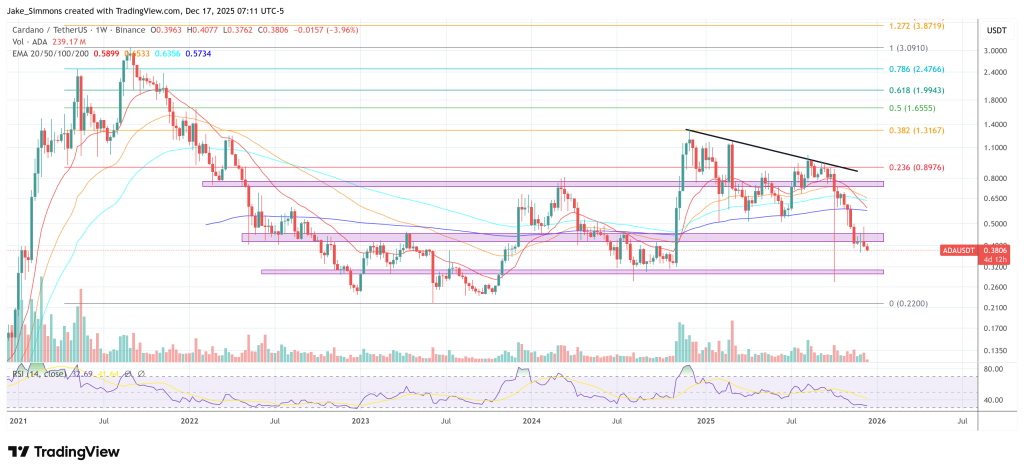
At press time, Cardano traded at $0.38.