Why Bitcoin’s Current Weakness Is Structural, Not Emotional: The 2025 Reality Check

Bitcoin's price action isn't just a mood swing—it's a fundamental reset.
Forget the fear, uncertainty, and doubt. The chatter about scared money and paper hands misses the point entirely. The current pressure on Bitcoin stems from its own architecture, a series of built-in constraints and market mechanics hitting a critical phase. This isn't sentiment; it's system design.
The Infrastructure Bottleneck
Network upgrades and scaling debates have moved from whiteboard proposals to live network stress tests. Transaction finality times and fee markets aren't abstract concepts anymore—they're tangible friction points for institutional adoption. The blockchain doesn't get emotional about congestion; it just gets slower.
Miner Economics Under the Microscope
The halving cycle's aftermath is a brutal arithmetic problem. When block rewards get cut in half, operational margins get squeezed to zero unless price appreciation perfectly offsets it. That's not panic selling; that's spreadsheets flashing red. Miners capitulate when their machines become money-losing appliances, not when they get spooked by a tweet.
The Liquidity Mirage
Exchange reserves tell a story of shallow depth. Large orders now move the market with an ease that suggests a foundation built on sand, not bedrock. This structural illiquidity amplifies every sell-off and mutes every rally. It's a market design flaw, not a loss of faith.
The takeaway? Stop blaming the traders. The weakness is coded in. Fixing it requires protocol-level changes and market maturation, not just waiting for everyone to 'HODL' harder. After all, in traditional finance, they'd call this a 'feature, not a bug' and charge you a management fee for it.
Futures Positioning And Sentiment Signal Deep Stress
Adler explains that the Bitcoin Positioning Index provides a clear view of who controls the derivatives market. The indicator aggregates changes in open interest and funding rates to identify the dominant direction of futures positioning.
At present, the index sits at -4, firmly in negative territory. This reading corresponds to a bearish regime and aligns with an active downtrend signal. Visually, the chart is dominated by purple bars over the past four weeks, highlighting sustained pressure from short positions and a lack of bullish conviction in derivatives markets.

Negative positioning combined with falling prices confirms that bears remain in control of short-term market dynamics. According to Adler, a meaningful regime shift will only occur if the index returns above zero and the price consolidates above local resistance levels. Without that confirmation, downside risk remains elevated.
The bitcoin Fear and Greed Index reinforces this bearish backdrop. The index, which tracks market sentiment from extreme fear to extreme greed, has fallen deep into the extreme fear zone and well below the 25th percentile.
The 30-day SMA has dropped to 20, while the 90-day SMA sits near 32, signaling persistent sentiment deterioration since September. While extreme fear alone does not guarantee a reversal, its alignment with negative futures positioning suggests that selling pressure is structural rather than purely emotional.
Bitcoin Tests Critical Support As Downtrend Persists
The chart shows Bitcoin trading under sustained technical pressure after failing to reclaim higher levels. Price has decisively broken below the medium-term moving averages and is now consolidating around the $87,000–$88,000 zone, a level that previously acted as support during the mid-cycle advance. The rejection from the blue moving average signals that bullish momentum has weakened significantly, while the downward slope confirms a loss of trend strength.
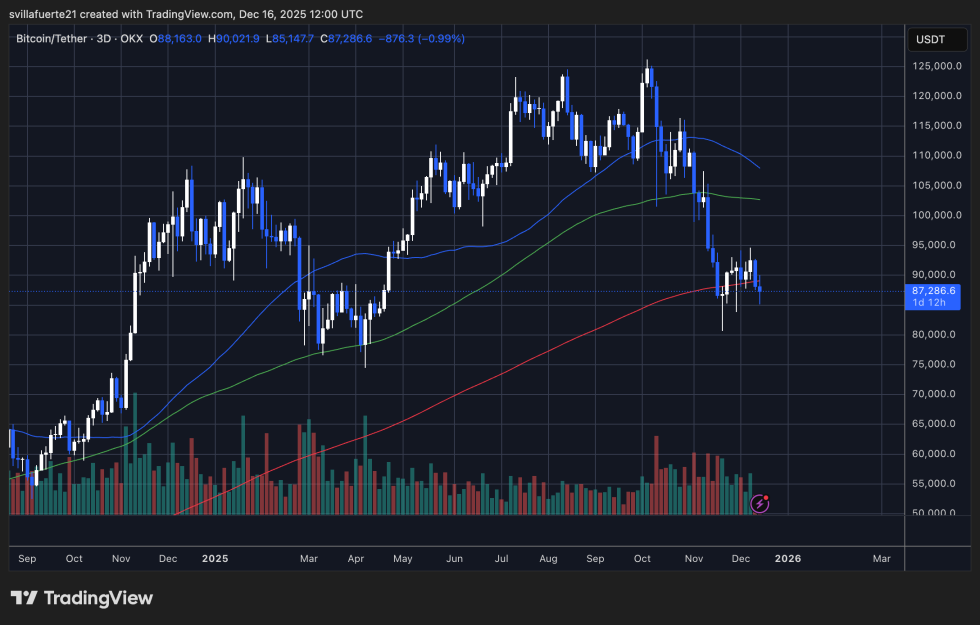
More importantly, Bitcoin is now hovering just above the red long-term moving average, a level that historically acts as a key structural support during broader corrections. The recent bounce from the $85,000–$86,000 area suggests that buyers are still present, but the response lacks conviction. Volume remains muted compared to earlier distribution phases, indicating hesitation rather than aggressive accumulation.
Structurally, the sequence of lower highs since the $120,000 peak remains intact. Until Bitcoin can reclaim the $92,000–$95,000 range and hold above the declining mid-term average, downside risks persist. A clean loss of the long-term support could expose deeper retracement levels toward the low $80,000s.
In the short term, this price behavior reflects a market in repair mode. Bitcoin is no longer trending, but it has not yet shown the strength required to invalidate the corrective structure.
Featured image from ChatGPT, chart from TradingView.com
