Bitfarms Bets Big on AI-Compute: Why This Pivot Could Dwarf Bitcoin Mining Profits

Bitfarms just dropped a bombshell—their AI-compute shift might leave Bitcoin mining in the dust. Here's why.
The AI Gold Rush
Forget pickaxes—Bitfarms is swapping crypto mining rigs for AI workloads. The pitch? Higher margins, less volatility, and a seat at the table of the next tech revolution.
Numbers Don't Lie (Unless They're Crypto)
While the original release played it coy on specifics, insiders hint the upside could make peak Bitcoin paydays look like a side hustle. Typical hedge fund reaction: 'We always believed in AI'—right after liquidating their BTC positions.
The Bottom Line
When a mining giant pivots this hard, it's either genius or desperation. Either way, the market's watching—and the suits are already recalculating their ROI models.
Bitfarms CEO Says Pivot To AI-Compute Business Could Out-Earn Bitcoin Mining
In a press release, bitcoin mining company Bitfarms has revealed plans to convert one of its facilities to support High-Performance Computing (HPC)/Artificial Intelligence (AI) workloads.
The mining site, located in the Washington State and drawing in 18 MW of power, will be upgraded with state-of-the-art liquid cooling to support Nvidia’s AI-infrastructure cards, GB300s. Bitfarms is targeting December 2026 for the facility’s conversion.
Established in 2017, Bitfarms has established itself as one of the largest miners on the Bitcoin network, but it appears that the company is now looking to MOVE to greener pastures.
BTC miners make income by adding blocks to the blockchain and receiving a combination of transaction fees and block subsidy as rewards. Revenue can be highly variable, however, depending upon network traffic conditions and the cryptocurrency’s price trend.
Also, miners face tough competition from their peers and since only one of them can grab the block reward at a time, which is dished out about every 10 minutes, it can be a battle to make away with a piece of the pie.
Ben Gagnon, Bitfarms CEO, thinks the GPU-as-a-service model can be more lucrative. As the CEO said in the press release,
Despite being less than 1% of our total developable portfolio, we believe that the conversion of just our Washington site to GPU-as-a-Service could potentially produce more net operating income than we have ever generated with Bitcoin mining.
The pivot to the HPC/AI business isn’t only for the Washington site, either, as Gagnon has revealed that the company is going to wind down its Bitcoin mining business over the course of 2026 and 2027.
As mentioned before, Bitcoin mining rewards are only given out in intervals of about 10 minutes. This happens because of the existence of a feature known as the Difficulty, which regulates the network’s toughness based on the speed at which miners are performing their duty.
If miners are producing blocks at an average time faster than 10 minutes, the network raises its Difficulty in the next biweekly adjustment. Similarly, it eases things up if miners aren’t able to hit the target time.
In October, Bitcoin miners rapidly expanded their facilities to a new all-time high (ATH), making them faster at their job, and forcing the blockchain to adjust the Difficulty to a new record as well.
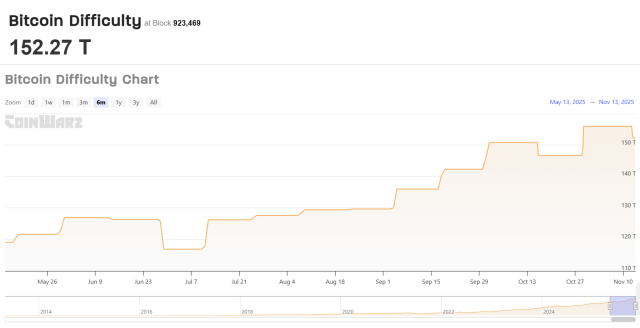
The latest adjustment, however, has brought with it a relief for the miners. As the above chart from CoinWarz shows, Difficulty has just seen a cooldown of about 2% from its ATH.
BTC Price
Bitcoin has continued its bearish momentum in the past day as its price has slipped to the $98,700 level.
