DeFi Under Fire: Senate Democrats Launch Aggressive Crackdown on Protocol Frontends

Washington declares war on decentralized finance interfaces—regulators claim they're closing the 'wild west' loophole that's been operating in plain sight.
The Regulatory Onslaught Begins
Senate Democrats are pushing sweeping legislation that would force DeFi frontends to implement traditional financial controls—KYC requirements, transaction monitoring, and compliance reporting. The move targets the very user interfaces that millions rely on to access decentralized protocols.
Financial Freedom vs. Regulatory Control
Proponents argue it's about preventing illicit finance and protecting consumers. Critics call it a direct assault on financial sovereignty—forcing centralized gatekeepers onto decentralized systems. The legislation would effectively treat frontend developers as financial institutions, complete with all the regulatory baggage.
Wall Street analysts are already salivating at the potential compliance contracts—because nothing says innovation like creating more paperwork for everyone.
The battle lines are drawn: either DeFi adapts to traditional finance's rules, or traditional finance adapts to DeFi's reality. Place your bets accordingly.
Democrats’ Proposal Raises National Security Concerns
Senate Banking Committee Democrats sent the proposal to Republicans, seeking to extend Know Your Customer (KYC) requirements to crypto frontends — including non-custodial wallets — while removing legal protections for developers.
Momentum had been building since the House passed the Digital Asset Market Clarity Act 294–134 in July. Senators Ruben Gallego, Andy Kim, Raphael Warnock, Angela Alsobrooks, Lisa Blunt Rochester, and Mark Warner support the new plan.
The proposal immediately drew sharp criticism from legal and policy experts in the industry. Jake Chervinsky, chief legal officer at Variant, said it “isn’t about establishing clear rules; it’s about banning an industry.”
“It doesn’t regulate crypto—it bans crypto. This is less a framework than an unprecedented, unconstitutional government takeover of an entire industry,” he added.
1/ Senate Democrats are trying to kill market structure.
A group just sent a counter-proposal to the RFIA and it is deeply unserious. These Senators claim to be pro-crypto, but what they propose is basically a crypto ban.
It's hard to imagine a good deal happening right now 🧵 https://t.co/yL5bDbdCvq
Former CFTC commissioner Summer Mersinger, now at the Blockchain Association, said the draft “would effectively outlaw decentralized finance in the United States.” She warned it could drive compliant developers overseas.
Industry sources said the draft’s language could cover nearly any entity ‘designing, deploying, or profiting from’ a DeFi frontend, making compliance nearly impossible. The move comes amid fiscal negotiations and a looming government funding deadline.
Observers warn that political strain could delay crypto legislation until mid-2026.
Market Reaction and Legislative Outlook
Analysts say the dispute exposes a deeper divide in priorities. The House promotes innovation through market clarity, while Senate Democrats focus on enforcement.
Zunera Mazhar, the Digital Chamber vice president, said the new draft is “heavy-handed, ineffective, and risks pushing innovation offshore.”
She added, “Good policy doesn’t punish decentralization. It protects consumers, preserves innovation, and fights illicit finance where it actually happens.”
🧵The new DEMS DeFi draft tries to fight illicit finance with outdated tools. It gives Treasury sweeping authority, narrowly defines decentralization, and treats front ends like financial intermediaries.
It’s heavy handed, ineffective, and risks pushing innovation offshore…
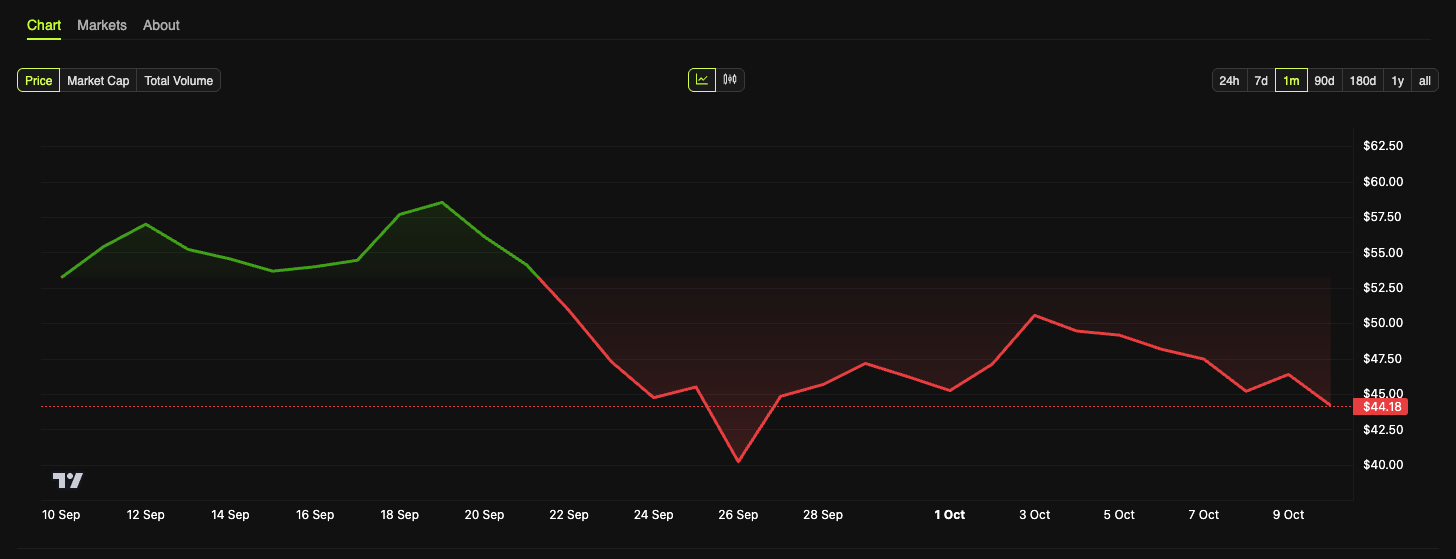
The market appeared to react to the regulatory uncertainty. On that day, based on CoinGecko’s DeFi coin aggregate, the DeFi market capitalization fell 3.4% from the previous day, settling at $164.1 billion.
Among the top-ranking coins, Hyperliquid (HYPE) recorded the steepest decline, dropping 5.5% to $44, followed by Astar (ASTR), which fell 10% to $1.7.
Analysts warn that ongoing gridlock could push liquidity and development toward Europe, where MiCA rules already define digital-asset oversight. Washington’s crypto ambitions remain stuck between control, compliance, and innovation.
