


Could the Midterm Elections Provide a Cushion for U.S. Stocks?
 BTCCAuthor: furrykon
The 2026 U.S. midterm elections have entered their final two-month countdown. After nearly two years of policy turbulence under Donald Trump, his administration is approaching its first major political test at the ballot box.
At the same time, the AI trade is increasingly crowded, long-term Treasury yields remain volatile at elevated levels, expectations for another rate hike are rising again, and the U.S.-Iran conflict continues to simmer. Against that backdrop, the midterms are more than a political contest — they could become an important catalyst for the repricing of global risk assets.
How might the elections affect markets, and how should investors assess the implications of different outcomes?
1. Midterm Elections Have Historically Been Positive for U.S. Stocks
Historical data suggest that midterm elections have generally been favorable for the U.S. equity market.
Since the collapse of the Bretton Woods system in 1973, the U.S. has held 13 midterm elections. Across 78 observations covering the three major U.S. stock indexes over 180-day and 365-day post-election windows, only three failed to generate positive returns. In most cases, stocks rose after the election.
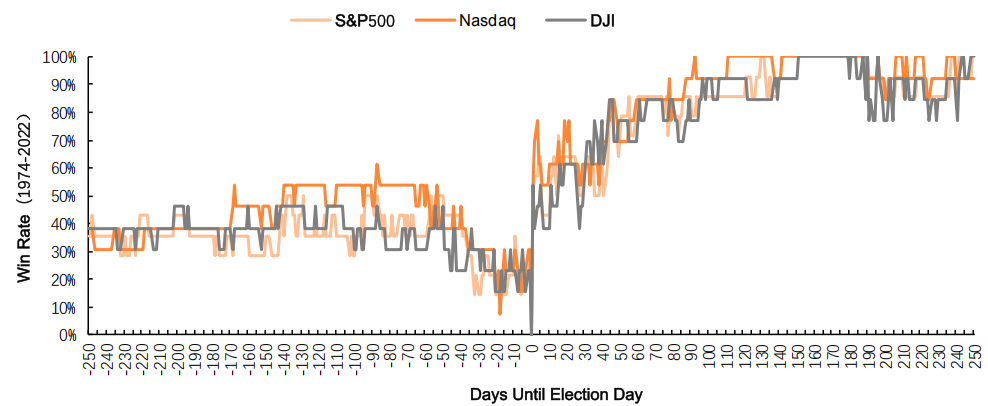
The positive midterm effect on equities can largely be explained through three channels.
Uncertainty Clears
In the 30 to 60 days before an election, markets typically worry about potential shifts in congressional control, tax policy, regulation and fiscal policy, pushing risk premiums higher. Once the election is over, regardless of the result, investors at least gain a clearer political framework. Risk appetite often improves as a result.
Divided Government Brings Stability
Historically, the president’s party tends to lose congressional seats in midterm elections and, in more severe cases, control of one or both chambers.
A divided government makes sweeping policy changes harder to enact. The probability of abrupt shifts in taxation, regulation and fiscal policy declines, often creating a more stable policy environment for financial markets.
The Presidential-Cycle Stimulus Effect
After the midterms, the president enters the third year of the four-year term, and markets often begin pricing in policy support ahead of the next presidential election.
Research suggests presidents have historically tended to expand fiscal deficits or introduce stimulus measures during their fourth year in an effort to win votes. Equity markets often begin reflecting those expectations during year three.
Together, these three channels form what is often described as the “midterm election effect”: political uncertainty weighs on markets before the vote, risk premiums decline once the outcome becomes clear, divided government reduces policy tail risks, and the next presidential-election cycle encourages expectations that policymakers will seek to support economic growth and asset-price stability.
2. Which Past Election Does 2026 Most Resemble?
From a political-structure perspective, 2026 most closely resembles 2018.
That year also featured a midterm election during a Trump presidency. Before the vote, Republicans controlled both the White House and Congress. After the election, Democrats regained control of the House while Republicans retained the Senate, shifting Washington from unified to divided government.
The current market baseline points toward a similar outcome.
The Trump administration is operating under the unusual combination of unified government and a president who cannot seek another term. Markets broadly expect Republicans could lose control of the House, restoring divided government. If that expectation proves correct, Trump’s ability to push through major policy initiatives would be constrained, while economic-policy stability could improve — potentially creating a more favorable backdrop for a rebound in U.S. equities.
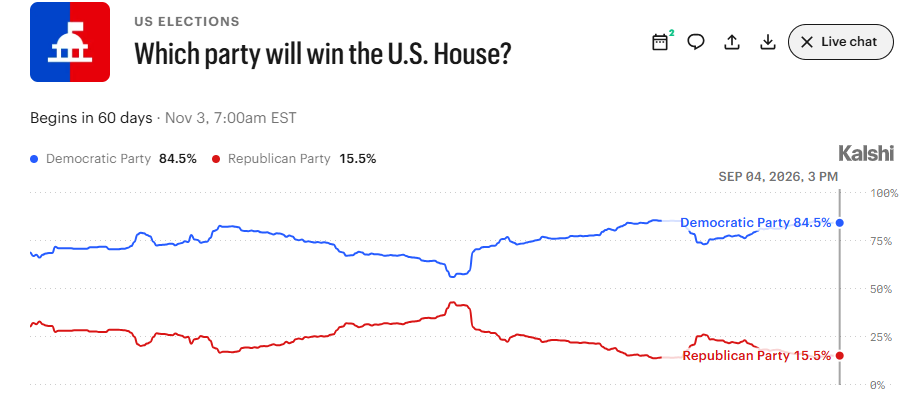
Even in the lower-probability scenario in which Republicans retain unified control, the result would more likely remove part of the expected bullish catalyst than create a genuinely new bearish shock.
The midterm effect could still benefit from the disappearance of political uncertainty and the presidential-cycle stimulus dynamic, providing some support for equities.
However, the election should be viewed more as a catalyst than a standalone driver. It may not independently generate a systemic market move. If high valuations, leverage, fiscal gridlock or other vulnerabilities are already present, the election effect cannot force markets to “swim against the tide.”
The historical midterm effect offers a probabilistic advantage in direction, not a guaranteed magnitude of gains — and certainly no immunity from black-swan events.
3. Could the Midterms Affect Crypto Markets?
Historically, the midterm effect has been most visible in U.S. equities, while Treasury bonds and the dollar have shown much less sensitivity.
Crypto, as a relatively young asset class, does not yet have enough historical observations to establish a reliable midterm-election pattern. But the mechanisms behind the effect suggest digital assets could still benefit.
The first channel is risk appetite.
If equities recover after the election, the VIX falls, and the dollar and Treasury yields stop climbing, BTC, ETH and crypto-related stocks would generally face a more favorable trading environment. Crypto has developed its own independent narratives, but in global asset allocation it is still frequently treated as a high-volatility risk asset.
The second channel is regulatory expectations.
The 2026 midterms are particularly important for the crypto industry because digital-asset companies and investors have become deeply involved in political donations and congressional lobbying.
Reuters reported that the crypto industry has committed nearly $200 million to the November midterms, aiming to advance legislation that would reshape the federal regulatory framework for digital assets. That effort builds on roughly $170 million spent by the industry in 2024 to support congressional candidates and secure favorable policy outcomes.
Bloomberg has also reported that crypto-linked political organizations had close to $180 million available ahead of the 2026 midterms, with the majority controlled by Fairshake. Its major backers include Coinbase, Ripple and Andreessen Horowitz.
One important distinction, however, is that the current governing party has generally supported crypto legislation, while Democrats have taken a more cautious stance.
Bloomberg Government has argued that if Democrats win a congressional majority in November, the crypto policy debate could shift away from market-structure legislation and toward greater oversight and investigation of major crypto companies, trading practices, investors and Trump-related crypto interests. Such a shift could complicate the industry’s most important legislative objectives.
The midterms, therefore, are not inherently bullish for crypto.
What helps crypto is greater regulatory certainty, institutional capital inflows and improving risk appetite. What hurts it is legislative gridlock, political investigations, regulatory reversals and tighter macro liquidity.
Conclusion: The Midterms Are a Cushion, Not a Free Pass
Under the baseline scenario, Republicans lose control of the House and the U.S. returns to divided government. That could reduce policy uncertainty, lower market risk premiums and provide support for U.S. stocks over the 180 to 365 days following the election.
But several risks could weaken the traditional midterm effect in 2026. Inflation, geopolitical conflict and an overcrowded AI trade could exert a more persistent influence on both equities and crypto assets. An unexpected reversal in sentiment or an external shock could trigger a rapid repricing of valuations.
For markets overall, the midterms are best understood as a clearing event for political uncertainty. They can improve the trading environment, but they cannot neutralize black-swan risks stemming from inflation, rate hikes, geopolitical conflict or concerns over an AI bubble.
This content is for informational and educational purposes only and does not constitute investment advice related to BTCC. BTCC makes every effort but cannot guarantee the truthfulness, accuracy, or originality of the content above.