


Bessent Pushes Yen Higher but Can't Hold Treasuries: Is He a Drag on US Stocks?
 Odaily
Original author: Long Yue
Original source: Wallstreetcn
US Treasury Secretary Bessent made consecutive moves this week: first, he issued a high-profile warning against shorting the yen, and the yen subsequently strengthened; then he significantly expanded the scale of Treasury buybacks in an attempt to cap long-end yields. The result: the yen rose, but Treasuries fell.
Each move has its own logic when viewed separately. Together, however, they pose a double threat to the nearly four-year bull market in US stocks—a stronger yen hits carry trades, while rising Treasury yields pressure valuations.
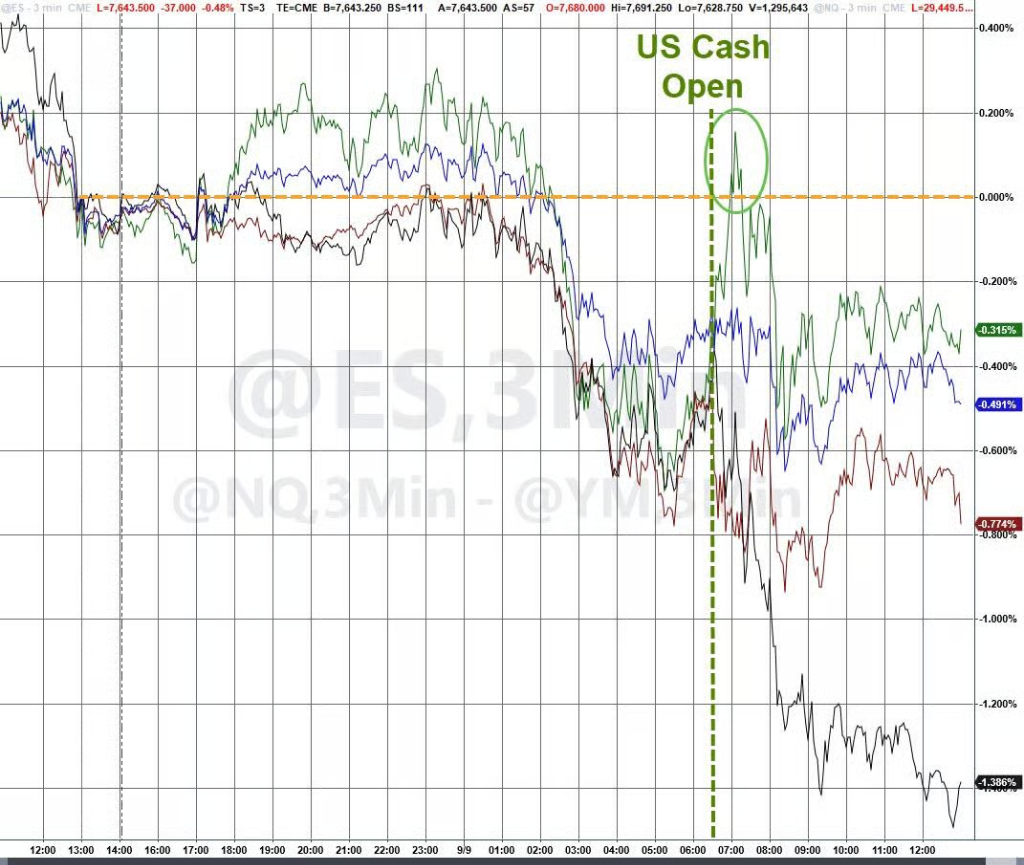
On Wednesday, September 9, 2026, US stocks fell for a third consecutive day. The Dow dropped more than 400 points, or 0.8%; the S&P 500 fell 0.5%; the Nasdaq declined 0.6%. AI tech stocks bore the brunt.
Treasury Buybacks: A 'Pea Shooter' the Market Rejects
On Wednesday, the US Treasury announced it would raise the cap on a single long-term Treasury buyback to $6 billion, tripling the originally planned size from last month.
But the market's reaction was: disappointment.
Bessent had previously hinted publicly that the buyback size could exceed $40 billion, and Wall Street had expected the single-operation cap to reach $80 billion to $100 billion. When the $6 billion figure came out, Treasury yields rose instead of falling.
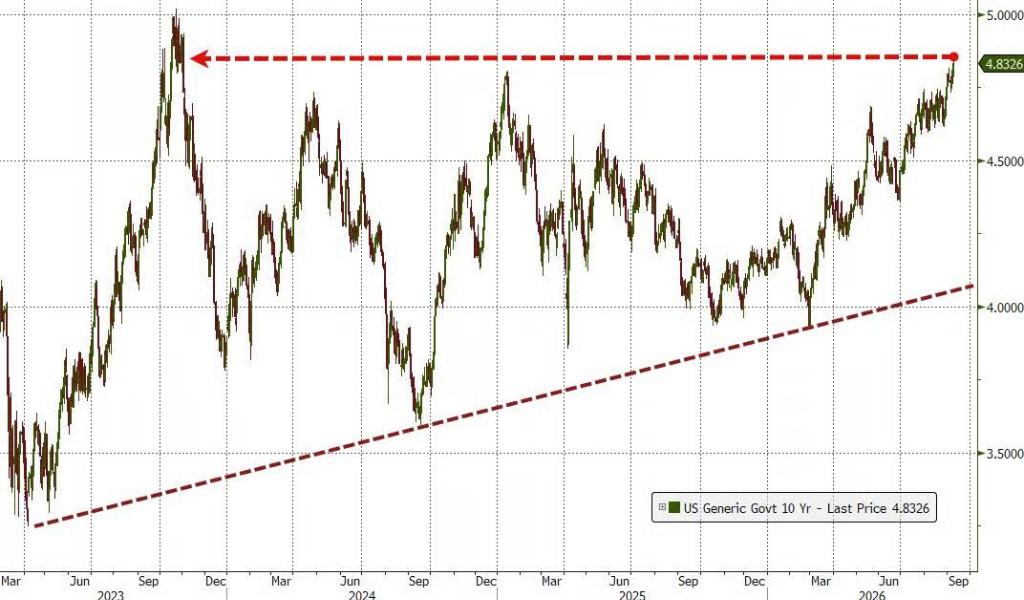
The 10-year Treasury yield touched 4.836% intraday, the highest since October 2023. The 30-year Treasury yield stood at 5.285%, approaching the 20-year peak of 5.30% hit last month.
Elias Haddad of Brown Brothers Harriman & Co. was blunt: "For now, the Treasury is bringing a pea shooter to a tank fight."
Deutsche Bank strategist Steven Zeng also said: "It's like the Treasury created a monster and now has to keep feeding it." He noted that the $6 billion announcement failed to deliver the "shock and awe" investors had hoped for.
Later on Wednesday, the Treasury auctioned $390 billion of 10-year notes at a yield of 4.834%, the highest yield on record for that maturity.
Dustin Reid, chief fixed income strategist at Mackenzie Investments, said: "It's still early days in terms of how they manage this situation. The Treasury certainly won't be too happy with today's market reaction."
Bessent Admits He Can't Control the 'Equilibrium' Price
Facing the market's strong reaction, Bessent acknowledged at an event in Texas on Tuesday that he cannot change the "equilibrium" price of Treasuries, and that his goal is only to slow the pace of price swings and prevent harmful narratives from taking hold and spreading.
He attributed the rapid rise in long-end rates to market panic over "America's inability to repay its debts," calling such concerns "absurd, but they became the dominant narrative for a time."
Wells Fargo macro strategists Angelo Manolatos and Francis Brown wrote in a research note that "other catalysts will be needed to push long-end yields lower," including slower growth and inflation, lower energy prices, reduced uncertainty about Federal Reserve policy, fiscal consolidation, or a contraction in corporate bond issuance.
The current reality is that none of these conditions are in place. High oil prices continue to push up inflation expectations, and the market is now pricing a 62% probability of a Fed rate hike at next week's FOMC meeting. Corporate bond issuance is also at a seasonal peak this week, with 18 borrowers tapping the market on Tuesday, making it the third-busiest trading day of the year.
"I'm the House"—He Talked Up the Yen, but at What Cost?
Just one day before the Treasury buyback hit a wall, Bessent issued a stern warning to yen short sellers at the same Texas event.
According to Bloomberg, he said: "I'm the house right now, so when we intervene in the yen, I know exactly what the Japanese, the Bank of Japan, and Japanese policymakers are going to do. If you want to bet against me, go ahead."
His confidence came from two sources: first, Bessent claimed he has insight into the moves of Japanese policymakers; second, the Bank of Japan is reportedly leaning toward raising its benchmark rate by 25 basis points this month.
The yen extended its gains on Wednesday, touching 153.49 per dollar intraday, after hitting its strongest level since February the previous day.

But the problem is: a stronger yen is not good news for US stocks.
The Yen Rises, and the Carry Trade 'Time Bomb' Starts Ticking
The yen has long been the world's cheapest funding currency. The typical carry trade logic is: borrow low-interest yen, convert it to dollars, and buy high-yielding assets like US tech stocks.
A stronger yen means the cost of this trade rises, and holders face pressure to unwind.
Steve Sosnick, chief strategist at Interactive Brokers, said the yen's current upward momentum "is already enough to shake some people who borrowed yen to make leveraged bets on high-flying US stocks."
Rich Privorotsky, head of Goldman Sachs' Delta-One desk, also noted that regardless of how one interprets Bessent's remarks, "the yen is objectively appreciating, and the market is betting on BOJ tightening and capital repatriation."
He then raised a key question: "What happens when yen carry trades unwind and capital flows back into Japanese bonds and stocks?"
His assessment: "The S&P and large-cap stocks overall feel inexplicably heavy, with no obvious fundamental reason. It's worth noting that some leveraged and carry positions may be quietly leaking out of the system."
Jordan Rizzuto, chief investment officer at GammaRoad Capital Partners, put it bluntly: "This is the biggest risk to the bull market."
Bessent's Dilemma: The Yen Can't Be Too Weak or Too Strong
There is an inherent contradiction here that is troubling Bessent's policy logic.
According to MarketWatch, Japan's holdings of foreign securities fell by nearly $880 billion at the end of August. Japan has long been a major holder of US Treasuries.
GammaRoad's Rizzuto noted that if Japan has been selling Treasury assets recently, it deserves close attention—because it comes right after the US and Japan jointly intervened in currency markets to support the yen. "It gives you a sense of the weight of these two things," he said.
The Treasury wants the yen strong enough so that Japan doesn't need to sell Treasuries to raise funds. But if the yen rises too sharply, a massive unwinding of carry trades would hit US tech stocks more directly.
Some traders are already privately wondering whether Bessent has the causality backwards—he hopes to ease pressure on long-end Treasuries by pushing the yen higher, but traditionally it is interest rate differentials that drive currency flows, not the other way around.

This content is for informational and educational purposes only and does not constitute investment advice related to BTCC. BTCC makes every effort but cannot guarantee the truthfulness, accuracy, or originality of the content above.