


ZEC Surges, Is NEAR Really Earning Passively? Data Check on the 'Pickaxe Seller' Narrative
 chaincatcher
Author: Little Cake
ZEC surged to $1,200 on Sept. 6, a 370% gain in three months. Grayscale's ZEC spot ETF (ZCSH) attracted over $460 million in assets within two weeks of launch, marking the most aggressive pricing correction for privacy coins in a decade.
However, the hottest trade discussion on Crypto Twitter skipped ZEC itself and pointed to a more refined logic: rather than guessing ZEC's next move at the $1,000 mark, buy the 'toll road' underneath it.
That road is called NEAR Intents.
Zashi Wallet and NEAR Intents: An Underestimated Pipeline
To understand this narrative, one must first recognize a key product component.
The Zashi wallet, developed by Electric Coin Company, is currently the most complete self-custody entry point in the ZEC ecosystem. In October 2025, Zashi launched 'Zashi Swaps', a cross-chain swap feature based on NEAR Intents, allowing users to directly swap assets like BTC, SOL, and USDC into shielded ZEC. Shortly after, the CrossPay feature was introduced, opening a payment channel from shielded ZEC to assets on any chain.
This means NEAR Intents is not only the 'on-ramp' for ZEC but also its 'off-ramp'.
Every cross-chain swap initiated from Zashi, regardless of direction, must pass through NEAR Intents' settlement layer.
On Feb. 23, 2026, NEAR Intents activated the 'fee switch'. From that day, all protocol-level fees are collected in NEAR tokens, and 100% of protocol fees are used to buy back NEAR on the open market. This forms a textbook value capture flywheel: higher trading volume leads to more fees, stronger buyback pressure, and reduced selling pressure on NEAR.
The transmission chain circulating on Twitter is as follows: ZEC demand rises → Zashi cross-chain swaps increase → NEAR Intents trading volume increases → protocol earns fees → fees buy back NEAR → NEAR forms structural buying pressure.
Data Verification
Let's verify this narrative with data.
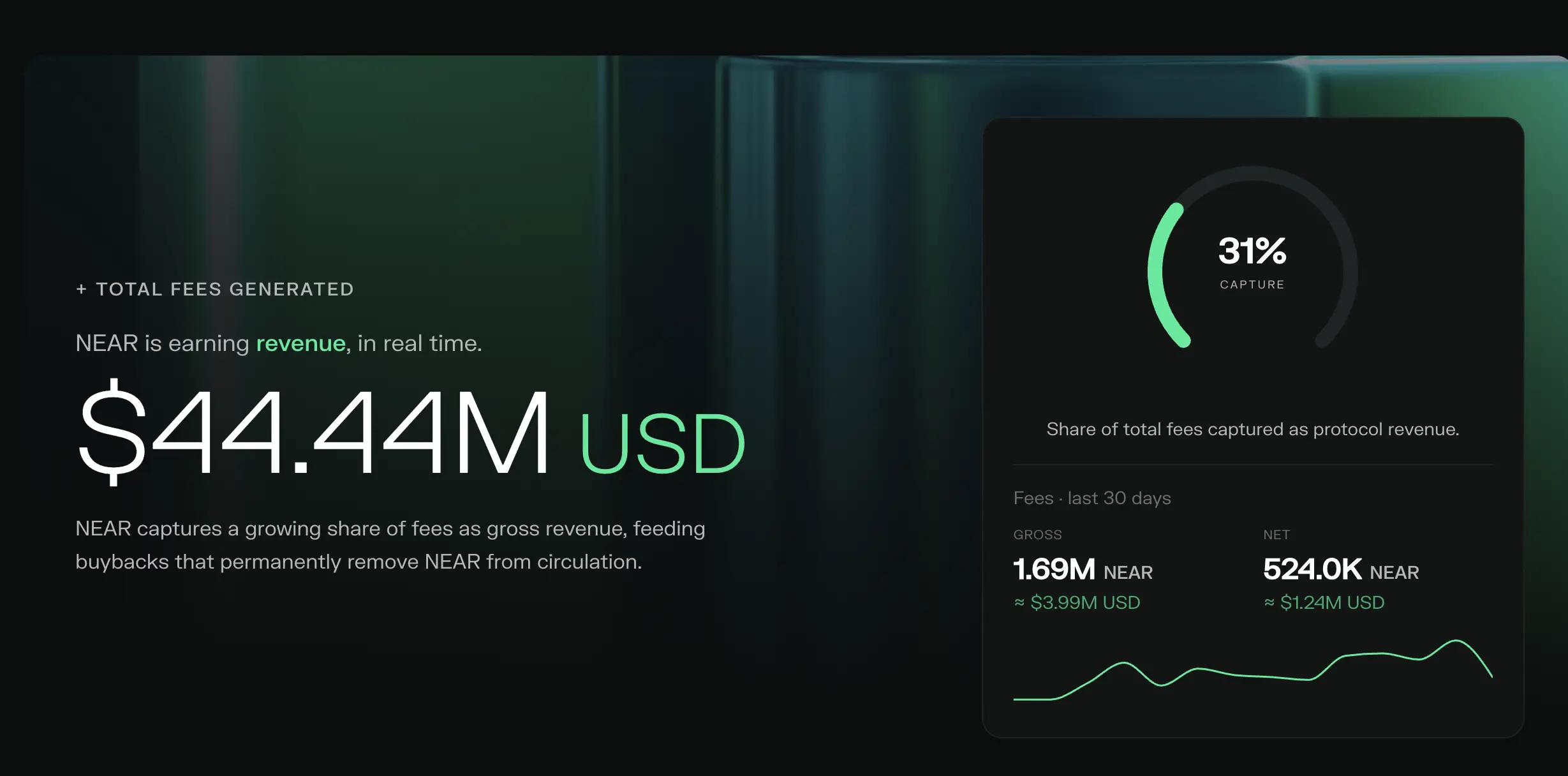
First, look at the totals. NEAR Intents' official data dashboard shows that as of early September, cumulative trading volume was approximately $27.6 billion, covering over 26 blockchains, generating about $45 million in fees, with 30-day trading volume around $3 billion.
Next, look at ZEC's share. Data from late 2025 shows ZEC trades accounted for about 10% of NEAR Intents' average daily trading volume, equivalent to roughly $15 million per day. However, CoinGecko trading pair data reveals a more aggressive reality: the USDT/ZEC pair on NEAR Intents currently accounts for 27.4% of total volume, and adding USDC/ZEC (7.1%), SOL/ZEC (2.5%), and ETH/ZEC (2.2%), ZEC-related pairs together account for nearly 40% of trading volume share.
The most critical link is value capture.
DefiLlama data shows NEAR Intents has generated $45 million in cumulative fees, but the 'protocol revenue' actually flowing into the treasury for NEAR buybacks is only about $5.51 million, with 30-day protocol revenue around $910,000, translating to a monthly buyback of about $900,000.
Early reports indicated monthly buybacks of about $3 million, which differs from DefiLlama's 'protocol revenue' metric. The source of the discrepancy is that most of the $45 million in fees went to solvers (market makers/settlement parties) and distribution channels (SwapKit alone exceeded $4.4 million, with Zashi contributing about $760,000), and only protocol-layer fees actually enter the NEAR buyback pool.
The Fate of the Pickaxe Seller Depends on How Long the Gold Mine Can Be Mined
The narrative of NEAR as ZEC's 'pickaxe seller' is logically sound.
The integration of Zashi wallet with NEAR Intents is a real product relationship, the buyback mechanism after the fee switch can be verified on-chain, and ZEC's share of NEAR Intents trading volume is indeed significant.
However, the transmission efficiency is actually far lower than what the community narrative implies, and it is highly dependent on the sustainability of ZEC's single-asset market performance.
If ZEC's ETF inflows maintain their current pace in the coming weeks, this transmission chain can continue to operate; if ZEC enters a period of high volatility or correction, NEAR Intents' trading volume distribution will expose a higher concentration risk than the 'multi-chain infrastructure' narrative suggests.
For traders, what really needs to be monitored is not just whether NEAR Intents' cumulative trading volume breaks $30 billion, but the trend of ZEC's share of that volume. If that ratio drops from 40% to below 15% while total volume continues to grow, then NEAR will have truly completed the narrative upgrade from 'ZEC's shadow' to 'cross-chain settlement infrastructure'.
This content is for informational and educational purposes only and does not constitute investment advice related to BTCC. BTCC makes every effort but cannot guarantee the truthfulness, accuracy, or originality of the content above.