


Debt Expansion, Currency Reshuffle: Arthur Hayes on the Biggest Beta Opportunity in Crypto
 Panewslab
Author:Arthur Hayes
Compiled by: Saoirse, Foresight News
On a Friday in the depths of Patagonian winter, I was doing what I love: backcountry ski touring. The annual Santa Rosa storm had dumped over a meter of snow on the high peaks, but it takes a few days of cold temperatures for the snowpack to stabilize and the avalanche danger to drop. The clouds lifted enough for decent visibility, and I managed a run down a south-facing bowl. In the Southern Hemisphere, south-facing slopes get the least sun, which means the best snow. It wasn't Japow (a popular ski term combining Japan and powder, referring to Japan's legendary dry powder), but it was the best snow I could find in August.
For financial markets, this Friday was special. Fed Chair Warsh (the author's sarcastic nickname for Fed Chair Kevin Warsh is "Weasel") was speaking in Jackson Hole, another ski town I love... Want to try Corbett's Couloir? But I had to stay focused; the snowpack was still unstable, and I was mentally rehearsing which escape route to take if I triggered an avalanche. Just moments earlier, my guide and I had discussed which slope to ski to reduce the angle and avalanche risk.
I'd rather spend my time skiing and surfing than "watching the markets." But as CIO of a family office, I have to make money—skiing is an expensive hobby. Given my lifestyle, I can only track one or two key price indicators to gauge whether the pace of fiat liquidity injection is accelerating or slowing. Based on those signals, I can instantly switch my portfolio to long or flat; I never short. These indicators change over time, and in this essay, I'll explain why my current macro anchor is the euro-yen exchange rate, EURJPY.
Before diving in, here's my call: by next June, EURJPY will fall from its current level of 185 to 140 or lower, and that will trigger a massive expansion of dollar liquidity. First, let me explain why I chose this indicator. In short, US Treasury Secretary Bessent (the author's mocking nickname for US Treasury Secretary Scott Bessent is "Buffalo Bill," describing him as tough and aggressive, stirring up global currency markets and forcibly reshaping the global exchange rate landscape) is the "serial killer" who wants to force US allies' currencies to appreciate against the dollar. In speech after speech, he has bluntly told the market his end goal, and in July-August of this year, he spelled out the means. Even though he wields enormous monetary and regulatory power to intervene in markets, the Treasury and FX markets are too large for him to permanently achieve his goals alone. He needs profit-seeking private investors to follow along. That's why he is so explicitly guiding the market: sell euros, buy yen.
The core thesis of this essay: behind Bessent's actions is a logically coherent strategy. I admit I'm giving him some credit here—sometimes you have to flatter the guy in charge of the printing press. Most global politicians are reactive, only care about the next election, and lack long-term strategy. But even if Bessent's decisions are pure guesswork, the chain reactions he triggers, regardless of intent, will serve the goals of the "Pax Americana" order.
Make America Great Again
The most brilliant political slogan in history—it's both empty and all-encompassing. Make America great again for whom? When was America ever great? Before the mid-20th century, "greatness" belonged only to white male property owners; everyone else had it bad. So which era are we going back to? It exploits misplaced nostalgia and panders to intellectual laziness. A perfect slogan—everyone can imagine themselves as a winner.
I've said it before and I'll say it again: the Trump administration, and whichever party takes power after 2028, wants to restore America's industrial economy to its 1945-1980 glory days. After 1980, first Japan, then China-led Asian emerging economies including South Korea and Taiwan, became the manufacturing hubs for the world's major goods. Conceptually, any country pursuing this mercantilist model must adopt the same policy mix: erect tariff barriers to block foreign goods while devaluing its currency against major trading partners.
America's real rival is China, which executes this playbook with great skill. US companies find it very hard to enter the Chinese market; once the powers that be in America decide the economy can withstand the cost of decoupling, the US market will also close its doors to Chinese companies. So the most important economic battleground becomes: from whom will Europe import goods? Europe is the second-largest economy after the US and can absorb either American or Chinese exports. For America to win the European market, several conditions must be met: the dollar must be weaker than the euro; EU member states must act independently rather than in unison, making them easier to divide and conquer; and the dollar must also weaken against other Asian economies' currencies, including the yen, won, and New Taiwan dollar.
Earlier I mentioned that EURJPY will fall due to Bessent's operations—how does that square with a weaker dollar against the euro?
To break Europe, you must first weaken Germany. The euro mechanism allows Germany to effectively undervalue the Deutsche Mark against other member states, prospering through exports—that was the economic price of German reunification. As a result, Germany has accumulated a massive net investment position, on par with China and Japan, the two most successful mercantilist economies since WWII. To compete effectively with Germany in the European market, the dollar must depreciate against the "nominal or de facto Deutsche Mark." Either Germany leaves the euro, or France effectively leaves the euro. The euro was flawed from birth. But what will truly push this fake currency system to its end is European internal politics, combined with market pressure from Japan on European government bond markets.
A few weeks ago, Bessent used the Exchange Stabilization Fund (ESF) to directly sell euros and buy yen, officially sounding the charge. As a profit-seeking private investor, I naturally follow his lead. Next, I'll explain why the euro will soon collapse, with some charts.
What Exactly Is the Euro?
The euro is essentially a quid pro quo. Germany promised to keep a low military posture; in exchange, German goods could be dumped tariff-free into other European markets. The system generally achieves balance, but under a single currency, German export prices don't appreciate, while the German banking system accumulates massive euro surpluses. Germany's export earnings must find investment destinations, so it lends to its trading partners so they can keep buying German goods. That's why Greece could borrow at rates close to Germany's. The imbalance shows up in the Target2 clearing system: German banks are net creditors, while banks in the rest of Europe are debtors. Thanks to this euro quid pro quo, Germany became wealthy—even one of France's largest creditors. France's generous welfare system also depends on the euro and the common market. These two points are crucial later.
It's not that Germans are inherently frugal and other Europeans lazy. Germany's claims correspond to France's debts—it's just an accounting identity, nothing to do with national culture. Money and trade flows shape social culture, not the other way around.
The structural problem with the euro is this: when imbalances reach a tipping point, people want their national sovereignty back. Germans want the government to spend more and strengthen labor rights; people in other European countries want their jobs back and an end to the boom-bust cycle driven by German bank credit.
EU elites and the ECB will never allow the people of Germany, France, and others to put national interests first, because that would strip them of power. That's why nationalist-first parties on both left and right are the bête noire of Brussels, and the centrists will do whatever it takes to suppress the people's right to choose.
First Down, Then Up
France is Europe's second-largest economy, yet its credit profile is already the worst in Europe. The behavior of French domestic savers confirms this.
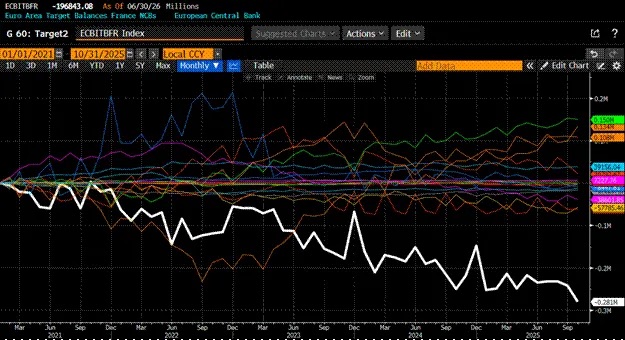
The first chart shows Target2 balances since 2021. France (white line) started as a net creditor, meaning more euros from other European countries flowed into French banks than French capital flowed out. But in 2021 the trend reversed, and France became the largest debtor in the Target2 system. French savers and other European investors are pulling euros out of French banks and moving them elsewhere in the eurozone. Why is this happening?
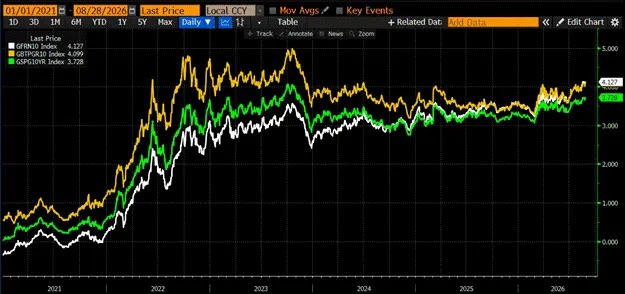
The second chart shows 10-year government bond yields for France, Spain, and Italy. Spain and Italy have always been the weak large economies of the eurozone, but France's 10-year yield has deteriorated from its former strong position to the worst performer among eurozone sovereign bonds.
French government spending is about 60% of GDP—only Finland has a higher government share. France needs to borrow huge sums every year to cover its widening fiscal deficit, pushing yields higher.
Making matters worse: France's deficit financing increasingly relies on foreign hot money, mainly from Germany and Japan.
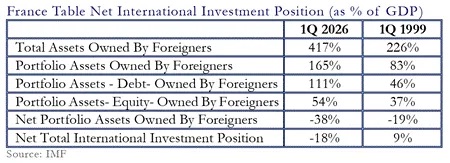
The core political question: do the French want a bigger or smaller government? Across the political spectrum, the French generally believe the problem is that the government isn't doing enough. Remember, when Macron merely tried to delay the retirement age slightly, it triggered nationwide strikes that paralyzed society. In the 2027 presidential election, far-left candidate Jean-Luc Mélenchon is polling second, behind only Marine Le Pen. On August 25, 2025, after French Finance Minister Bayrou's speech, he made remarks about foreign debt:
"Don't create panic by hyping a French crisis. Three trillion in debt, 60% held by foreign investors. Make them fear France. If they try to short and destroy France, they will pay the price themselves."
After reading that, can you blame French and European savers for rushing to pull their capital out? To maintain the level of government spending the public expects, France will ultimately have to impose capital controls and financial repression.
Bessent has lit the fuse on this powder keg, and next year all the contradictions will explode. Schrödinger's euro will emerge from the flames.
Japan: The Fuse
In my essay "Yen-Quake," I wrote that the Bank of Japan is reluctant to raise rates. The bureaucracy doesn't want to bear the book losses and public criticism from a stronger yen. So the Japanese government will persuade its private and quasi-official institutions (Japanese corporate groups) to sell overseas assets and repatriate capital, pushing the yen higher. The problem is that the largest share of Japan's overseas assets is US assets. America will not allow one of its biggest creditors to dump Treasuries just to solve Japan's domestic problems. South Korea is experiencing this reality right now: Trump is scaling back US-South Korea military exercises and diverting THAAD interceptor missiles originally destined for South Korea to the Middle East. The subtext: if you don't follow US orders, face China alone. Due to historical geopolitical concerns, Japan, South Korea, Taiwan, and most North Asian economies choose to comply with the US rather than make other choices. I don't think a hot war would break out in North Asia without US troops stationed there, but historical animosities and real fears exist and deeply influence current economic and political decisions.
Bessent offered a solution: Japan, South Korea, Taiwan, and other compliant Asian exporters don't need to dump Treasuries directly; they can swap their Treasuries for dollars through the Fed's FIMA repo facility. To maintain US geostrategic interests, Bessent and the Fed are willing to fire up the printing press to avoid a disorderly collapse of the monetary system built after the 1998 Asian financial crisis. I suspect that if China were willing to accept US competition rules in some trade areas, Trump would even offer China the same facility. But China abandoning its mercantilist policies would upset deeply entrenched domestic interest groups—impossible in reality.
European assets then become the second-largest pool that Japan and other Asian exporters can sell. Bessent directly used the ESF to sell euros and buy yen, completing the yen intervention without even notifying the ECB in advance, breaking diplomatic norms among central banks. Trump simultaneously wields the stick, making clear to Asian countries under the security umbrella what happens if they disobey. South Korea is being disciplined precisely because it refused to deeply engage in the US confrontation with Iran. Later this month, Xi will visit the US—Trump's words and actions will be worth watching.
Although there is no official breakdown of "which country sold which assets on which day," we can observe the market performance of French government bonds after Japan's Finance Ministry official Katayama publicly demanded on July 10 that Japanese corporate groups repatriate capital.
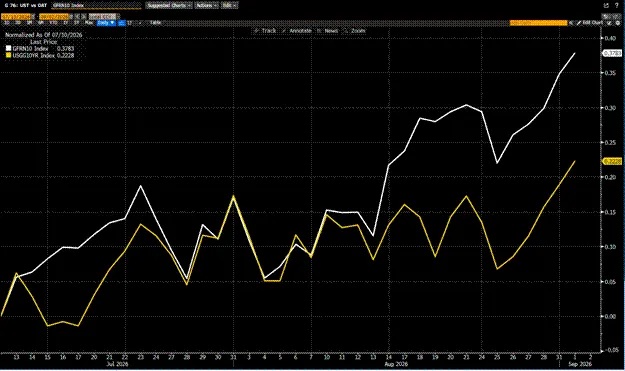
French 10-year OAT yields rose 38 basis points, while US 10-year Treasury yields rose only 22 basis points over the same period. Japanese institutions, under orders, went from marginal buyers of French bonds to sellers—and the French market can least afford selling right now.
It's not just French government bonds: about 71% of French banking sector debt is held by foreign investors, and that will also be sold.
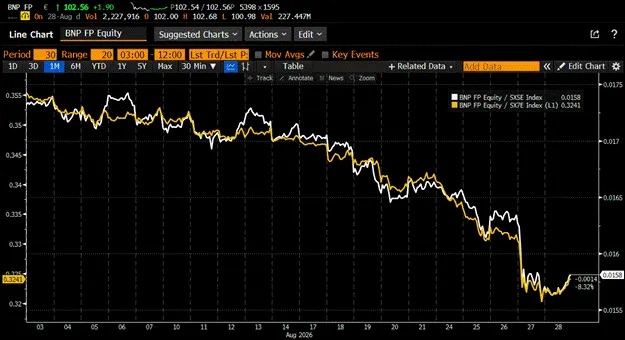
Look at the performance of BNP Paribas, France's largest bank, relative to the Euro Stoxx index and the Euro Stoxx Banks index. BNP Paribas is a global systemically important bank (GSIB) and a very important funding source for US hedge funds—more on that later. Its stock already performed poorly in August; as foreign investors dump its debt and depositors move funds to Germany and Switzerland as much as possible, its situation will only worsen.
It didn't have to come to this. The ECB has designed various money-printing tools to smooth out market pricing of bonds if prices threaten the euro's survival. But the ECB imposes political conditions on member states before it will step in. For France: do you accept that Brussels' power outranks Paris? If yes, the ECB will print euros to absorb foreign selling; if no, the ECB will stand by and let the market clear freely.
The ECB hopes Macron's successor will also obey Brussels—current ECB President Christine Lagarde is even a potential candidate. Imagine her moving into the Élysée Palace. French voters are extremely averse to that future. So voters lean left or right, and both camps advocate French national interests first.
The ECB believes it can create panic to force French voters to elect the "right" candidate. By letting French government bonds and the banking system collapse under foreign selling pressure, it aims to scare the public into ceding sovereignty to the EU to escape the pain. In 2011, the ECB successfully ran this playbook in Greece: Syriza's platform could have pushed Greece out of the euro, but the ECB manufactured enough fear that Greek voters ultimately accepted austerity and let Draghi impose a brutal bailout. But young French people have gone on strike over pensions—I don't think the ECB can scare the French into accepting austerity.
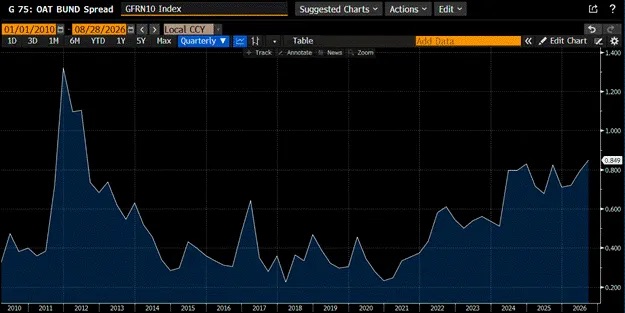
The longer the ECB delays rescuing France, the wider the spread between French OATs and German bunds—already at the widest since the 2011 eurozone debt crisis. Unless the TPI (Transmission Protection Instrument) money-printing tool is activated, French bonds will keep underperforming.
By the time the French presidential election concludes next May, all the contradictions will converge and the situation will explode.
Schrödinger's Euro
How do you stay in the eurozone while effectively leaving the euro?
Even if the public chants "France first," "Germany first," "Italy first," people are not psychologically ready to fully exit the euro. The ECB's scare narrative and flawed economics have taken deep root. So the Banque de France will take a soft exit path from the euro: print bank reserves to backstop domestic government and bank bonds.
The full logic chain: Problem: foreign investors keep selling bonds, yields keep rising. Solution: if the ECB refuses to act, the Banque de France breaks the rules, prints bank reserves, and buys domestic government and bank bonds in the open market, putting them on its balance sheet. That's quantitative easing (QE), which the ECB explicitly prohibits.
Capital controls? Capital controls are essential. If capital can flow freely out of France, QE would just turn domestic savings into foreign assets—pointless. Once capital outflows are restricted, the government will force funds into "compliant financial assets," theoretically boosting the French domestic economy.
Impact on the euro: France effectively devalues its currency, creating a "French euro"—the livre-euro. This currency circulates only within France, and whether it can be exchanged for foreign currency depends entirely on Banque de France approval. Like other controlled economies, exporters can apply for cross-border fund flows only with genuine invoices.
Currency devaluation gives French goods a price advantage over other eurozone members. As the eurozone's second-largest core economy, once France does this, all other members except Germany and a few Nordic countries will follow suit. Under this "Schrödinger's euro" system, every country can devalue in disguise. Germany continues to play by the old rules but ends up holding Europe's strongest currency—the Deutsche Mark returns.
The euro dies, replaced by Schrödinger's euro. But this still doesn't explain Fed money printing. This system explains why EURJPY falls, but to achieve US export goals, the dollar must also weaken against both the euro and the yen. I explained the dollar-yen weakening logic in "Yen-quake"; now let's see how Schrödinger's euro forces the Fed to expand its balance sheet to support the Treasury repo market.
How Do You Say "Repo" in French?
Fed Chair Warsh is ostensibly a monetary hawk. In his Jackson Hole speech, he reiterated his goal of bringing inflation down to 2% (government measure, not the inflation ordinary people feel) and previously said the Fed's balance sheet is too large. But for crypto to have a true bull market, the Fed needs to accelerate money printing. The Fed needs a respectable excuse—some economic theory detached from reality—to claim that expanding its balance sheet to buy bonds won't cause inflation. The easiest place to see money-printing expansion is in the tools it's already running.
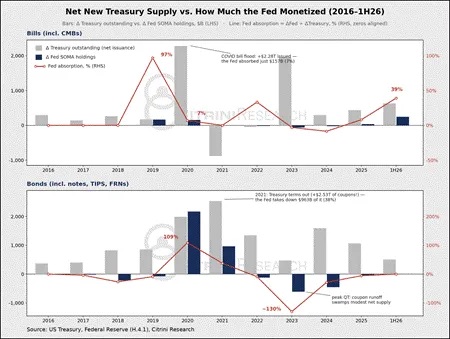
The Fed has now absorbed 39% of short-term Treasury issuance, compared with zero at the end of 2024. Simply put, the Fed has fired up the printing press and is financing nearly half of Bessent's short-term debt issuance. This RMP (Reserve Management Purchases) tool launched last December. So how does the market force the Fed to print even more?
Trigger: large banks reduce their lending in the repo market.
Are there distressed banks with a huge share of the repo market? Yes—French GSIBs led by BNP Paribas. As discussed, their debt is highly dependent on foreign investors, and their operating capacity will be severely hit. BNP Paribas's weak stock price is a leading signal of credit stress and accelerating deposit outflows. France's worsening Target2 deficit confirms this.
How big is the French GSIB share of the repo market? US Treasury OFR money fund monitoring data shows that BNP Paribas, Crédit Agricole, and Société Générale together account for about 20% of repo market lending—a massive share. Once they cut lending, marginal repo rates will spike and bond financing costs will swing violently.
Uncertainty is the enemy of hedge fund relative value strategies. These funds use heavy leverage to capture tiny spreads between cash Treasuries and derivatives. If they can't be sure of financing at SOFR or lower, risk managers will force them to deleverage and cut positions. Hedge funds are the most important marginal buyers of Treasuries; if they buy less, the cost of rolling Bessent's short-term debt will soar. That is absolutely unacceptable. So the New York Fed will dramatically expand RMP purchases to fill the gap left by French banks exiting the repo market.
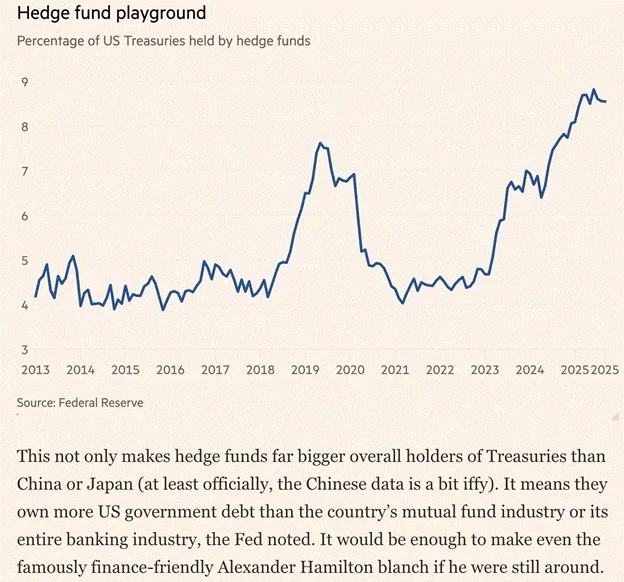
Source: Financial Times
So Warsh can talk about shrinking the balance sheet all he wants—reality makes it impossible. Don't listen to what he says; the funding needs of the Treasury market dictate that RMP purchases must continue.
How big will the money printing be?
It depends on Bessent's Treasury buyback program and how aggressively he uses the Treasury General Account (TGA) to buy long-end bonds. If long-end yields stay high and Bessent ramps up long-end purchases, the Fed's balance sheet expansion could approach $100 billion per month. Since December 2026, the average monthly expansion has been about $22 billion.
A quote from Bessent lays bare his game:
"Everyone has bad information, and I have asymmetric information. So the market should ask: why did we intervene in the currency market together with Japan? Do we know something the market doesn't? In the bond market, we are willing to implement a so-called Treasury twist operation. What do I know that the market doesn't?"
Sounds like a crypto speculator bragging about manipulating the market to pump a shitcoin. His push for crypto regulatory legislation may not succeed, but Trump is arguably the first US president with the temperament of a crypto speculator—you can see it in his staff's rhetoric.
Bessent wouldn't be this arrogant if he weren't certain the Fed can ramp up RMP money printing at any time to backstop the repo market. So I completely ignore Warsh's public statements. If you listen to his spin and lose money, you have only yourself to blame.
The beauty of this RMP mechanism is that it injects liquidity directly into the market in the short term. French bank stocks already started selling off last month. As investors connect the dots and the French election approaches, these banks' credit will take a beating. The ECB welcomes the pain, hoping voters will reject left- and right-wing nationalist candidates because of it. The signal that the crisis is erupting will be a sharp drop in EURJPY. So EURJPY is the early warning system for imminent short-term dollar liquidity expansion.
Victory Day
Bessent's goal is to bring about this Schrödinger's euro scenario. No country needs to formally exit the euro; each country, acting in its own self-interest, launches its own QE to backstop its bond market. In the end, Germany is isolated, holding Europe's strongest currency.
Amid the eurozone chaos, Bessent and Lutnick (Howard Lutnick, current US Secretary of Commerce, former Cantor Fitzgerald Wall Street heavyweight, major supporter of Bitcoin and Tether, leading US tariff and trade policy) can strike bilateral trade deals with European countries one by one. The dollar weakens as the Fed's RMP purchases and FIMA repo facility inject dollars, and dollar depreciation massively boosts US exports. The euro-yen trade is set. Yacht party time.
Trading Strategy
If you can, buy EURJPY put options. We're looking at listed options, but liquidity is very poor. Even without direct positioning, I get indirect EURJPY volatility exposure through my investment in David Dredge's Convex Asia volatility fund. If you have an ISDA agreement with a bank, you can go for it. But my experience is that with OTC derivatives at investment banks, the door in is big, but the door out is small.
For crypto speculators, we have the best asset to capture the dividends of Bessent's plan. Money printing will come from two sources. First, as I wrote in "Yen-quake": once the Fed lifts the counterparty limit on the FIMA repo facility, the Fed can release trillions of dollars, giving US allies dollar liquidity without selling Treasuries. Japan will be the biggest user, which is why the yen is strengthening. Second, the core of this essay: French banks get into trouble and exit the repo market, forcing the Fed to expand RMP and print money to finance the US government. Use EURJPY as the alarm signal—when it crashes, it signals French banks are about to blow up and the Fed will step in to keep the Treasury market functioning.
Maelstrom's favored crypto assets haven't changed. Long Bitcoin remains the cornerstone of the portfolio. The 2026 short-term speculative targets remain Ether (target $10,000), Ethena (target $0.50), and Ether.fi (target $2). Where did my Zcash go? No idea—maybe AI stole it from the mining pool.
Listen up: Bessent is playing for real. After a day of skiing wet snow in Patagonia, it's time to make money and enjoy life.
This content is for informational and educational purposes only and does not constitute investment advice related to BTCC. BTCC makes every effort but cannot guarantee the truthfulness, accuracy, or originality of the content above.