Elixir Games: The Web3 Gaming Platform Revolutionizing PC Gaming

Web3 gaming just leveled up—Elixir Games launches its PC-integrated platform, bridging traditional gaming with blockchain technology.
The Seamless Integration
Gamers can now access Web3 titles directly through their existing PC libraries—no clunky extra installations or confusing crypto setups required. The platform bypasses traditional gaming storefronts, putting ownership back in players' hands through NFT assets and tokenized rewards.
Why This Changes Everything
Elixir's approach cuts through the typical Web3 complexity that scares away mainstream gamers. Imagine earning actual value for your gaming achievements while Wall Street analysts still struggle to explain what an NFT actually does.
Traditional gaming meets decentralized finance—and honestly, your gaming rig might soon be more profitable than your retirement portfolio.
Elevate Your Investing Strategy:
- Take advantage of TipRanks Premium at 50% off! Unlock powerful investing tools, advanced data, and expert analyst insights to help you invest with confidence.
The three firms brought together an advance in the STAC-M3 benchmark, which is intended to provide an edge in high-frequency quantitative trading. Delivering better performance on this front can generate a direct improvement in trading profits, so for Intel to have a hand in this is, undoubtedly, welcome.
Supermicro supplied its Petascale servers, and Micron brought its 9550 solid-state drives along with DDR5 memory. Intel kicked in the Xeon 6 processors, a MOVE which should help give Intel’s processors a brand-new credibility in the market. That is something Intel very much needs right now, considering how much market share Intel has lost to its various competitors over the last few years.
Why Lip-Bu Tan Got Involved
Meanwhile, Intel’s newest CEO, Lip-Bu Tan, got more personally involved, revealing why he had joined Intel to begin with. He noted that his plan was to “refocus” the chipmaker, putting a particular emphasis on engineering. Intel had “…too many layers of management,” Tan revealed, and set about flattening the company’s org chart, as well as removing large portions of it altogether.
In the place of all that management, Tan has focused on advancing Intel’s position in artificial intelligence—which had been lagging the market for quite some time—as well as improving the foundry business, which received quite a bit in the way of investment, but did not deliver much in return. At least, not yet.
Is Intel a Buy, Hold or Sell?
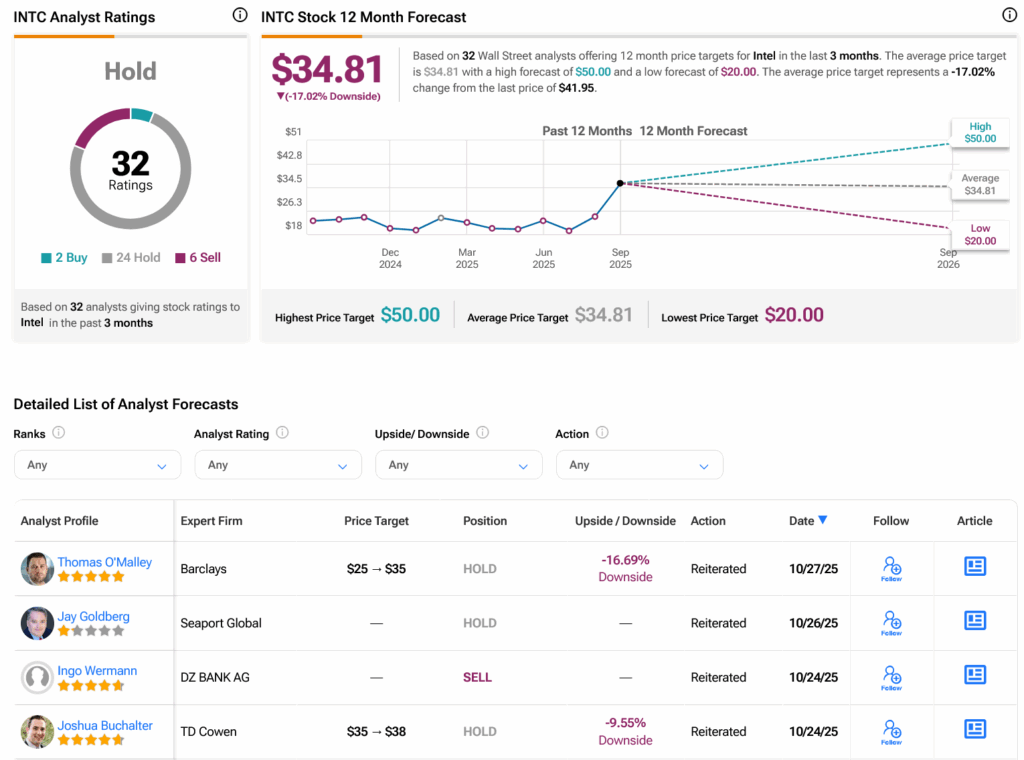
Turning to Wall Street, analysts have a Hold consensus rating on INTC stock based on two Buys, 24 Holds and six Sells assigned in the past three months, as indicated by the graphic below. After a 72.66% rally in its share price over the past year, the average INTC price target of $34.81 per share implies 17.02% downside risk.
Disclosure
