Tesla’s Electric Vehicle Empire Faces Shakeup: 86% of Earnings May Soon Come From This Unexpected Source
Elon Musk's automotive giant Tesla might be steering toward an unexpected revenue revolution—and it's not about selling more cars.
The Shifting Revenue Engine
While Tesla continues to dominate electric vehicle sales, insiders suggest a staggering 86% of future earnings could emerge from a completely different sector. This isn't about solar panels or battery tech either.
Beyond the Assembly Line
The company's traditional automotive business, once the undisputed king of revenue streams, now faces potential disruption from within. Tesla's innovative approach to monetizing its ecosystem—rather than just manufacturing vehicles—could rewrite the entire automotive business model.
Wall Street's Blind Spot
Analysts obsessed with delivery numbers might be missing the bigger picture. While they crunch quarterly production figures, Tesla quietly builds revenue streams that could eventually make car sales look like small change—proving once again that traditional finance minds often miss the real disruption until it's already in their rearview mirror.
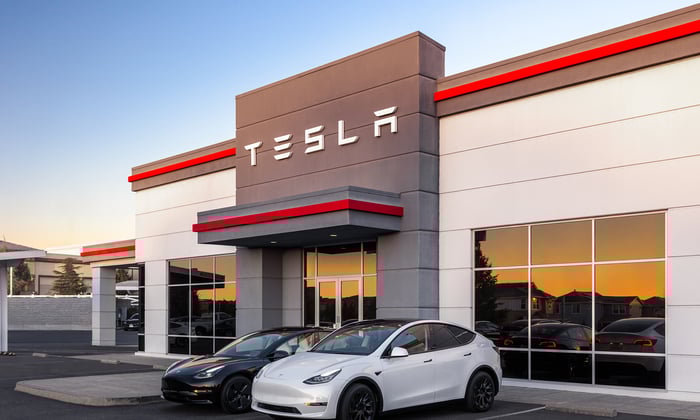
Image source: Tesla.
Tesla's EV business is sputtering
To meet Ark's bullish 2029 forecast, Tesla will have to transition from selling passenger EVs to selling self-driving robotaxis, and it will also have to build new services like an autonomous ride-hailing network.
Unfortunately, Tesla is currently operating from a position of weakness, which is forcing this shift earlier than the company perhaps WOULD have liked. After all, government regulators haven't approved Tesla's full self-driving (FSD) software for unsupervised use anywhere in the U.S. yet, which is a huge barrier to the success of its upcoming Cybercab robotaxi.
Tesla delivered 1.79 million passenger EVs during 2024, which was down 1% from the prior year, marking the first annual decline since the company launched its flagship Model S in 2011. The situation is much worse in 2025, with deliveries shrinking by a whopping 13% in the first half of the year. This led to a 14% decline in Tesla's revenue and a 31% collapse in its earnings per share (EPS) during the same period, which is alarming to say the least.
A rapid increase in competition is a key reason for Tesla's woes. Low-cost EV producers like China-basedare making serious inroads into some of Tesla's biggest markets. Tesla's sales sank by 40% across Europe in July, despite EV registrations climbing by 33% overall. BYD, on the other hand, saw a whopping 225% increase in sales in the region.
Simply put, Tesla is quickly losing market share in the passenger EV space. The company is launching a low-cost EV of its own in order to compete, but production just started so it probably won't be a factor until next year at the earliest.
86% of Tesla's earnings could soon come from autonomous robotaxis
Elon Musk is making a big bet on autonomous ride-hailing. The Cybercab, which will enter mass production in 2026, will run entirely on Tesla's FSD software, so it's designed to operate without any human intervention. In theory, that means it can haul passengers and even small commercial loads at all hours of the day, creating a lucrative new revenue stream for the company.
Scaling this business will come with challenges. I mentioned FSD isn't approved for unsupervised use in the U.S. just yet, but Tesla will also have to compete with established ride-hailing giants like, which has already partnered with 20 other companies in the autonomous driving space. Around 180 million people already use Uber every single month, so it's in a much better position to dominate the autonomous ride-hailing industry compared to Tesla, which has to build an entire network from scratch.
However, Ark thinks Tesla will eventually make it work. Its forecasts suggest the company will generate $1.2 trillion in annual revenue by 2029, with 63% ($756 billion) coming from its robotaxi platform alone. Ark says that could translate to $440 million in earnings before interest, tax, depreciation, and amortization (EBITDA), with 86% attributable to the robotaxi because of its high profit margins -- human drivers are the largest cost in existing ride-hailing networks, but the robotaxi won't need them.
Don't rush to buy Tesla stock just yet
In my opinion, Ark's predictions are too ambitious. Wall Street thinks Tesla will generate around $93 billion in revenue during 2025 (according to Yahoo! Finance), so that figure will have to grow by almost 1,200% over the next four years to meet Ark's forecast of $1.2 trillion -- driven by a brand-new robotaxi product that hasn't even hit the road yet.
Tesla's valuation is another issue. Its stock is trading at an eye-popping price-to-earnings (P/E) ratio of 209, making it almost seven times as expensive than thetechnology index -- which trades at a P/E ratio of 31.6. Remember, Tesla's earnings are currently shrinking, which makes its premium valuation even harder to justify.
Therefore, I'm hesitant to buy into the idea that Tesla stock could surge by another 615% over the next four years to reach Ark's price target of $2,600. It might be possible if the company's robotaxi platform becomes as successful as Ark predicts, but I think that's unlikely in such a short period of time. After all, Elon Musk has promised unsupervised self-driving cars for the last 10 years, and Tesla still hasn't delivered.
