The One Ethereum Advantage Wall Street Can’t Ignore: Programmable Money Revolution
Ethereum isn't just another cryptocurrency—it's the backbone of the entire decentralized economy.
Smart contracts automate trillion-dollar industries while traditional finance still uses fax machines.
Why institutions are flooding into ETH:
The network effect: Thousands of dApps, millions of users, and billions in locked value create an unstoppable flywheel effect.
Upgrade complete: Ethereum's shift to proof-of-stake slashed energy consumption by 99.95%—silencing environmental critics while attracting ESG funds.
Real-world adoption: From tokenized real estate to corporate treasury operations, enterprises are building on Ethereum while bankers still debate blockchain's merits.
Scarcity mechanics: ETH's burn mechanism destroys more tokens during network congestion—creating deflationary pressure during bull markets.
Developer dominance: More builders choose Ethereum than all other chains combined—because liquidity follows innovation, not the other way around.
Wall Street might finally understand blockchain, but Ethereum's already executing what traditional finance is still PowerPointing about.
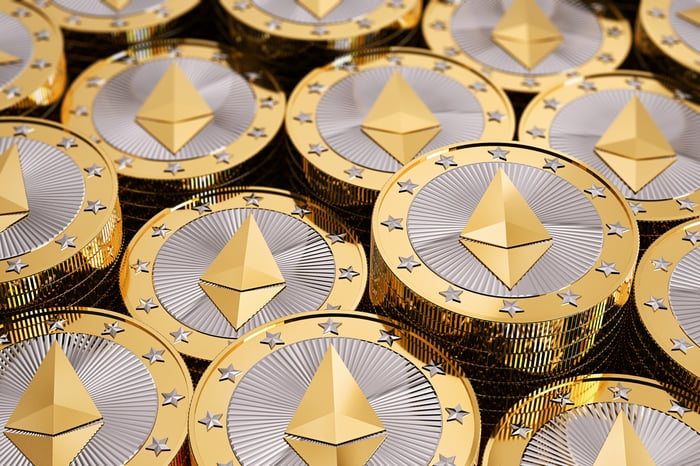
Image source: Getty Images.
Ethereum is the most widely used blockchain
Ethereum was the first blockchain that could run smart contracts -- self-executing programs built on a blockchain. The introduction of smart contracts was a major development that expanded on what blockchains could do. It led to the creation of decentralized finance (DeFi) services, stablecoins, and tokenized real-world assets (RWAs), to give a few examples.
Many blockchains with smart contract functionality are competing with Ethereum now. But because Ethereum was the first mover, it has been able to capture a dominant market share.
The current total value locked (TVL) into DeFi applications across all blockchains is $156 billion, according to DefiLlama. Ethereum accounts for a whopping 61% of that with $95 billion in TVL.ranks a distant second with $11 billion. It's the same story with stablecoins, where Ethereum tokens account for 52% of the entire market.
Most of the money and activity is on Ethereum, which has kept it firmly entrenched as the second-largest cryptocurrency after. All the activity on the Ethereum blockchain drives adoption of its native cryptocurrency, because gas fees are paid in ETH tokens.
Ahead of the pack
Ethereum is in a competitive space, and many blockchains have been called potential "Ethereum killers," including Solana,, and. But even after being around for years, they're well behind Ethereum in terms of value and usage, so none of them have lived up to that title so far.
Ethereum may not completely maintain its current market share. It's still well-positioned to remain a top blockchain since it is far ahead in terms of usage.
