Trump Administration Eyes Equity Stakes in Intel, TSMC, Micron, and Samsung - Setting a Dangerous Precedent

Washington moves to take direct stakes in chip giants—reshaping the global tech landscape overnight.
The Play
Intel, TSMC, Micron, and Samsung now sit in the crosshairs of potential government ownership. The administration pushes for strategic control—citing national security and supply chain resilience. No specifics on stake size or deal structure yet, but the intent rings clear: Uncle Sam wants a seat at the semiconductor table.
Market Tremors
Investors flinch at the blurring line between state and market. Tech stocks wobble as analysts question valuation impacts and operational freedom. Long-term contracts? Supply agreements? All now subject to political winds. Private sector purists call it a creeping capture—disguised as patriotism.
The Precedent
One move like this opens the floodgates. Which industry is next? AI? Quantum? Pharma? The doctrine of strategic intervention gains momentum—and once that genie’s out, good luck putting it back. It’s industrial policy with a capital ‘P’—and a side of moral hazard.
Because nothing says ‘free market’ like the government picking winners—and then buying a piece of the trophy. Just ask your portfolio.
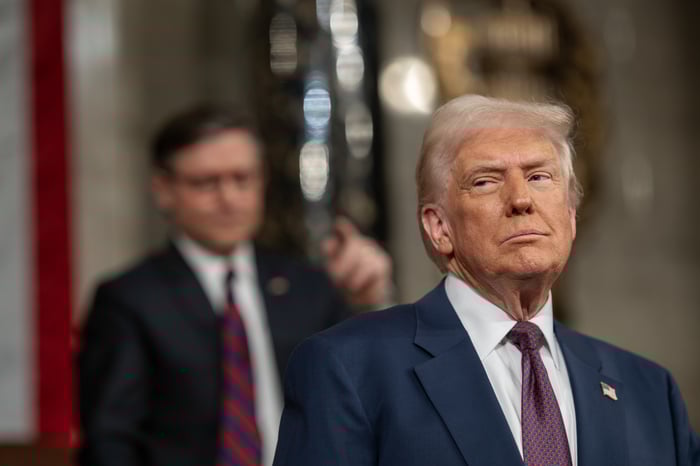
President Trump delivering his State of the Union address. Image source: Official WHITE House Photo.
But tariffs represent just one of the ways the Trump administration can potentially influence equities on Wall Street.
According to reports and recent statements made by a member of Trump's cabinet, the federal government is pondering equity stakes in some of the world's leading semiconductor companies, including(INTC 5.64%),(TSM 2.58%) (commonly known as "TSMC"),(MU 1.82%), and(SSNL.F 9.01%). While the rationale behind this idea might be intriguing on paper, it runs the risk of setting a dangerous precedent on Wall Street.
Commerce Secretary Howard Lutnick proposes converting CHIPS Act grants into equity
Before diving further into the proposed details, some background is sorely needed.
Three years ago, in August 2022, President Joe Biden signed the CHIPS and Science Act (commonly known as the "CHIPS Act") into law. This law authorizes grants from the federal government to encourage the domestic manufacture of semiconductor chips, as well as to promote biotechnology and clean-energy technology innovation within the U.S. More than $52 billion was set aside by the CHIPS Act to support the construction and/or expansion of chip fabrication plants in the U.S., as well as advanced semiconductor research and development.
During President Trump's State of the Union address to a joint session of Congress in March, he referred to the CHIPS Act as a "horrible, horrible thing," and encouraged lawmakers at the time to defund the program. But his tune may have changed, courtesy of U.S. Secretary of Commerce Howard Lutnick.
In a recent interview with CNBC, Lutnick laid out something of a take-it-or-leave-it style proposal that WOULD convert CHIPS Act grants into stock equity for the federal government. Said Lutnick:
The Biden administration literally was giving Intel for free, and giving TSMC money for free, and all these companies just giving them money for free. Donald Trump turns that into saying, "Hey, we want equity for the money. If we're going to give you money, we want a piece of the action."
Lutnick clarified his statements by noting that these equity stakes wouldn't provide the U.S. government with any voting power in these businesses. Instead, it would be all about the American people getting a stake in the businesses U.S. funds are supporting.
Trump has reportedly favored the idea of the U.S. government being given equity stakes in exchange for CHIPS Act funds, with Sen. Bernie Sanders (Ind.-VT) also voicing his support for such a move. "Taxpayers should not be providing billons of dollars in corporate welfare to large, profitable corporations like Intel without getting anything in return," extolled Sanders.
If this proposal were to MOVE forward, the Trump administration would take up to a 10% stake in Intel, valued at roughly $10.9 billion. Multibillion-dollar stakes would also be made in TSMC, Micron, and Samsung.

Image source: Getty Images.
Government ownership of stocks can be a slippery slope
Though there's a logical argument to be found in the Trump administration's proposal to transform these grants into equity stakes, there are also reasons for concern.
Looking to the past as a predictor of the future, there have been previous instances where the federal government took equity stakes in public companies. However, these prior occurrences correlate with periods of historic economic instability.
For instance, the Troubled Asset Relief Program (TARP) gave the federal government the green light to take equity stakes in struggling financial institutions during the Great Recession. Additionally, select airline companies issued stock warrants to the U.S. Treasury during the height of the COVID-19 pandemic in 2020 and 2021 as partial compensation for the financial assistance they received. Equity stakes on a for-profit basis, as proposed by Lutnick, would be a new and potentially dangerous precedent.
Although the Commerce Secretary told viewers these would be nonvoting equity stakes, the Trump administration nevertheless passes the laws and fiscal policy that can directly impact chip manufacturers. While the federal government might not be voting on executive compensation packages, it'll have a direct and undeniable influence on the stock(s) it owns. This is effectively the same debate of whether members of Congress should be able to own individual stocks while passing laws that directly impact said stocks... just taken to another level.
For example, a solid argument can be made that President Donald Trump's tariff and trade policy is far more powerful than a 10% voting share in Intel, or a single-digit percentage voting share in TSMC, Micron, or Samsung. Pardon the necessary pun, but Trump has previously used chip companies, including, as bargaining chips to negotiate trade deals. There would be nothing to stop the president or members of his administration from using these bargaining tools to influence corporate strategy and decision-making.
Furthermore, adjusting the funding strategy for the CHIPS Act three years after its passage might encourage chip fabricators to keep their distance from the U.S. government. While subsidies of $6.6 billion, $6.2 billion, and $4.75 billion were awarded to TSMC, Micron, and Samsung, respectively, in 2024, none of these three companies necessarily need this funding to build/expand their chip fabrication presence on U.S. soil. If they had known that an equity stipulation was a possibility, they may not have agreed to a dime in funding.
Even Intel, which has struggled mightily under the weight of increasing competition and the high costs of organically building out its foundry division, may not have opted for government funding if it would have resulted in a forced equity stake. Over the trailing-12-month period, Intel has generated more than $10 billion in cash FLOW from its operations.
Though discussions are ongoing and nothing is set in stone, as of this writing in the late evening of Aug. 20, the Donald Trump administration potentially becoming shareholders of some of Wall Street's leading semiconductor stocks likely wouldn't be a development to cheer.
