3 Must-Know Facts About Visa Before You Buy the Stock - What Wall Street Isn’t Telling You

Visa's payment empire faces digital disruption—here's what really matters for investors.
Network Dominance Isn't Forever
Visa controls over half of global card transactions, but blockchain and real-time settlements are chipping away at that moat. Centralized rails look increasingly archaic when decentralized alternatives process cross-border payments in seconds—not days.
Regulatory Target on Its Back
Governments worldwide are scrutinizing interchange fees and antitrust concerns. Visa's profit margins rely heavily on transaction fees that regulators increasingly view as excessive—especially when open-source protocols charge fractions of a cent.
The Crypto Paradox
Visa's experimenting with crypto integrations while simultaneously fighting existential threats from decentralized finance. It's like selling both lifeboats and holes to the Titanic—profitable short-term, potentially catastrophic long-term.
Traditional finance loves moats until technology builds tunnels underneath them. Visa's stock might be blue-chip, but in the digital age, even giants can stumble when disruption cuts out the middleman.
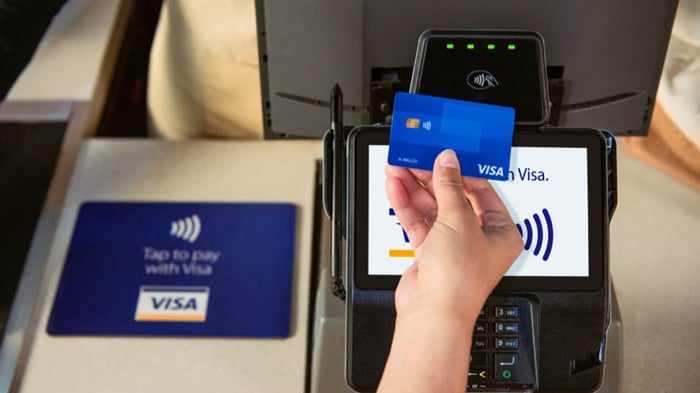
Image source: Visa.
1. Visa's growth drivers
In the past decade, Visa's revenue has increased at a compound annual growth rate of 11.3%. According to Wall Street analyst expectations, the top line will grow at a yearly clip of 10.5% between 2024 and 2027. Looking beyond that forecast period, I wouldn't be surprised if the business continues the same level of gains for many years.
Visa is positioned to benefit from some long-lasting trends. The first is the rising penetration of digital and cashless transactions. The U.S. might be a developed economy, but 52% of Americans will go completely cashless in 2025, according toShopping Research. There's still so much room for card payments to proliferate, which means the opportunity in less developed emerging markets is much bigger.
Another growth driver is general economic expansion. As countries increase their gross domestic product (GDP), consumers and businesses will spend more money. This activity helps Visa handle more payment volume, which leads to greater revenue.
During the latest fiscal quarter, Visa raked in $2.8 billion (or 27%) in revenue from add-on services, like risk and identify solutions and advisory services. What's more, the business is pressing the gas pedal on innovation, working on things within artificial intelligence (AI) and stablecoins. There could be growth potential in these areas.
2. Visa's formidable competitive position
At a high level, Visa connects merchants, consumers, and financial institutions to help facilitate the FLOW of money. Consequently, the company has developed an extremely powerful network effect. This underpins its competitive position.
There are 4.8 billion Visa cards in use out in the world. On the other side, there are more than 150 million merchant locations that accept them as a FORM of payment. So many people have Visa cards because so many merchants accept them, with the opposite also being true. It's a system that gets stronger as it grows, and it's very difficult for anyone to disrupt.
A potential challenger WOULD need to build the underlying technical infrastructure, while also convincing banks to lend with its credit cards. This is an impossible task because there aren't any merchants that use this new entrant's system yet. The problem arises from trying to bring on stakeholders when there's no value being offered.
3. Is the stock cheap?
Most would agree that Visa is a great company. Its durable growth, network effect, and incredible profitability (with a Q3 net profit margin of 52%) resemble a business that investors should want in their portfolios.
However, investing in the company right now might not provide a clear margin of safety. As of Aug. 18, the stock traded at a price-to-earnings (P/E) ratio of 33.5. On the one hand, that metric is below the five-year trailing average. But on the other hand, Visa shares have underperformed thesince August 2020. The best decision, in my view, is probably to wait for a pullback.
There might still be investors who are interested in owning this business, regardless of the valuation. Maybe a dollar-cost averaging strategy makes sense. But you're now familiar with Visa's growth drivers, its network effect, and the stock's valuation. Knowing this info will support a better decision-making process.
