This Forgotten Healthcare Stock Is a Sleeping Giant—Here’s Why It Could 10X Your Portfolio

Wall Street's ignoring a healthcare gem—while chasing AI hype and meme stocks. Meanwhile, this under-the-radar player could deliver generational wealth.
The Setup: A battered sector, zero analyst coverage, and institutional blind spots create the perfect contrarian opportunity.
The Catalyst: Aging populations don't care about Fed rates or crypto crashes—they need treatments. This company's pipeline addresses a $200B+ market with patent cliffs looming for competitors.
The Punchline: Institutions will FOMO in at 52-week highs after retail gets shaken out. Classic.
CRISPR Therapeutics' first success
CRISPR Therapeutics' first approval was for Casgevy, a treatment for sickle cell disease (SCD) and transfusion-dependent beta-thalassemia (TDT), which it developed in collaboration with. Before Casgevy, no CRISPR-based gene-editing medicine had been approved.
While it became the first, it still faces some challenges. Ex vivo gene-editing therapies require a complex manufacturing and administration process that can only be performed in authorized treatment centers (ATCs). Moreover, they're expensive. Casgevy costs $2.2 million in the U.S. Getting third-party payers on board for that is no easy feat.
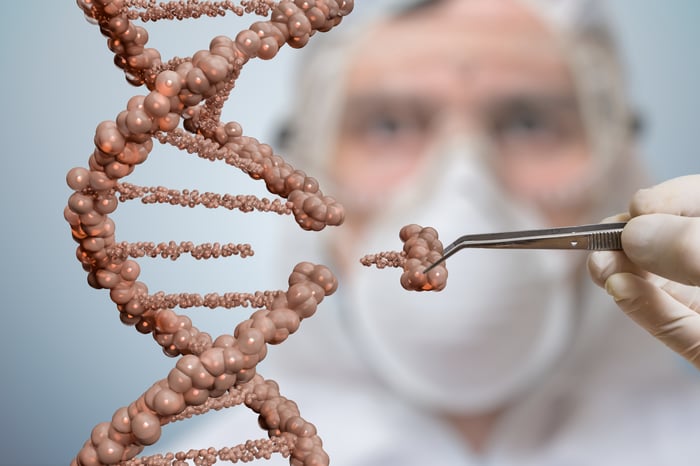
Image source: Getty Images.
Still, CRISPR Therapeutics and Vertex Pharmaceuticals are making steady progress. As of the second quarter, CRISPR Therapeutics had achieved its goal of activating 75 ATCs. It had also secured reimbursement for eligible patients in 10 countries. The two companies estimate there are roughly 60,000 eligible SCD and TDT patients in the regions they have targeted.
Let's say they continue to strike reimbursement deals and can count on third-party coverage for 70% of this target population (42,000 people), then go on to treat another 30% of that group in the next decade (12,600 patients). Assuming they could extend that $2.2 million price tag to those countries, Casgevy could generate more than $27.7 billion over this period. Based on its agreement with Vertex, 40% WOULD go to CRISPR Therapeutics, or roughly $11.1 billion over a decade. That's not bad, but it's not that impressive either.
So, while Casgevy could contribute meaningfully to CRISPR Therapeutics' results -- and may even reach blockbuster status at some point -- the medicine may primarily serve as a proof of concept to demonstrate that the biotech's approach can be effective.
Substantial progress with its first commercialized product will help the stock price. But the company's performance will depend even more on future clinical and regulatory milestones, especially as it shows with Casgevy that it can manage the intricacies and complexities of marketing gene-editing medicines.
Can the pipeline deliver?
CRISPR Therapeutics has six candidates in clinical trials, which isn't bad at all for a mid-cap biotech company. One of its leading programs is CTX310, a potential therapy designed to help reduce low-density lipoprotein (LDL) cholesterol in patients with certain conditions. CTX310 is already producing encouraging clinical trial results. Additionally, it's an in vivo medicine, meaning it bypasses the need to harvest patients' cells to manufacture therapies; in vivo gene-editing treatments are easier to handle than their ex vivo counterparts.
The company's path to creating life-changing returns hinges on its ability to deliver consistent clinical and regulatory wins over the next few years for CTX310 and other important candidates. If CRISPR Therapeutics can successfully launch several new products in the next five to seven years, its shares are likely to skyrocket.
In the meantime, under this scenario, the company would succeed in making gene-editing medicines more mainstream. This would encourage third-party payers to get on board -- and healthcare institutions, and perhaps even governments, to help push for more ATCs, since there'd be a greater need to accommodate these treatments.
Can CRISPR Therapeutics achieve this? In my view, the biotech stock is on the riskier side, but does carry significant upside potential. There's a (small) chance the gene-editing specialist will deliver life-changing returns in the next decade, but investors need to hedge their bets. It's best to start by initiating a small position in the stock, then progressively add more if CRISPR Therapeutics lands more wins.
