🚀 $6.3B Space Tech IPO Blasts Off—Will This Stock Moon or Crash?

Another day, another sky-high valuation—this time it's a space tech firm hitting the public markets with a $6.3 billion price tag. Wall Street's already placing bets: visionary breakthrough or overhyped rocket science?
Gravity-Defying Ambitions
The company's IPO marks the largest space tech debut this year, fueling speculation about whether it can sustain orbit or succumb to re-entry pressures. Analysts are split—bulls see a SpaceX rival, bears see a meme-stock-in-waiting.
The Fuel Behind the Frenzy
Retail investors are piling in, lured by the sector's sizzle (and maybe FOMO). Institutional players? More cautious—they remember how Virgin Galactic flatlined after liftoff.
Final Countdown
One thing's certain: if this stock moons, it'll mint a new generation of 'astro-traders.' If it tanks? Well, at least the bankers got their fees. Welcome to the SPAC... sorry, space race 2.0.
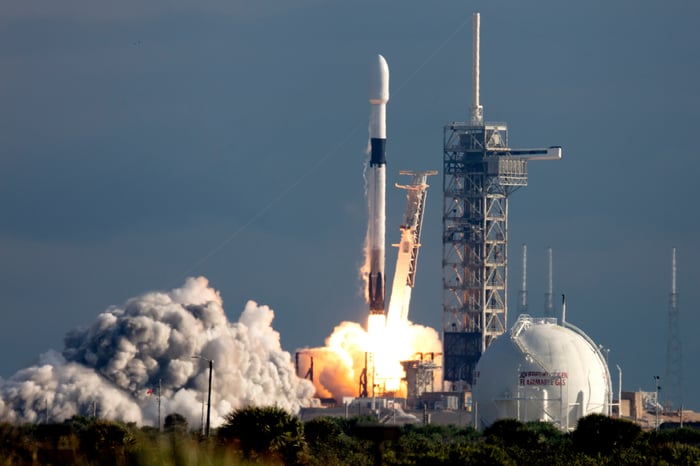
Image source: Getty Images.
What Firefly actually does
Fans of the canceled-way-too-soon space Western Firefly will be sad to learn that the company's name isn't actually related to the TV series. Instead, it's a name Firefly founder Tom Markusic -- a former SpaceX and(SPCE -9.21%) engineer -- selected to embody a hypothetical future in which rocket launches are as common in the night sky as fireflies.
Indeed, Firefly Aerospace has gone all-in on making launches more frequent and more accessible. It developed the Alpha rocket, a smaller, lighter rocket manufactured from carbon fiber composites that launched a satellite into orbit with just 24 hours' notice in 2023. While the Alpha is certainly lighter (and thus, less expensive to launch) than most other commercial rockets, the roughly one-ton payload capacity is somewhat restrictive: Firefly's Blue Ghost lunar lander, for example, was too heavy for the Alpha rocket and had to be launched using a SpaceX Falcon 9.
Firefly is also working on the Elytra orbital vehicle and lunar imaging service Ocula. The company has nine planned non-test missions through 2029: five for NASA, one for the U.S. Space Force, and three for commercial clients, for a total current project backlog of $1.1 billion.
Why its stock might take off...
With more companies (and people) heading to space, demand for cheaper spaceflight is likely to skyrocket (no pun intended). As a company offering a more affordable rocket that has already had successful launches, Firefly is well ahead of many would-be competitors.
Additionally, Firefly is receiving investment and support from industry heavyweights including(LMT -1.19%) and(LHX -1.52%). In May, Firefly received a $50 million investment from(NOC -1.07%). Being in the good graces of such major aerospace players is a big advantage for the start-up, both financially and reputationally.
Today's commercial space industry is a fairly crowded place, with companies big and small jockeying for limited funds and contracts. However, early success tends to encourage investment, which fuels future success. Firefly seems to have all the right ingredients, including an active contract pipeline, major industry partnerships, and a few successful early missions. If it can keep it up, it could be the next SpaceX...or maybe an even bigger success story.
...and why it might not
For an 11-year-old company, Firefly has had a checkered past, which includes IP issues, a 2017 bankruptcy, government intervention over national security concerns, and an abrupt July 2024 CEO departure (current CEO Jason Kim took the helm in October 2024). Meanwhile, private equity firm AE Industrial Partners controls the company with a 40.9% stake; the firm's employees currently hold five of Firefly's nine board seats. As the IPO prospectus notes, "AE Industrial Partners controls us, and its interests may conflict with ours or yours in the future."
That's...a lot, and we haven't even gotten to the company's financials.
Because it's an IPO, we don't even have a full quarterly financial report from Firefly yet. But its IPO prospectus shows a net loss of about $125 million in the first half of 2025, along with negative free cash FLOW of about $97.5 million, with just $205.3 million in cash on its balance sheet and $173.6 million in debt. Not a pretty picture.
Now, it's not unusual for new start-ups to have high net losses and negative free cash flow, but given the lack of context and details, it's worth asking: Does this business deserve a $6.3 billion valuation? How about $8.4 billion, which the company briefly hit on its first day of public trading Thursday?
To me, that seems pretty expensive for an unproven business with opaque financials in a competitive, high-risk industry that's controlled by a venture capital firm and led by a brand new CEO. Before I'd buy shares, I'd want to at least see a few quarterly reports to get a clearer picture of how the company operates. It WOULD still be a risky bet, but right now it feels too risky to buy.
