Buying UPS Stock in 2025: Your Ticket to Financial Freedom?

Wall Street's latest obsession: Can a brown delivery truck unlock generational wealth?
Forget meme stocks—UPS is the stealth play no one's talking about. The logistics giant quietly moves 6% of US GDP daily. Missed Amazon in 2010? This might be your second chance.
Why analysts are bullish:
- E-commerce tailwinds accelerating through 2026
- Autonomous delivery fleets entering beta testing
- Labor cost pressures finally easing
But here's the kicker: UPS yields 4.2% while growing faster than Treasury bonds. In a world where 'safe' investments barely beat inflation, that's like finding a Bitcoin ATM in 2012.
Caveat emptor: The stock's already priced for perfection. One missed earnings report could turn those capital gains into return-to-sender.
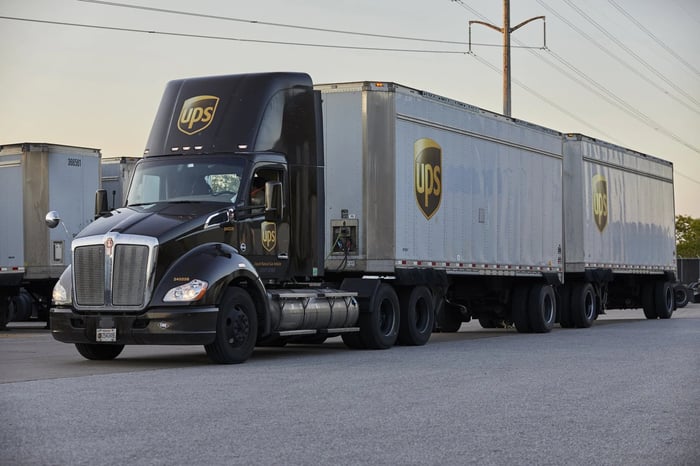
Image source: UPS.
What happened to UPS over the past few years?
UPS' average daily package volume, average revenue per piece, and total revenue all increased in 2020 and 2021 as the pandemic drove more people to shop online. That rising demand enabled it to charge higher fees, which boosted its adjusted operating margins and earnings per share (EPS).
But in 2022 and 2023, its daily package volumes dipped as it lapped its pandemic-era growth spurt, inflation curbed consumer spending, and threat of a strike from the Teamsters drove some of its customers to shift their orders to other couriers like(FDX 1.37%). UPS tried to offset that pressure with price hikes, but its higher labor and fuel costs offset those gains, crushed its adjusted operating margins, and caused its EPS to plummet.
|
Average Daily Package Volume |
21.88M |
24.68M |
25.25M |
24.29M |
22.29M |
22.42M |
|
Average Revenue Per Piece |
$10.87 |
$10.94 |
$12.32 |
$13.38 |
$13.62 |
$13.60 |
|
Total Revenue |
$74.09B |
$84.63B |
$97.29B |
$100.34B |
$90.96B |
$91.07B |
|
Adjusted Operating Margin |
11% |
10.3% |
13.5% |
13.8% |
10.9% |
9.8% |
|
Diluted EPS |
$7.53 |
$8.23 |
$14.68 |
$13.20 |
$7.80 |
$6.75 |
Data source: UPS.
In 2024, its daily package volume and revenue increased again as the macro environment stabilized and it negotiated a new labor contract with the Teamsters. But those higher labor and pension costs, its divestment of Coyote Logistics, regulatory fines in the U.S. and Italy, impairment charges, and investments in its digital ecosystem reduced its operating margins and EPS again.
UPS isn't out of the woods yet
In the first six months of 2025, UPS' average daily package volume declined 4% year over year to 20.26 million. Its average revenue per piece grew 4% to $14.28 as its adjusted operating margin expanded 50 basis points to 7%, but its revenue dipped 2% and its EPS fell 1%.
That decline was mainly caused by three strategic shifts. First, it accepted fewer shipments from(AMZN -0.23%), its largest customer, because those deliveries generated much lower margins than its deliveries for smaller customers. UPS aims to reduce its Amazon-related volumes by at least 50% by mid-2026. Second, it raised its prices to reduce its mix of lower-value shipments (like its Ground Saver economy service).
Lastly, it closed dozens of distribution centers and laid off thousands of workers to resize its business and offset the pressure from its new labor contracts. All these moves indicate that UPS will sacrifice its near-term revenue growth to strengthen its long-term margins, but it will struggle to grow its EPS until its top-line growth stabilizes again. The TRUMP administration's unpredictable tariffs on cross-border purchases -- and their effect on e-commerce orders from China to the U.S. -- could further complicate its recovery.
Don't count on UPS to deliver life-changing gains
UPS hasn't provided any revenue or earnings guidance for the full year. However, analysts expect its revenue and EPS to decline 4% and 7%, respectively, as it slogs through those aforementioned challenges. They expect UPS' revenue and earnings to finally grow modestly again in 2026 and 2027 after it slims down its business, but investors should take those estimates with a grain of salt.
It might be a good value play for income investors at these levels, since its low valuation and high yield should limit its downside potential. But investors looking for a stock that can set them up for life should probably avoid UPS and look for higher-growth plays with more upside potential.
