U.S. Inflation Hits 2.7%: How 2 Consumer Goods Giants Are Weathering the Storm

Inflation refuses to bow out quietly—The Motley Fool’s latest data pegs it at 2.7%. Here’s how two household-name consumer staples are navigating the squeeze.
Grocery Aisles Get a Reality Check
Prices keep climbing, but shoppers aren’t biting. One staple brand slashes promotions while another bets on shrinkflation—because nothing says 'value' like less product for the same price.
The Discount Game
Retailers play chicken with inflation, testing how much consumers will tolerate before switching to store brands. Spoiler: loyalty is thin when wallets are thinner.
Wall Street shrugs—because if there’s one thing that never inflates, it’s corporate optimism.
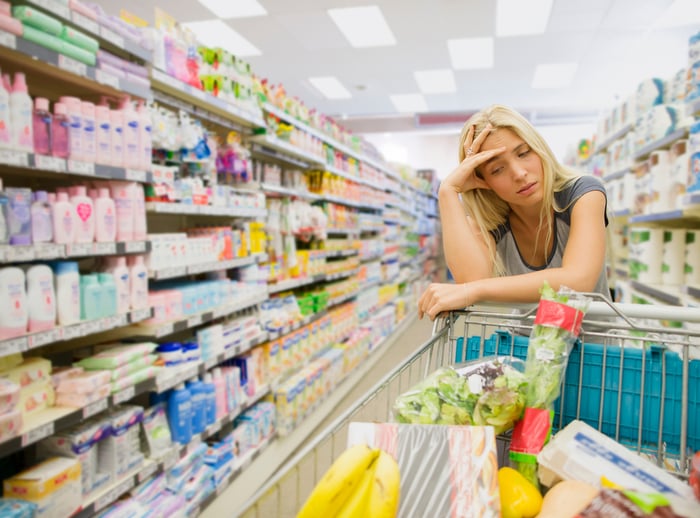
Image source: Getty Images.
1. PepsiCo
(PEP 1.02%) sells beverages, snacks, and convenience foods. It produces these products under well-known brands like Pepsi-Cola, Gatorade, Doritos, and Quaker.
Nonetheless, despite these products' long-standing popularity, people seem tired of paying higher prices given elevated overall inflation. You can see that by looking at PepsiCo's results, which have seen sluggish volumes in the face of price increases.
The company's second-quarter revenue, adjusted to remove foreign-currency translation effects and the effect of acquisitions/divestitures, ROSE a tepid 2%. This was due entirely to higher prices, which contributed 4 percentage points. Meanwhile, lower volume subtracted about 1.5 percentage points.
The price hikes weren't sufficient to offset higher costs, however. PepsiCo's adjusted operating income fell 3%.
Investors haven't been too pleased with the company's results. PepsiCo's share price has dropped 16.9% over the last year through July 28. Meanwhile, theindex gained 16.8% during this time.
When inflation abates and PepsiCo can hold the line on prices, volume and sales growth should increase. That will likely boost profitability. Investors perhaps see the light at the end of the tunnel.
The valuation has become more expensive over the last month, with the price-to-earnings (P/E) ratio increasing from 19 to 26. Still, that's cheaper than the S&P 500's P/E multiple of 30. Given the valuation and prospects for better results down the line, patient investors may find themselves rewarded.
2. Procter & Gamble
(PG 0.11%) sells items that people use every day. These include shampoo, deodorant, razor blades, toothbrushes, laundry detergent, and diapers. It sells these products under popular brands like Head & Shoulders, Old Spice, Gillette, Crest, Tide, and Pampers.
These basic items should be fairly impervious to price increases. After all, people will still use them no matter what's going on with their personal finances.
Nonetheless, consumers have been shying away from its products. Procter & Gamble's fiscal third-quarter adjusted sales grew a scant 1%. Higher prices accounted for the entire increase, with volumes flat versus a year ago. The company's earnings per share increased 1%. The period ended on March 31.
It was a similar story in the recently reported fourth quarter. Procter & Gamble's adjusted sales increased 2%, with higher prices and mix each adding 1 percentage point. Volume was constant compared to last year. Management expects a range of 0% to 4% sales growth this year.
Procter & Gamble's stock price has dropped 7.9% over the last year. The share's P/E multiple has contracted from 28 to less than 25 during this time.
Despite the better valuation, I'd hold off on purchasing the stock. Given the type of products it sells, I'd expect Procter & Gamble to have performed better during an inflationary environment.
