Flying Cars Aren’t Sci-Fi Anymore: This Publicly Traded Company Is Making Them Real—Would You Take the Ride?

Buckle up—the future of transportation just got a turbo boost. A publicly traded firm is turning flying cars from Jetsons fantasies into runway-ready reality. But will regulators and wallets keep pace with the tech?
The sky's the limit—until the FAA says otherwise.
Investors, take note: this isn't another vaporware moonshot. The company's already cleared key engineering hurdles (and yes, it's traded on the Nasdaq—because where else would you park your speculative capital in 2025?).
Here's the real question: Would you trust your commute to a flying car? The tech might be ready, but are we?
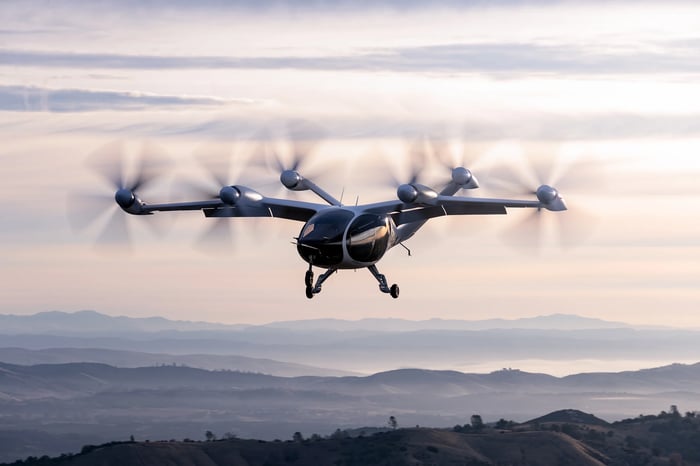
Image source: Joby Aviation.
Meet George Jetson?
In the 1960s animated TV show The Jetsons, George Jetson flew to work every day in a flying car. Along the way, he dropped his kids, Elroy and Judy, off at school, and his wife, Jane, at a shopping center.
The Jetsons was set in 2062, less than 40 years from now. However, a version of George Jetson's flying car is already soaring through the skies.
JoeBen Bevirt founded Joby in 2005 to develop consumer products. He had previously co-founded robotic laboratory systems developer Velocity11 before selling it to. In 2009, Bevirt created(JOBY 3.36%) to push the boundaries of aviation.
By 2012, Joby Aviation was selected by NASA to work on electric flight projects. Within three years, an early prototype of the company's electric vertical take-off and landing (eVTOL) aircraft flew for the first time. In 2019,invested in Joby and assigned engineers to help the company develop manufacturing operations for its aircraft.
Joby's aircraft could be aptly described as a flying car, albeit one that's different from the one seen on The Jetsons. It's powered by six electric motors that are as quiet as a mouse. One pilot and four passengers can zip through the skies at speeds up to 200 miles per hour. Joby says that flying in its aircraft "might feel more like getting into an SUV than boarding a plane."
Building a business
Instead of targeting individuals, Joby Aviation decided early on to go after the air taxi market. In 2019, the company partnered with. That relationship deepened the following year, with Uber investing in Joby, while Joby acquired Uber's Elevate division.
Joby has made significant progress toward building a full-fledged aerial ride-sharing service business. The company hopes to begin transporting its first air taxi passengers in Dubai next year.
What about in the U.S.? Joby has fully completed stages one and three of the U.S. Federal Aviation Administration's (FAA) certification process. The company is 97% finished with stage two and 62% through its part of the stage four process. The primary remaining effort required is stage five -- showing and verifying the airworthiness of its fleet.
When Joby is fully FAA certified, look for rapid commercialization. The company inked a deal within 2022 to provide home-to-airport transportation for Delta customers, starting in New York and Los Angeles. Delta also owns a 49% stake in Virgin Atlantic, which teamed up with Joby earlier this year to launch an air taxi service in the U.K.
Is this futuristic stock a smart pick to buy?
Joby Aviation's stock is sizzling hot, more than doubling so far this year. Is this futuristic stock a smart pick to buy now? Maybe.
On the positive side, Joby has tremendous potential. The company seems to be getting close to the point where it can generate revenue. It also has an impressive lineup of partners, including Toyota, Uber, Delta, and Virgin Atlantic.
However, Joby remains unprofitable. With no real revenue or earnings (and no reliable price-to-sales or price-to-earnings multiples), it's next to impossible to value the company with any level of confidence. Joby also faces competition from rivals pursuing the air taxi market, such as, and others going after the personal eVTOL market, such as Jetson One (yes, it's named after The Jetsons).
Joby Aviation is the kind of stock that could be a huge winner over the next decade -- or a big flop. However, one thing seems clear: Another major revolution in transportation could be on the horizon.
