Nvidia (NVDA) Stock: Buy Before Aug. 27? History Reveals the Shocking Truth

Nvidia's stock splits have a habit of shaking markets—but will history repeat itself this time?
Key Dates & Market Moves
Aug. 27 looms as NVDA’s next potential inflection point. Past splits saw rallies, but Wall Street’s memory lasts about as long as a crypto bull run.
Chip Dominance vs. Hype Cycles
The AI boom turbocharged Nvidia’s valuation, but remember: even the mightiest GPUs can’t render away overbought RSI levels.
The Verdict?
Traders are placing bets like it’s a Vegas altcoin casino. Smart money watches the tape, not the calendar—because in tech, fundamentals eventually matter. Just ask the metaverse bagholders.
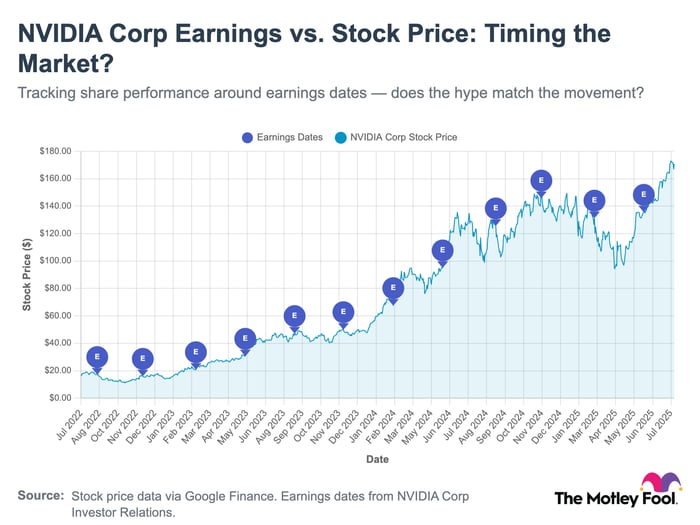
Image source: The Motley Fool.
No correlation between earnings and stock performance
The first thing to notice in the above chart is that there's no consistency between Nvidia's earnings and the immediate performance of its stock price. Below is how Nvidia's stock price has performed the day after its past four earnings reports:
| May 2025 | No | (2.9%) |
| February 2025 | Yes | (8.5%) |
| November 2024 | Yes | 0.5% |
| August 2024 | Yes | (6.4%) |
Data source: AlphaQuery and YCharts.
Even after beating earnings expectations, Nvidia's stock has experienced noticeable declines on the next day. This shows that investors aren't solely concerned about over- or underperformance. They may also be looking at factors like future guidance, valuations, and overall market sentiment.
Correlation (or lack thereof) aside, one thing to keep in mind is that trying to time the market is a recipe for disappointment and can often be counterproductive. Even if it seems like a stock's price should move in a certain direction because of results, the stock market doesn't operate on logical cause and effect.
Nvidia's high valuation leaves little room for error
Nvidia's trailing-12-month price-to-sales (P/S) ratio of 29 is the highest you'll find in an S&P 500 stock and 10 times the S&P 500 average.
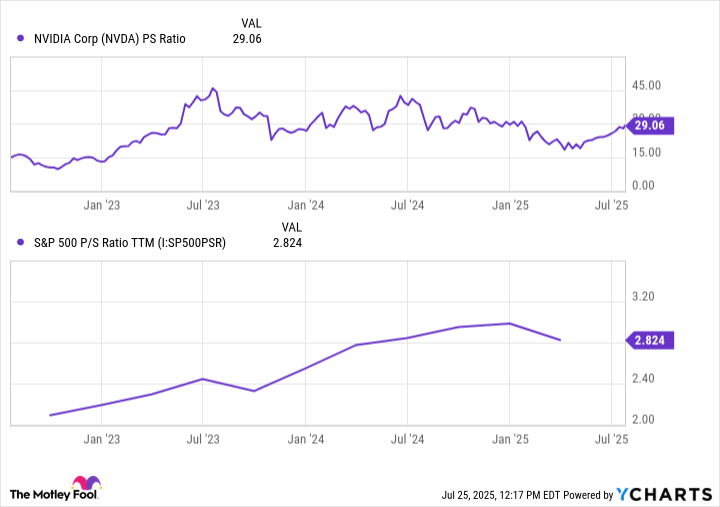
NVDA PS Ratio data by YCharts
This ultra-high valuation leaves Nvidia with little room for error -- or what investors may perceive as error -- and can increase volatility. If you like Nvidia as a company, a smart strategy WOULD be to dollar-cost average. This will allow you to slowly but surely accumulate shares and offset some of the volatility risks.
Nvidia's stock has shown long-term growth despite short-term drops, and that's what investors should focus on the most and bank on.
