Tesla’s Crypto Gambit: What Elon’s Latest Power Play Means for Your Portfolio

Tesla just dropped another blockchain bombshell—and Wall Street's scrambling to decode the implications.
The Electric Shockwave
When Elon Musk moves, markets ripple. Tesla's latest crypto maneuver isn't just another corporate announcement—it's a strategic power play that could reshape how traditional investors view digital assets.
Beyond the Balance Sheet
This isn't about quarterly earnings or production numbers. Tesla's positioning itself at the intersection of technological innovation and financial revolution—bypassing traditional banking channels and embracing decentralized finance protocols.
The Institutional Domino Effect
Watch for other blue-chip companies to follow suit. When Tesla makes crypto moves, corporate treasuries worldwide take notes—even if their CFOs still pretend not to understand blockchain.
Investor Takeaway: Adapt or Get Left Behind
The message is clear: digital asset exposure is becoming mandatory rather than optional for forward-thinking portfolios. Traditional diversification strategies look increasingly archaic as crypto assets demonstrate their staying power.
Wall Street's playing catch-up while Tesla builds the future—proving once again that the most profitable investments often come from betting against conventional financial wisdom.
Tesla's electric vehicle sales growth
One thing is clear: Tesla's 2025 hasn't panned out quite the way management expected it would. Back in October of last year, CEO Elon Musk made a rough estimate that the company WOULD achieve 20% to 30% EV sales growth in 2025, backed by lower-cost vehicles "starting in the first half of 2025," and "the advent of autonomy."
However, despite robust sales in the third quarter (partly due to a pull forward in sales as customers rushed to take advantage of the federal EV tax credit, which the Big Beautiful Bill ended as of Sept. 30), Tesla's vehicle deliveries were still down 6.4% year over year for the first nine months of 2025. Its new, lower-priced variants only became available in the fourth quarter, and if by "advent of autonomy" Musk means fully autonomous robotaxis and/or a fully autonomous full self-driving (FSD) option for the cars it sells, it hasn't achieved that yet either.
New, lower-cost vehicles
That said, the lower-cost trims (a Model Y standard selling for just under $40,000 and a Model 3 standard selling for just under $37,000) will likely help its sales efforts. Moreover, they align with management's statements to investors this year, not least when Musk "let the cat out of the bag" on the earnings call in July, saying the affordable model would be "just a Model Y." In other words, he did not promise to release the company's long-awaited, brand-new, lower-cost model in 2025.
The strategy makes sense, particularly in light of Washington's removal of the EV tax credit. The Model Y and Model 3 have been selling well in the U.S. in 2025, and the arrival of versions with meaningfully lower base prices will inevitably help sales. Moreover, the new trims are unlikely to cannibalize sales of the higher-end Model Y and Model 3 trims, as the price differentials between the new models and the next-cheapest models are $5,000 and $5,500, respectively.
Instead of the much-anticipated launch of a low-cost model, this MOVE appears to be a response to the removal of the tax credit in the U.S. and the persistence of relatively high interest rates worldwide.
What the new models mean to investors
While these cheaper EVs aren't game-changers in themselves, they do build on some improving sales trends for the company. Indeed, there's evidence to suggest that Tesla's sales are already building momentum after a disappointing first half.
For example, interpolating from Tesla's third-quarter delivery data and industry analysis of Tesla's sales in the U.S., it's possible to argue that its strength in the third quarter was broad-based and possibly related to the Model Y refresh gaining traction. Remember that the looming removal of the federal EV tax credit only impacted U.S. sales, so Tesla's strength in international sales was particularly welcome.
|
Tesla worldwide deliveries (units) |
497,099 |
462,890 |
7.4% |
|
Tesla estimated U.S. vehicle sales (units)* |
179,525 |
166,923 |
7.5% |
|
Tesla estimated international vehicle sales (units)** |
317,574 |
295,967 |
7.3% |
Data source: Tesla presentations, *Kelley Blue Book EV sales report, **author's analysis
Moreover, the fact that the new models are unlikely to cannibalize sales of existing Model Y and Model 3 vehicles means the road is still clear for Tesla to launch its much-talked-about $25,000 car, which some refer to as the "Model 2." If that vehicle comes to market, it's highly likely to be a wholly new and differentiated product that won't impact sales of other Tesla models.
What it means for investors
These models should build on the momentum the company gained in the third quarter and help it navigate a challenging period in the U.S., particularly due to the loss of the EV tax credit. They will also add to the fleet of vehicles on the road whose values could be significantly raised by the "advent of autonomy."
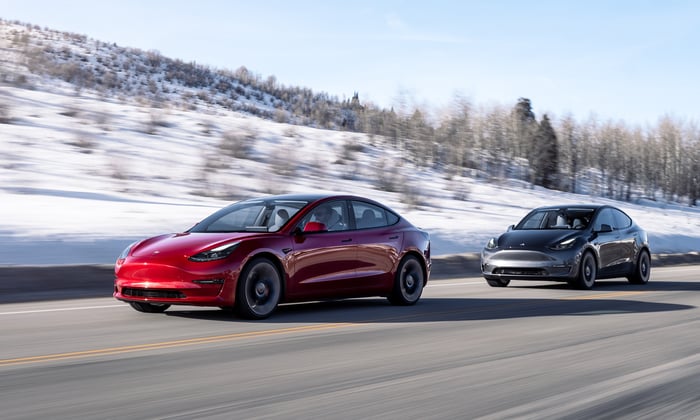
Image source: Tesla.
While uncertainty remains when it comes to the timeline of these events -- specifically, the company's deployment of fully autonomous robotaxis and the later public availability of fully autonomous FSD (which would be a game-changer) -- the stock will remain an option for speculative investors, albeit an excellent one.
