Billionaire Paul Tudor Jones Dumps Palantir - Here’s the Quantum Computing Stock He’s Betting Big On With Major Catalyst Ahead

Wall Street legend Paul Tudor Jones just made a massive portfolio shift that's turning heads across financial markets.
The billionaire investor completely exited his position in Palantir Technologies while loading up on a quantum computing play positioned for explosive growth.
Quantum Leap Ahead
Jones isn't just dipping toes - he's diving headfirst into quantum computing as the sector approaches its defining moment. The massive catalyst looming could reshape entire industries overnight.
Following the Smart Money
When a billionaire who called multiple market crashes makes this dramatic of a pivot, Wall Street pays attention. His timing suggests something big brewing in quantum technology that most investors haven't spotted yet.
Of course, following billionaire moves blindly is like chasing last year's crypto rally - sometimes you catch the wave, sometimes you're just left holding the bag while they've already moved on to the next trade.
Palantir's meteoric rise and why Jones likely cashed out
Palantir has been one of the defining stories in software over the past three years. Once viewed largely as a government contractor with erratic revenue streams, the company successfully reinvented itself as a platform powering artificial intelligence (AI) operations across defense, healthcare, logistics, financial services, aviation, and beyond.
Its flagship Artificial Intelligence Platform (AIP) -- built on the backbone of Foundry, Gotham, and Apollo -- has driven a surge in enterprise adoption and marked Palantir's transformation into a consistently profitable business with expanding free cash FLOW and net income. This momentum fueled intense investor enthusiasm, propelling the stock to eye-popping gains over the last year.
However, success has also invited sky-high expectations. Palantir now trades at price-to-sales (P/S) and price-to-earnings (P/E) multiples that are detached from both the fundamentals and valuation norms of its software-as-a-service (SaaS) peers.
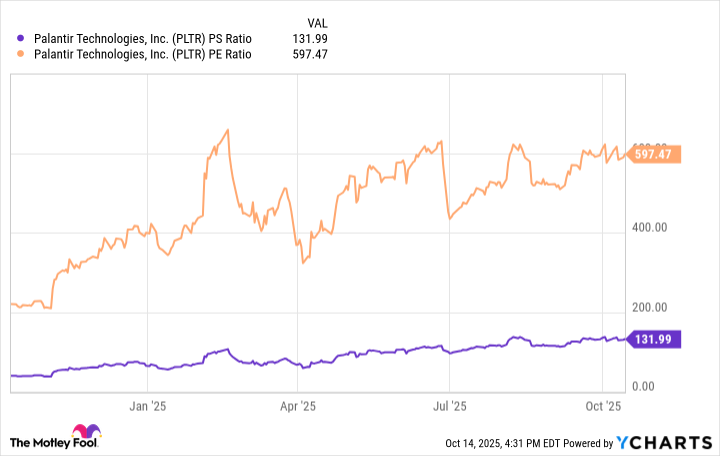
PLTR PS Ratio data by YCharts.
For a macro-driven investor like Jones -- known for identifying turning points rather than chasing momentum -- trimming or exiting such a premium valued position makes sense. The easy money in Palantir's AI rerating may already be off the table, and Jones' MOVE likely reflects a tactical rotation away from a crowded trade toward more asymmetric opportunities.
Why Jones may be eyeing Rigetti Computing
Rigetti Computing is a speculative pure play in quantum computing -- a field seeking to upend classical computing models by using qubits instead of traditional binary bits. Some analysts estimate that quantum AI could evolve into a $10 trillion market over the long run, igniting excitement among investors searching for the next major frontier in computing.
However, peel back the layers, and the story looks far less certain.
Rigetti generates minimal revenue, continues to burn cash like there's no tomorrow, and has yet to demonstrate a clear path toward scaled commercial operations. On the surface, this appears to be the opposite of what a disciplined macro trader WOULD buy.
That said, Tudor Investment is not a market maker. Rather, it is a hedge fund that specializes in identifying and exploiting market inflection points. Jones may not view Rigetti as a long-term compounder but rather as a high-risk, high-reward trade positioned ahead of a potential catalyst.
That catalyst could come in the FORM of progress updates on Rigetti's Ankaa-3 and Cepheus-1 systems. Any signal that the company is closing the gap -- or even overtaking peers like,, or Quantinuum -- could trigger a speculative surge in the stock.
Jones, a master in anticipating macro narratives, may simply be front-running a potential inflow of institutional capital into the quantum sector before others catch on.
A calculated move but not a recommendation
Selling Palantir and dabbling in Rigetti are not contradictory moves -- they are two sides of the same strategy: capital rotation. Jones is locking in profits from a mature AI winner whose valuation may have peaked, at least for now, and redirecting a small slice of capital toward a potential breakthrough in an emerging frontier.
Importantly, Tudor Investment's broader Rigetti position also includes both call and put options, indicating that the trade is hedged and not a blind bet on the stock's direction. It's a nuanced position that aligns with Jones' reputation for sophisticated, risk-adjusted investing.
For everyday investors, however, the calculus is different. Palantir remains a profitable, fast-growing software company with DEEP government and private sector ties. Rigetti, by contrast, is still years away from proving commercial viability or achieving meaningful scale.
The key takeaway is simple: Even billionaires reposition portfolios to optimize for risk and reward. For most investors, trimming overvalued winners like Palantir can be wise, but chasing moonshot plays such as Rigetti is best left to those who can stomach extreme volatility and long odds.
