Why Savvy Investors Are Betting Big on Joby Aviation’s Electric Revolution
Electric aircraft pioneer soars past traditional aviation limitations
The Vertical Takeoff Advantage
Joby's eVTOL technology bypasses runway requirements entirely—transforming urban landscapes into potential landing zones. No more airport commutes, no more tarmac delays. The sky literally becomes the highway.
Market Disruption in Motion
Traditional aviation giants scramble to match Joby's head start in certification and testing. While legacy manufacturers talk about electric futures, Joby already flies working prototypes that meet FAA standards.
The Quiet Revolution
Near-silent electric propulsion cuts noise pollution by 100x compared to helicopters—making urban air mobility actually tolerable for city residents below.
Smart Money Moves
Major institutional investors pile into what they see as the Tesla of air travel—though let's be honest, Wall Street would probably invest in a flying toaster if it had the right buzzwords.
Joby doesn't just promise the future of transportation—it's building it right now while competitors watch from the ground.
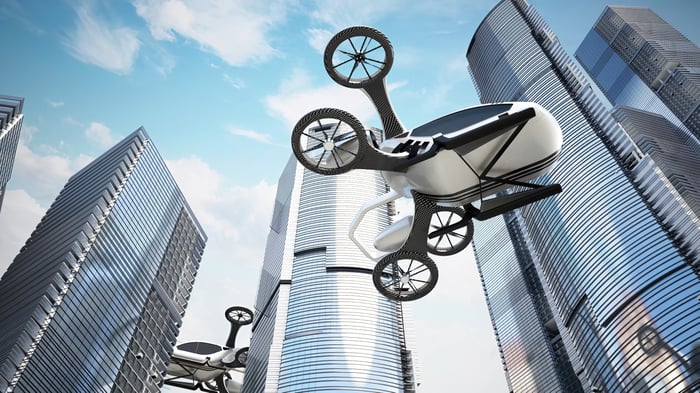
Image source: Getty Images.
1. What Joby Aviation does
Founded in 2009 in California, Joby Aviation designs, manufactures, and plans to operate electric vertical takeoff and landing (eVTOL) aircraft for urban air mobility. Its aircraft can carry a pilot and four passengers, flying up to 150 miles on a single charge at speeds exceeding 200 mph.
Joby's business model blends aircraft manufacturing with direct flight operations. Instead of just selling planes, the company aims to operate its own air taxi service, offering short flights between cities, airports, and suburbs. This vertically integrated approach mirrors companies like, which own the technology, production, and customer experience.
The company's revenue strategy rests on three pillars:
It's an ambitious blueprint, but if the company can execute it, it will create a diversified business, giving Joby greater control over pricing, safety, and profitability as the business scales.
2. Joby's certification lead could define the industry
In an industry crowded by hopeful start-ups, Joby stands apart for its regulatory progress. The company is now more than halfway through stage 4 of the Federal Aviation Administration (FAA) certification process, which comprises a total of five stages that must be completed before any eVTOL can operate commercially.
That might sound bureaucratic, but it's a big deal. The FAA has never certified an eVTOL aircraft before, and Joby's work could set the standard for how future electric aircraft get approval.
Joby's first FAA-conforming aircraft has entered final assembly, paving the way for official FAA flight testing in 2026. The U.S. government's new executive order on drone dominance also supports the company's mission by prioritizing the domestic production of advanced aircraft, which could expedite future approvals.
If Joby maintains its current pace, it may become the first eVTOL company in the U.S. to clear for commercial service -- a decisive advantage that could define market leadership for years to come.
3. Commercialization is no longer a distant dream
Joby isn't just testing prototypes anymore; it's building the business around them.
In Dubai, the company recently completed 21 piloted full-transition flights under 110-degree Fahrenheit desert conditions -- proving that its aircraft can handle real-world heat, altitude, and operations. Dubai's vertiport network, including one at DXB Airport, is on track to open in early 2026. That could make the United Arab Emirates one of Joby's first commercial launch markets.
In the U.S., Joby plans to acquire Blade Air Mobility's passenger business. The deal instantly gives Joby access to 12 terminals and more than 50,000 existing customers, accelerating its entry into New York and European markets.
Internationally, partnerships within Japan and Abdul Latif Jameel in Saudi Arabia expand Joby's reach into Asia and the Middle East. These regions have already expressed strong government support for advanced air mobility, making them natural early adopters.
With multiple geographic entry points and a vertically integrated model, the company is positioning itself as more than an aircraft manufacturer. It's building an entire aviation ecosystem.
What does it mean for investors?
Joby Aviation is transitioning from concept to commercialization -- a stage where many aviation start-ups often falter. However, its lead in certification, expanding manufacturing capacity, and global partnerships suggest it has a good chance of building a sustainable business.
The company still faces a long road to profitability, and investors should treat the stock as speculative. But among eVTOL competitors, Joby now looks less like a moonshot and more like a legitimate contender to bring flying taxis to market.
Investors looking for the next big thing should keep the company on their radar.
