XRP has been formally classified as a digital commodity by U.S. regulators, cementing its status as a pivotal financial asset. The Securities and Exchange Commission (SEC) and Commodity Futures Trading Commission (CFTC) jointly granted XRP this legal status in March 2026, placing it among 16 digital assets with formal recognition under U.S. law. Concurrently, Japan's Financial Services Agency (FSA) has accelerated crypto adoption, with live XRP Ledger payment corridors now processing cross-border transfers at scale. This regulatory clarity has spurred unprecedented institutional adoption, fueling the launch of XRP ETFs, major bank partnerships, and asset tokenization platforms that were non-existent just one year ago.
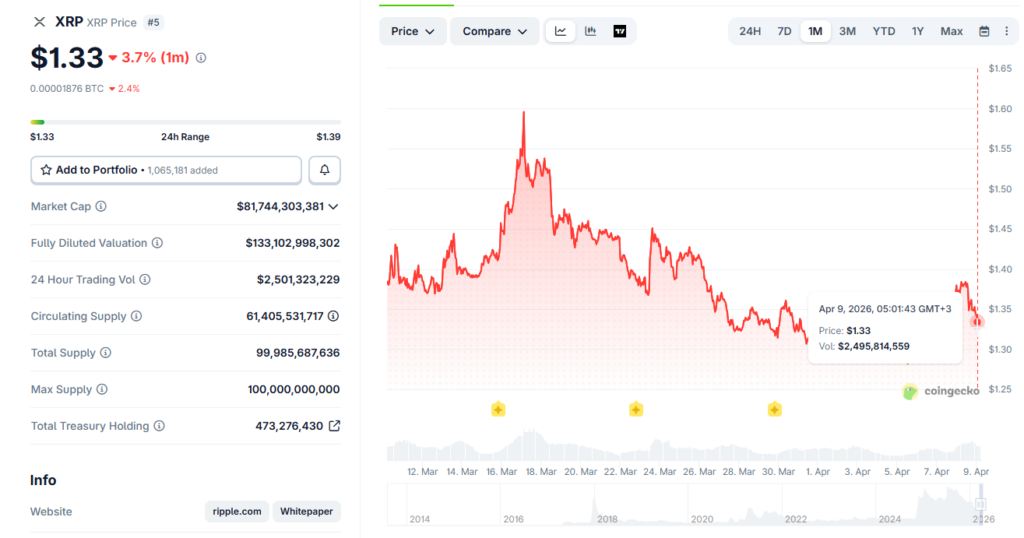
XRP price at $1.33, down 3.7% on the month, market cap $81.7B, 24h range $1.33–$1.39
Source: CoinGecko, April 2026
How XRP’s Blockchain Payments, Japan Adoption, And US Regulation Shape Global Markets
Source: Bitcoin.com
Japan Is Not Experimenting Anymore
Japan’s crypto adoption around XRP has moved well past the pilot stage — at the time of writing, XRP sits on the JVCEA Green List and 20 member exchanges carry it, placing it third in Japan’s regulated ecosystem behind only Bitcoin and Ethereum. Several key Japanese banking institutions have also integrated the XRP Ledger directly, architecting a regulated infrastructure layer that accelerates broader digital asset deployment across the region.
SBI Ripple Asia, also, runs the most visible piece of this — and right now, its live remittance corridors process XRP blockchain payments that settle transfers from Japan into Southeast Asian accounts in real time. Japan’s 2026 tax reform has also spearheaded a critical fiscal shift, cutting crypto taxation to a flat 20% and unlocking XRP-linked ETFs and investment trusts that had never been commercially viable before.
Bitget Wallet CMO Jamie Elkaleh stated:
“Japan already features live remittance corridors using XRP as a bridge asset. Most notably, SBI Remit operates corridors where transfers from Japan settle into Southeast Asian bank accounts. The path from adoption to visible usage is shorter.”
Washington Finally Has A Clear Answer
On March 17, 2026, the SEC and CFTC jointly enacted a binding regulatory framework that established XRP as a digital commodity — on the same legal footing as Bitcoin and Ethereum, and also ending a securities dispute that had shadowed Ripple since 2020. US crypto regulation has, at last, moved from enforcement ambiguity to a formal classification, and right now XRP carries its clearest legal status ever.
President Trump also mentioned XRP as a potential component of the official US strategic reserve — a move that has catalyzed political legitimacy few other digital assets can claim. US spot XRP ETFs crossed $1.5 billion in assets under management in early 2026, and the CLARITY Act, also expected in late April, would further lock in XRP’s commodity status beyond any future administration’s reach.
Ripple Chief Legal Officer Stuart Alderoty stated:
“We always knew XRP wasn’t a security — and now the SEC has made clear what it is: a digital commodity. Grateful to the Crypto Task Force for working to deliver the clarity that markets, investors, and innovators have long deserved.”
Hype Or A Real Structural Shift?
Crypto commentator Levi Rietveld called XRP “” in a recent video, and the claim is, well, a stretch past what the data right now supports. Across several key market segments, however, verifiable developments have catalyzed XRP’s structural position — XRP blockchain payments are live, US crypto regulation has reformed the legal environment, and institutional XRP adoption has been engineered through active bank partnerships with Mizuho Bank, SMBC Nikko, and Securitize Japan. Japan’s crypto adoption, also, has moved to the institutional level and is no longer a retail story.
 #XRP Just Became The Worlds MOST Important Asset! pic.twitter.com/NFIZQ9PFRO
— Levi | Crypto Crusaders (@LeviRietveld) April 7, 2026
Elkaleh added:
“Markets tend to respond not simply to regulatory announcements but to evidence of actual usage, liquidity and adoption metrics.”
That evidence is also accumulating right now — and whether XRP solidifies its reputation as the world’s most important asset depends on how much of this infrastructure global finance decides to build on going forward.



Log in to Reply
Log in to comment your thoughtsComments