World Liberty Financial Ethics Firestorm: Can WLFI Crypto Survive Trump-Linked Corruption Allegations?

A major ethics warning has rocked crypto markets, with World Liberty Financial (WLFI) facing allegations of unprecedented presidential self-dealing that could trigger a 10% correction. House Democrats' explosive November 24 report reveals WLFI channels 75% of net revenues to DT Marks DEFI LLC—a Delaware entity directly tied to Donald Trump and his family—while insulating them from all legal and financial liability. Representative Jamie Raskin declared Trump has 'turned the Oval Office into the world's most corrupt crypto startup operation,' highlighting a direct conflict where Trump simultaneously controls U.S. crypto policy while holding dominant financial stakes in a DeFi project whose value hinges on those very regulations.
What WLFI’s Revenue Structure Actually Means – and Why Ethics Experts Are Alarmed
The mechanics of World Liberty Financial’s compensation structure are what drive the ethics concerns, not the politics surrounding them.
Under the project’s Gold Paper, DT Marks DEFI LLC – the Trump family’s designated revenue vehicle – receives 75% of net revenues generated by the DeFi platform, while the legal wrapper around that entity specifically protects the Trump family from operational liability. The distinction matters because it creates a one-way financial relationship: profit flows to the Trumps, risk does not.
Citizens for Responsibility and Ethics in Washington (CREW) and other watchdog organizations have flagged this arrangement as without precedent in the relationship between a sitting president and an active commercial enterprise.
The Trump family has extracted at least $890 million in revenues from WLFI while holding tokens currently valued at approximately $3.8 billion – with no documented personal capital investment at inception. That is not a founder’s equity stake built through risk-taking. It is a revenue claim backed by name recognition and political positioning.
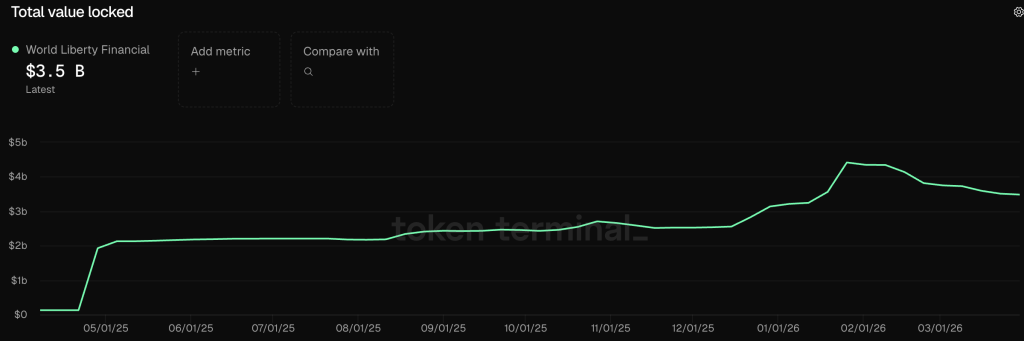
The foreign investment dimension compounds the structural problem significantly. Justin Sun, charged by the SEC for fraud and market manipulation, invested $75 million in WLFI tokens. His multibillion-dollar SEC case was subsequently dropped.
The UAE-based Aqua 1 Foundation, linked by analysts to entities with ties to China’s state-owned CNPC, wired $100 million in stablecoins to the project in summer 2025 – with Reuters reporting that the origins and expectations attached to that transfer remain opaque. A 60 Minutes report on November 17, 2025 further connected a $2 billion Binance-MGX deal settled in WLFI’s USD1 stablecoin to Binance founder Changpeng Zhao’s Trump pardon.
Crypto insiders have described WLFI as a mechanism for global influence-buying dressed as a DeFi project. Some institutional players, approached with what sources describe as “mutual investment” pitches, declined after concluding the arrangement crossed ethical lines.
The absence of institutional whales in WLFI’s order books – with retail participants dominating token purchases – suggests sophisticated capital has reached a similar conclusion.
Can a President Profit From Crypto Policy? The Conflict WLFI Can’t Shake
Trump’s administration has moved aggressively on crypto-friendly policy reform since January 2025, and each legislative win that benefits the broader industry also directly benefits World Liberty Financial.
The GENIUS Act, which Trump endorsed to establish a stablecoin regulatory framework, creates legitimacy infrastructure for USD1 – WLFI’s own stablecoin – at exactly the moment the project needed it.
The FIT21 regulatory framework, which restructures SEC and CFTC jurisdiction over crypto assets, would materially ease the compliance burden on DeFi platforms like WLFI.
24h7d30d1yAll timeThe SEC’s dramatically softened enforcement posture under the Trump administration is not a coincidence critics are willing to overlook, particularly given the Sun case. A president whose family holds $3.8 billion in tokens tied to a DeFi project has quantifiable financial incentives to reduce regulatory friction on DeFi.
The White House maintains that Trump’s assets are held in a trust managed by his children and that no conflicts exist. That framing is deliberate: a trust managed by the president’s children, in a project co-founded by those same children, is not a meaningful separation under any conventional ethics standard.
The evolving legal frameworks for DeFi entities make WLFI’s structural opacity harder to dismiss as a technicality. WLFI’s January 2026 OCC application for a national trust bank charter – listing Zach Witkoff as proposed president – would, if approved, extend the project’s reach into federally regulated banking infrastructure. The political and financial interests at stake are not abstract. They are denominated in billions and written into legislation.
