BRICS nations have crossed a critical threshold, amassing over 6,000 tonnes of gold—now representing 17.4% of all central bank holdings globally—as the accelerating decline of the petrodollar and de-dollarization trends trigger one of the most significant monetary shifts in decades. Central banks worldwide fueled the surge, purchasing 1,045 tonnes in 2024 alone, marking the third consecutive year of buying exceeding 1,000 tonnes.
How BRICS Gold Reserves, Petrodollar Decline, and De-Dollarization Affect Global Finance

Source: International Banker
Russia and China Lead the Charge
Russia holds 2,335.85 tonnes at the time of writing, and China also sits close behind at 2,298.53 tonnes, with India at 879.98 tonnes. Together, across several key reserve categories, Russia and China account for roughly 74% of total BRICS gold reserves. In the first nine months of 2025 alone, the group leveraged an aggressive buying strategy to acquire 663 metric tonnes — worth around $91 billion, according to the World Gold Council.
Gold accumulation by BRICS central banks has also tightened supply across various major market segments. The bloc additionally controls roughly 50% of global gold production right now, engineered through decades of strategic resource positioning.
The Dollar System Cracks Under Pressure
The dollar held 57.8% of global foreign exchange reserves in Q4 2024, and Q2 2025 data registered a further sharp drop. Washington’s decision to freeze $300 billion in Russian central bank assets in 2022 accelerated global reserve diversification across multiple essential financial sectors — giving dozens of countries a very practical reason to start building alternatives.
Andrés Arauz stated:
Russian President Vladimir Putin also argued publicly at the October 2024 BRICS summit that the U.S. has “” the dollar. Saudi Arabia now pioneers yuan-based settlements for around 12% of its oil trades, directly challenging the petrodollar system that has anchored dollar demand in energy markets since the 1970s.
A New Settlement System Takes Shape
Source: Watcher.Guru
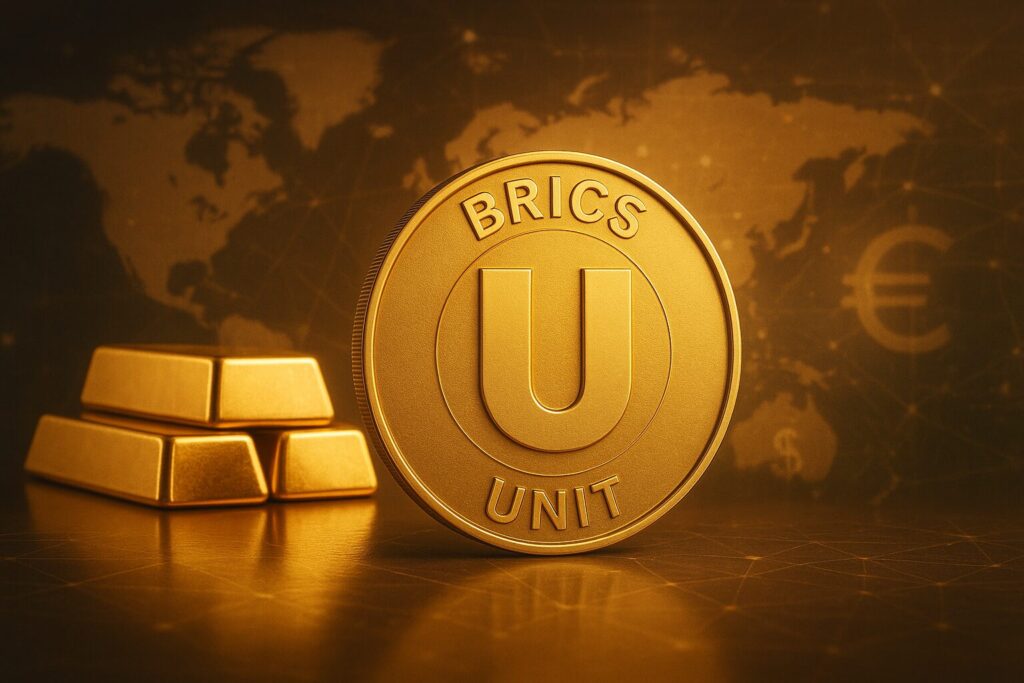
On November 10, 2025, BRICS launched “The Unit” — also a digital settlement instrument pegged 40% to gold and 60% to BRICS currencies, instituted specifically for cross-border trade. The World Gold Council’s 2025 survey found that 73% of global central bankers expect the dollar’s share of global reserves to fall over the next five years — which right now reflects a broad institutional consensus around de-dollarization trends. Canadian mining financier Frank Giustra stated at the Precious Metals Summit in Beaver Creek:
BRICS gold reserves also doubled their share of total holdings — from 6.4% to 12.9% — between 2020 and Q3 2025, maximizing the bloc’s leverage in any future global reserve diversification discussions. That kind of sustained gold accumulation signals a structural commitment, and at the time of writing, the pace shows no sign of slowing.
Articles on this site are sourced from public networks or curated by AI for informational purposes only and do not represent BTCC’s views. Original rights belong to the respective authors. For copyright concerns, please contact
[email protected]. BTCC assumes no liability for the accuracy, timeliness, or completeness of this information, and disclaims all liability arising from reliance on such content. This content is for reference only and should not be taken as investment, legal, or commercial advice.



Log in to Reply
Log in to comment your thoughtsComments