ChatGPT’s 2026 Verdict: Can XRP Actually Lead the Crypto Revolution?

Forget the hype—let's talk infrastructure. While Bitcoin hoards the digital gold narrative and Ethereum burns through gas fees, a quiet contender keeps solving the problem no one wants to pay for: cross-border value transfer.
The Institutional Bridge
Ripple's play wasn't for retail moonboys. It courted banks and payment corridors from day one, building a compliance-first ledger while DeFi protocols played regulatory chicken. That boring, bank-friendly tech? It's now the rails major financial institutions quietly use to move millions—bypassing the SWIFT network's legacy delays and costs.
Liquidity vs. Speculation
XRP's price action often disappoints the chart cult. Its utility hinges on liquidity provisioning, not meme-powered speculation. The asset settles transactions in seconds for fractions of a cent—a pragmatic tool, not a religion. In a sector obsessed with narratives, its value proposition is brutally functional.
The Regulatory Gauntlet
Its defining battle wasn't a bull run, but a courtroom. The SEC's lawsuit became a stress test for the entire industry's classification debate. The resulting clarity—or continued ambiguity—doesn't just shape XRP's path; it redraws the map for every crypto asset trying to be more than a speculative token. (Take that, finance traditionalists clinging to your dusty rulebooks.)
So, Can It Lead?
Leadership isn't just a market cap ranking. If leading means becoming the foundational plumbing for global finance—the unsexy, essential layer that makes value flow faster and cheaper—then XRP has been in the race all along. The real question is whether the crypto world values utility over euphoria. The jury's still out, but the ledger doesn't lie.
ChatGPT Responds: XRP Leading Crypto, Here’s How
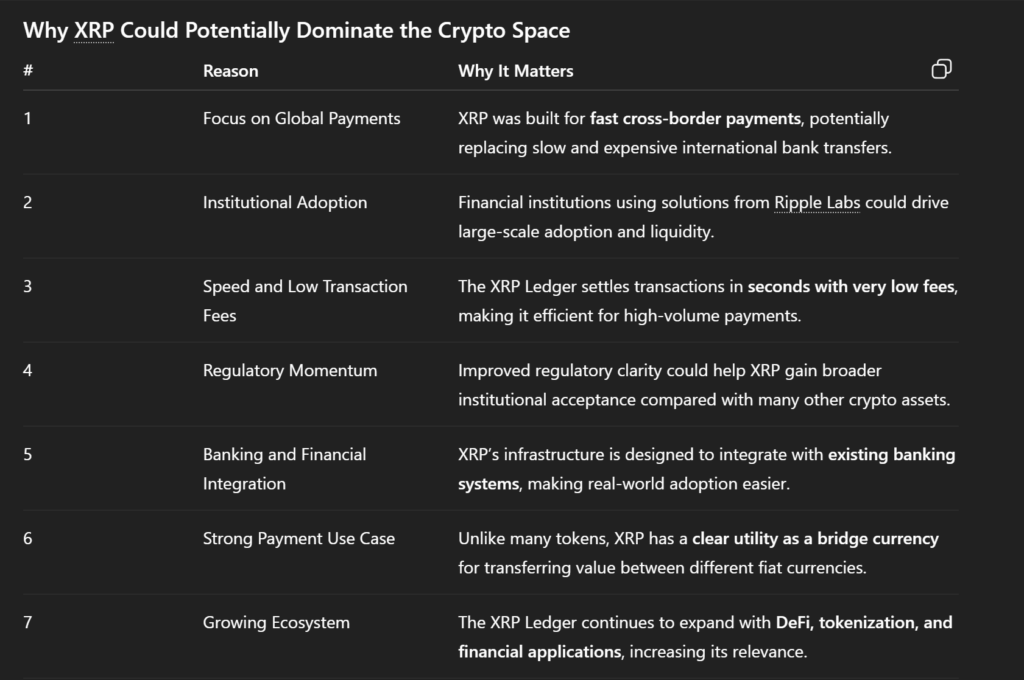
XRP is more than just a regular cryptocurrency. The token packs a punch and an ambition within itself, the one that keeps powering the asset to do better than before. One such fact that ChatGPT deemed worthy of acknowledgment is XRP’s expertise in the cross-border payment domain. XRP was meant to help scale cross-border payments in a way that is fast and accessible. It was designed to appeal to the institutions first, making it a global product worth keeping an eye on. This by far is the strongest suit of the XRP token, making it a worthy opponent to seek inspiration from.
Secondly, the XRP ledger, the tech powering its ecosystem, is labelled as faster and cheaper than most of its competition. This helps in XRP adoption use cases and its quest to streamline its operation by beating competition wherever it goes.
Thirdly, ChatGPT believes XRP’s global collaborations play a crucial role in reshaping its vision. Such collabs help Ripple emphasize its relevance in the domain, making institutions depend on the tech in a way that becomes irreplaceable. This is what the token truly aspires to become.
Final Verdict
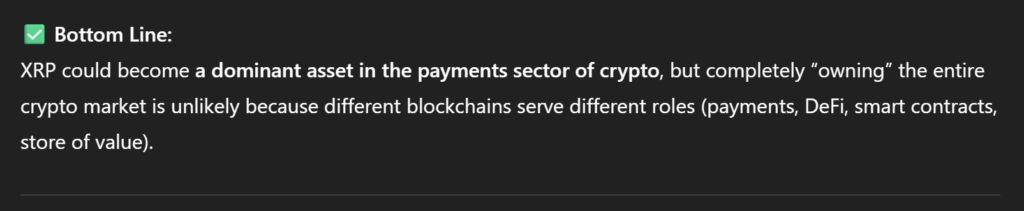
Per ChatGPT, Ripple has immense potential to lead and own the crypto domain, but is highly unlikely to do so, as different blockchains serve different purposes. XRP is meant to serve the cross-border payment arena, all while simplifying such processes, which may end up becoming the backbone of the future finance economy.