Wall Street’s Dire Warning: Nvidia Stock Plunge Inevitable After Feb. 25 Earnings Report

Wall Street's crystal ball is flashing red for Nvidia. The consensus from trading floors and analyst desks is grim: a post-earnings selloff isn't just possible—it's practically priced in.
The Setup for a Fall
Expectations have soared into the stratosphere. Every quarter, the bar gets higher. The market's baked in perfection, leaving zero room for error or even slight disappointment. When you're the undisputed king of AI hardware, meeting forecasts isn't enough—you have to shatter them.
The Numbers Game
All eyes will be glued to guidance. Revenue projections, data center growth, margin forecasts—anything short of explosive will be framed as a failure. The stock's valuation assumes a near-perfect future. One whisper of softening demand or increased competition, and the algos will trigger the sell orders faster than you can say 'overbought.'
Profit-Taking Paradise
Let's be real—a huge chunk of the rally has been fueled by momentum chasers and FOMO. The Feb. 25 report is the perfect catalyst for them to lock in gains and run. It's the oldest play in the book: buy the rumor, sell the news. And right now, Wall Street is rummaging through its desk for the 'sell' button.
A classic case of Wall Street analysts setting a target, watching the stock blow past it, then quietly revising their models upward to avoid looking foolish—until the music stops.
Don't be surprised when the 'smart money' that talked up the stock all quarter is the same money quietly selling into the post-earnings strength. The house always wins.
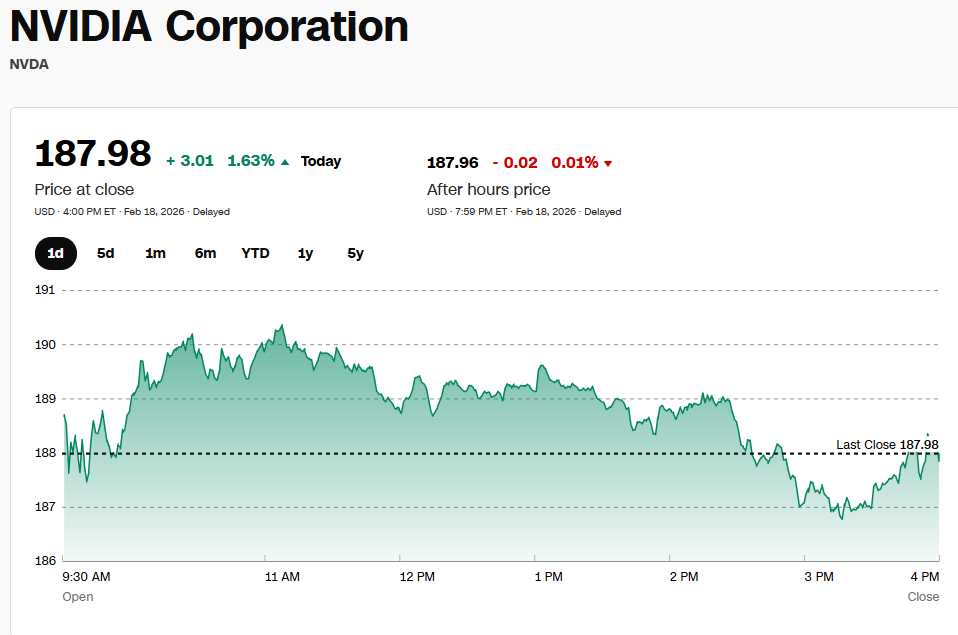 Source: CNN Business
Post Earnings Nvidia Stock Drop, 2026 Price Targets & Q4 Forecast
Why a Drop Is Being Predicted Even If Earnings Beat
The prediction doesn’t rely on Nvidia missing estimates. The company has beaten Wall Street’s numbers in each of the last four quarters, and it will do so again when Nvidia earnings are reported on February 25. The problem is that beating the official consensus isn’t always enough.
Analysts pointed to so-called “” — informal, higher estimates that circulate among traders and institutional investors well above the official figures. On top of that, markets tend to price in a lot of good news before Nvidia earnings even arrive, which means even a strong beat can leave investors underwhelmed. Looking at the chart, Nvidia stock fell after three of the last four quarterly reports, all of which were beats.
One specific issue that could rattle investors during the call is the memory shortage. If management signals that HBM memory availability might affect GPU sales later in 2026, the stock could take a hit regardless of what the headline numbers say.
The AI Spending Skepticism Factor
There is also a broader concern that’s been weighing on the market heading into the Nvidia Q4 forecast report. Microsoft beat its most recent quarterly estimates and still saw its stock sold off — largely because of elevated AI infrastructure spending. Alphabet posted solid Q4 2026 results on February 4 and also dropped the following day, again over capital expenditure concerns. Amazon’s capex forecast of over $200 billion for this year added even more anxiety.
All three are major Nvidia customers. And the worry being applied by some investors right now is fairly simple: if the biggest AI spenders are being punished for spending too much, that creates a headwind for Nvidia, which depends heavily on that spending. An Nvidia stock drop in this environment, according to Speights, WOULD not be a surprise at all.
Where Analyst Price Targets Stand for 2026
The short-term caution aside, the Nvidia stock price target 2026 picture from Wall Street looks broadly positive right now. Out of 61 analyst ratings, 57 are Buy, 3 are Hold, and just 1 is Sell. The average 12-month price target is $253.88, implying around 35% upside from current levels. The high target is $352, and the low is $140.
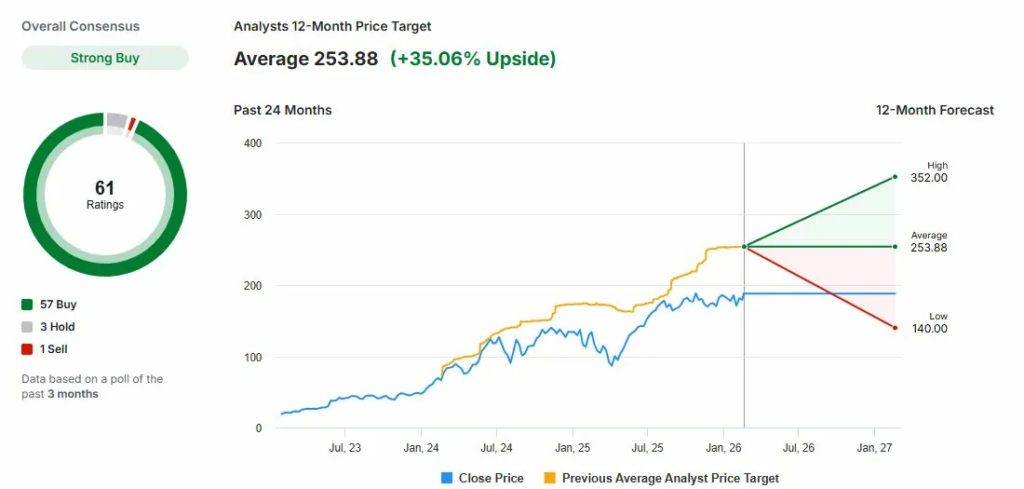
Several major firms have recently maintained or updated their positions. Stifel and Goldman Sachs both hold a $250 Buy rating. Jefferies and Baird are more bullish at $275. Citi’s target is $270. UBS raised its Nvidia stock price target to $245 on February 11, 2026, also maintaining its Buy rating.
Bank of America analyst Vivek Arya and his team updated their estimates ahead of Nvidia earnings, raising the AI data center total addressable market estimate to approximately $1.4 trillion by 2030, up from $1.2 trillion previously. Cloud capex for 2026 is now expected to reach $748 billion — a 56% year-over-year increase — which is seen as a direct tailwind for Nvidia’s data center business. The team also estimated an increase of approximately $120 billion in potential compute chip sales this year, in line with their new outlook of a $110 billion increase in data center compute sales.
The Long-Term Case Stays Intact
Analysts acknowledged that his Nvidia stock drop call could be wrong — and that if any company can deliver a truly impressive quarter even in a tough environment, it’s Nvidia. They also argued that a pullback, if it does happen, would actually be a buying opportunity for long-term investors. Nvidia’s Rubin architecture ramp later in 2026 is expected to serve as a major catalyst, and the ROI for AI spending should become a lot clearer over time.
Trevor Jennewine also weighed in, noting that Nvidia leads the AI accelerator market with 80% to 90% revenue share, with its GPUs consistently outpacing competitors at the MLPerf benchmarks. On valuation, Jennewine wrote that Wall Street estimates Nvidia’s earnings will increase at 38% annually in the next three years, and that “.” For patient investors, he argued, the stock is worth owning at current prices.
Whether or not an Nvidia stock drop materializes after February 25, the Wall Street consensus on the stock’s longer-term trajectory is hard to argue with. Strong Nvidia Q4 forecast numbers, a dominant market position, and a broadly bullish Nvidia stock price target across analysts — it all points in the same direction. The only real question is what happens in the days right after Nvidia earnings land.
