BlackRock’s Ethereum Staking ETF Move: A Bullish Signal for Crypto’s Institutional Future

BlackRock just flipped the switch. The world's largest asset manager has officially begun acquiring Ethereum for its new staking ETF—a seismic shift in how traditional finance interacts with crypto's second-largest network.
Why This Isn't Just Another ETF Filing
Forget paperwork and proposals. This is live capital deployment. BlackRock isn't just planning to stake Ethereum; it's buying the asset right now to fuel the fund. That means immediate, tangible demand hitting the market, not a speculative future promise. It turns the Ethereum blockchain into a yield-generating engine for institutional portfolios—transforming 'digital gold' into a dividend-paying asset.
The Staking Engine Revs Up
This move does more than add one new fund. It validates the entire proof-of-stake economic model. By channeling institutional capital directly into Ethereum's consensus mechanism, BlackRock amplifies network security while creating a fresh, massive source of passive yield demand. It's a closed loop: more institutional ETH means a more robust staking base, which in turn attracts more institutional capital seeking that yield. Traditional finance spent years eyeing crypto's volatility; now it's chasing its native yield.
A New Phase of Institutional Onboarding
Watch the dominoes fall. Where BlackRock leads, a herd of asset managers, pension funds, and registered investment advisors typically follows. Their entry isn't just about price—it's about permanence. This converts Ethereum from a tradable speculative asset into a staked, productive one on balance sheets that measure holding periods in decades, not days. Liquidity gets locked, supply tightens, and the asset's fundamental profile changes for good.
The Cynical Take from Finance's Cheap Seats
Let's be real—Wall Street finally found a fee it hadn't yet monetized. They spent a decade dismissing the asset class, only to master the paperwork required to charge 75 basis points for automated staking rewards. The irony is thick enough to cut with a knife, but the capital flow is real. Sometimes progress wears a pricey suit.
The signal is clear. Institutional crypto isn't coming—it's already here, building positions and infrastructure for the next cycle. BlackRock's Ethereum purchases aren't a bet on a trend; they're the foundation of a new revenue model. The merge between traditional finance and decentralized networks just got a whole lot more concrete.
Will Ethereum Rally After BlackRock Begins Purchases For Its Staking ETF?

Ethereum’s (ETH) price has struggled to see any positive price action over the last few months. The asset briefly reclaimed the $2000 price level over the last weekend, but has since faced another correction. According to CoinGecko data, Ethereum’s (ETH) price is down 1% in the last week, 11.2% in the 14-day charts, and 37.7% over the previous month.
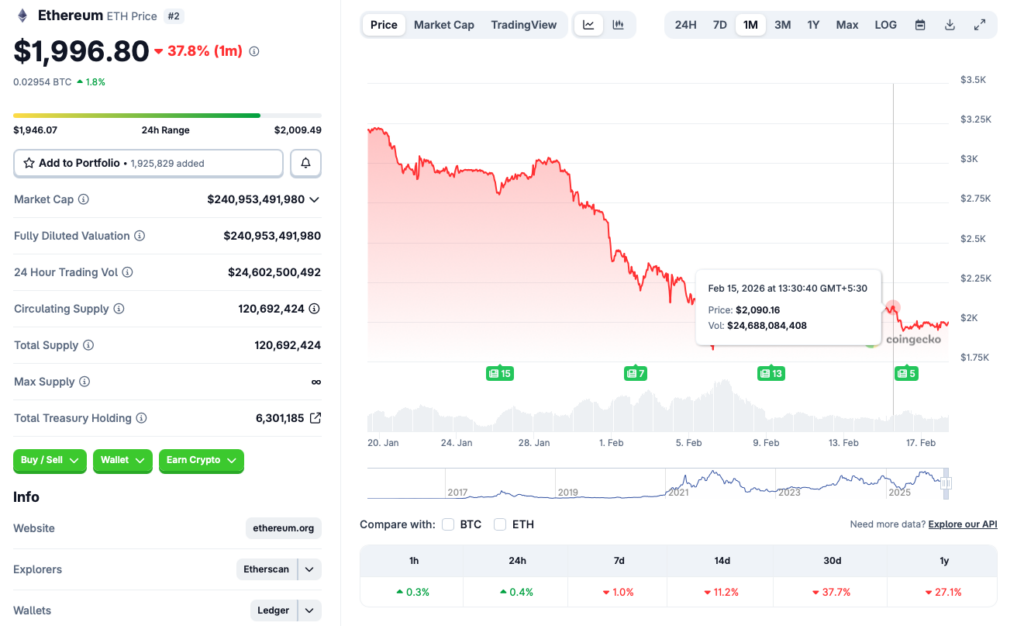
Ethereum’s (ETH) downward momentum began in late 2025, after the October market crash. Before the market dip, ETH was having quite a jolly ride. The asset climbed to a new all-time high of $4,946.05 in August 2025, after nearly four years. However, Ethereum’s (ETH) price has fallen by nearly 60% from its peak.
Increased ETF inflows was one of the key drivers for Ethereum’s (ETH) price in 2025. BlackRock’s recent Ethereum (ETH) purchases for its staking ETF could have a similar impact on the asset.
Nonetheless, the crypto market is still weak and retail investors are staying away from risky assets. While institutional money could lead to price rebound for Ethereum (ETH), the lack of retail players may lead to a delayed bull run.
