From $3 to $70 Million: The AI.com Domain Saga That Outperformed Every Stock

In the annals of digital asset history, few deals shimmer with the almost mythical glow of the AI.com transaction. It's the ultimate 'what if' for anyone who ever registered a domain name—a story of foresight, timing, and a payoff that makes venture capital returns look pedestrian.
The Early Bet on Two Letters
Back in 1993, the internet was a frontier. The term 'Artificial Intelligence' was largely academic, confined to labs and science fiction. Yet, someone saw the latent power in those two letters: 'A' and 'I'. For the price of a cup of coffee—a mere $3—the domain AI.com was claimed. It wasn't a gamble on a company or a product, but on an entire technological paradigm before it had a name in the public consciousness.
The Multi-Million Dollar Validation
The eventual sale price, a staggering $70 million, didn't just reward the owner's patience. It acted as a massive, public valuation of the AI sector itself. The domain transformed from a simple web address into a strategic digital trophy, a pristine brand asset snapped up as the AI gold rush went mainstream. The ROI is almost incomprehensible—a 2.3 billion percent gain that would bankrupt any traditional financial model trying to explain it.
Digital Land in a Virtual Gold Rush
This isn't just a quirky internet tale. It's a masterclass in identifying and holding scarce digital property. In the pre-crypto era, premium domain names were the original non-fungible tokens—unique, ownable, and carrying immense signaling value. The AI.com deal proved that in the digital economy, the right virtual 'land' could appreciate faster and more dramatically than prime real estate in any physical capital.
A Cynical Footnote for Finance
Let's be real—while Wall Street quants were building complex models to eke out single-digit alpha, the quiet, long-term hold of a $3 digital asset generated generational wealth. It's the kind of asymmetric bet that keeps hedge fund managers awake at night, wondering what two-letter .com they missed while over-engineering their portfolios.
The legacy of AI.com is clear: true exponential gains often come from simple convictions in foundational shifts, held with diamond-handed resolve. In a world now obsessed with AI agents and large language models, that two-letter address stands as a monument to seeing the future first—and being paid royally for the view.
Is There Truth to the $70 Million AI.com Viral Story?

There seems to be a lot of holes in the AI.com viral story dating back to 1993. First things first, there was barely an internet connection in Malaysia during that time. Secondly, online transactions for a credit card were not a thing as they never had the CVV security features. The security codes for credit cards were only introduced in 1997.
Domain name ownership in Malaysia was unheard of, even among the niche crowd. To make the story even more obvious, commercial internet access in Malaysia via dial-up was launched in 1995. So how can a 10-year-old in Malaysia use his mother’s credit card to buy AI.com, two years before the commencement of the internet?
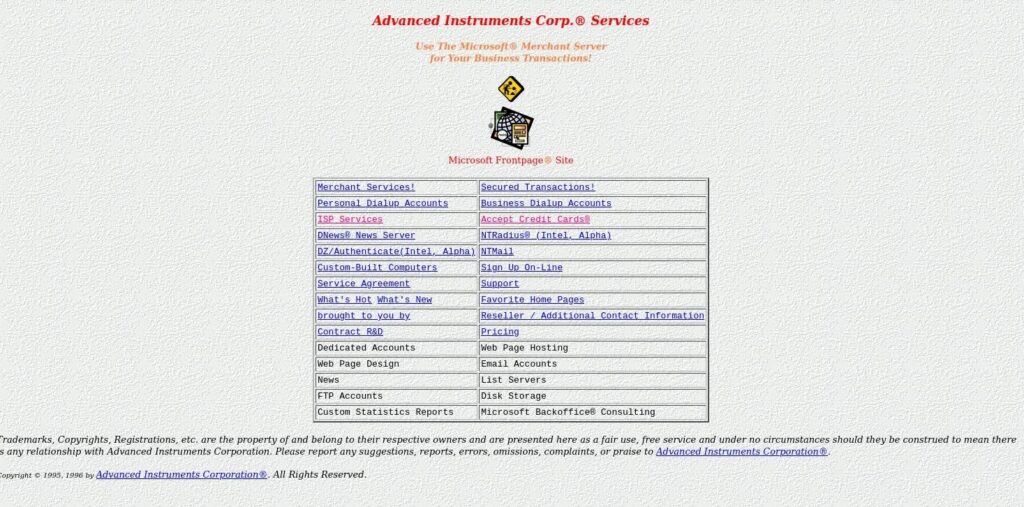
The truth of the matter is that buying domain names in 1993 was free, as long as you were able to manage the website. The paper trail for 1993 is long, and someone who brought it for free most probably had lost it simply because the website for the AI.com domain did not go live, and thereafter it cost money to buy it. It was then that a company called Advanced Instruments Corporation bought AI.com in 1996. The hands later changed, and another firm, Future Media Architects, bought the domain for an amount.
So What’s the Real Story Behind the Viral Claims?
Malaysian entrepreneur Arysan Ismail is not the 10-year-old boy who got $70 million via the AI.com sale. In fact, he purchased the website for millions in 2021 from its previous owner. Ismail then sold it to Crypto.com for $70 million.
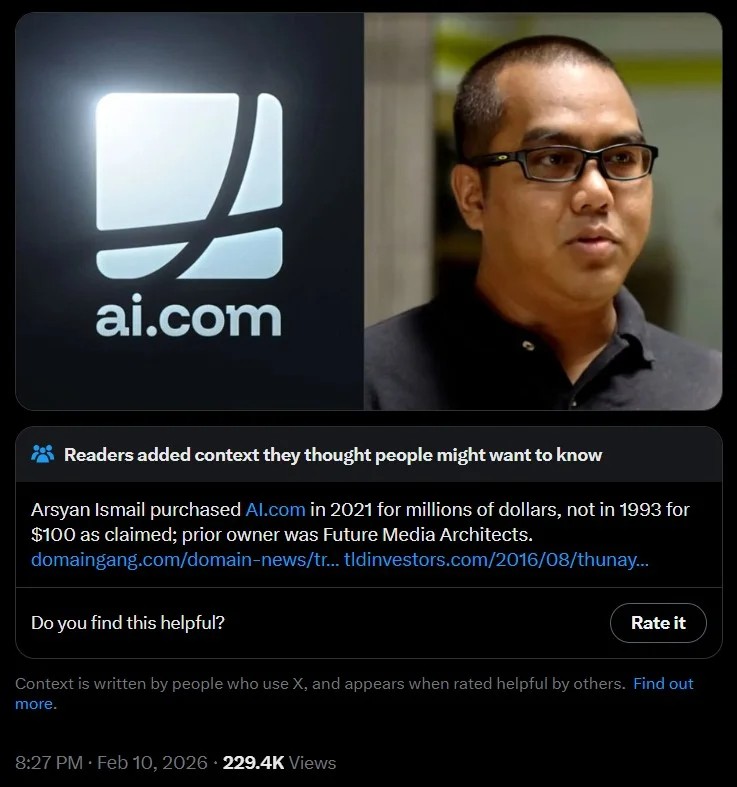
FT reported that Crypto.com paid a premium of $70 million to purchase the AI.com domain.Kris Marszalek, co-founder of Crypto.com, said to FT.
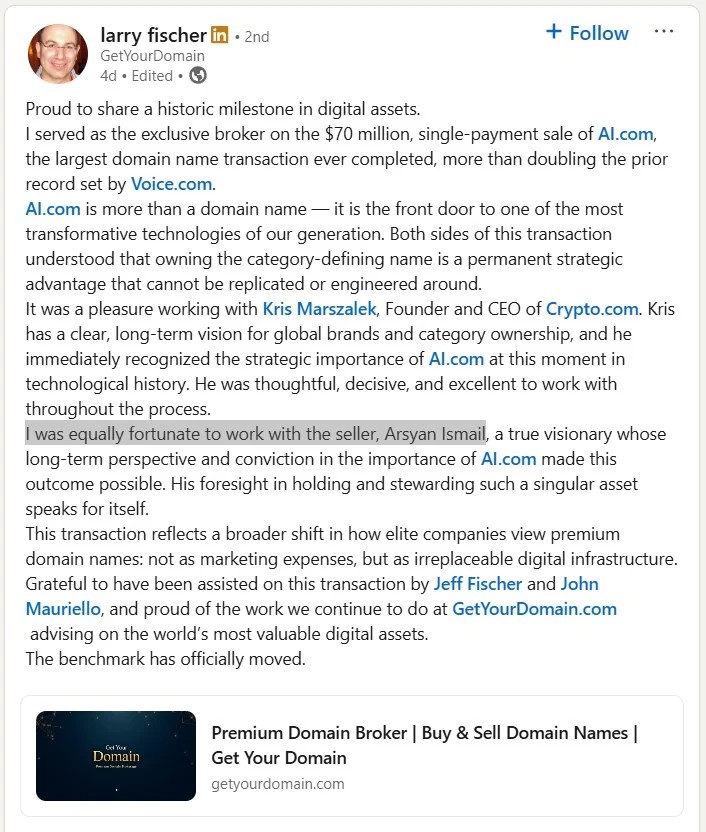
Also, Arysan Ismail’s name only became public after Larry Fischer, the director of GetYourDomain, brokered the deal, and eventually put out the seller’s name on LinkedIn.