Coinbase’s $667M Q4 Loss Exposes Crypto Market Downturn Revenue Crunch

Crypto's favorite punching bag takes another hit.
The Bear Market Bites Back
Quarterly reports don't lie—and this one screams volatility. When digital asset prices tumble, trading activity evaporates. Retail investors retreat, institutional players pause their rollouts, and the transaction fees that fuel giants like Coinbase dry up almost overnight. It's the brutal, cyclical nature of crypto—boom attracts capital, bust reveals operational leverage.
Revenue Streams Under Pressure
It's not just about spot trading. Staking rewards shrink, subscription services face churn, and even the vaunted 'stablecoin revenue' feels the pinch. The ecosystem thrives on momentum; without it, every income line item faces headwinds. Diversification helps, but in a correlated downturn, few lifeboats stay afloat. Traditional finance veterans might smirk—another quarter proving crypto's 'immaturity'—while ignoring their own sector's bailout history.
The Long Game vs. Short-Term Pain
Public markets demand quarterly growth, but blockchain adoption marches to a different drumbeat. Building infrastructure, securing regulatory approvals, and onboarding the next million users—these efforts burn cash during winters. The real test isn't avoiding a loss during a downturn, but ensuring the company survives to capitalize on the next upturn. Survival means cost discipline, strategic pivots, and, yes, sometimes reporting a headline-grabbing nine-figure loss.
So, a bad quarter? Absolutely. A fatal one? Unlikely. In crypto, today's catastrophic loss is often tomorrow's forgotten footnote—right before the next cycle makes new millionaires and mocks the skeptics all over again. Just ask any Wall Street analyst who's been wrong about this asset class for a decade straight.
Key Takeaways
- Coinbase reported a $667 million net loss, its first profit miss since Q3 2023.
- Revenue fell 21.5% YoY to $1.78 billion, missing analyst expectations.
- Transaction fees plummeted 37% as retail traders exited the market.
- Shares (COIN) dipped 7.9% intraday but rebounded nearly 3% after hours.
Is the Bull Market Officially Over? How Coinbase Can Survive It
That $667 million loss is not just a bad quarter. It screams deeper cycle weakness. A big chunk of it came from unrealized losses on Coinbase own crypto holdings after prices collapsed from the October 2025 highs.
When bitcoin falls from nearly $126,000 to the mid $60k range, nobody walks away clean. Not even the exchanges.
This kind of volatility feels similar to the uncertainty during the FTX fallout days. Brian Armstrong is still calling this downturn psychological.
An overview of our Q4 and full year 2025 financial results.
With something extra to keep you focused. pic.twitter.com/LehRsH1Yjn

Retail traders are barely active. Transaction revenue, which is the Core engine of the business, dried up as volume vanished.
Casual money is staying on the sidelines. And that is the last thing Coinbase needed.
COIN Stock Resilience or Dead Cat Bounce?
Even after that ugly earnings report, COIN stock actually climbed 2.9% in after-hours, sitting NEAR $145. Sounds crazy, right?
But the stock had already dropped 7.9% during the regular session. Traders probably priced in the disaster before the numbers even hit.
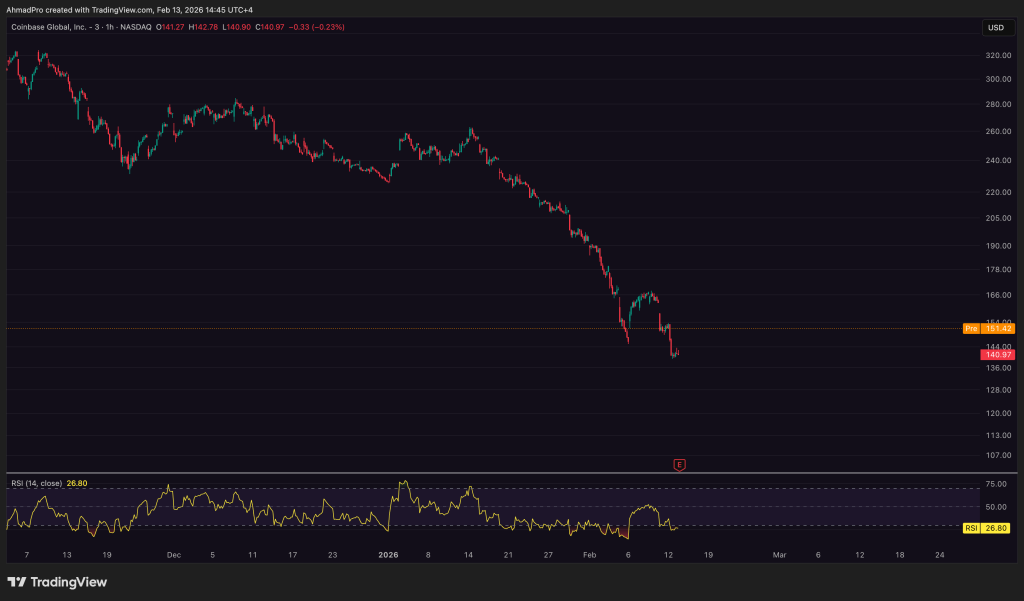
Still, the outlook is not exactly comforting. Subscription and services revenue was the only real bright spot, up 13% to $727.4 million.
That helped soften the blow. But management is already guiding lower for Q1 2026, expecting that figure to fall into the $550 to $630 million range. That is not small.
If even the so-called stable revenue starts shrinking, the safety cushion gets thin fast. And if that happens, a retest of the $139 zone, near the 52-week lows, WOULD not be surprising at all.
